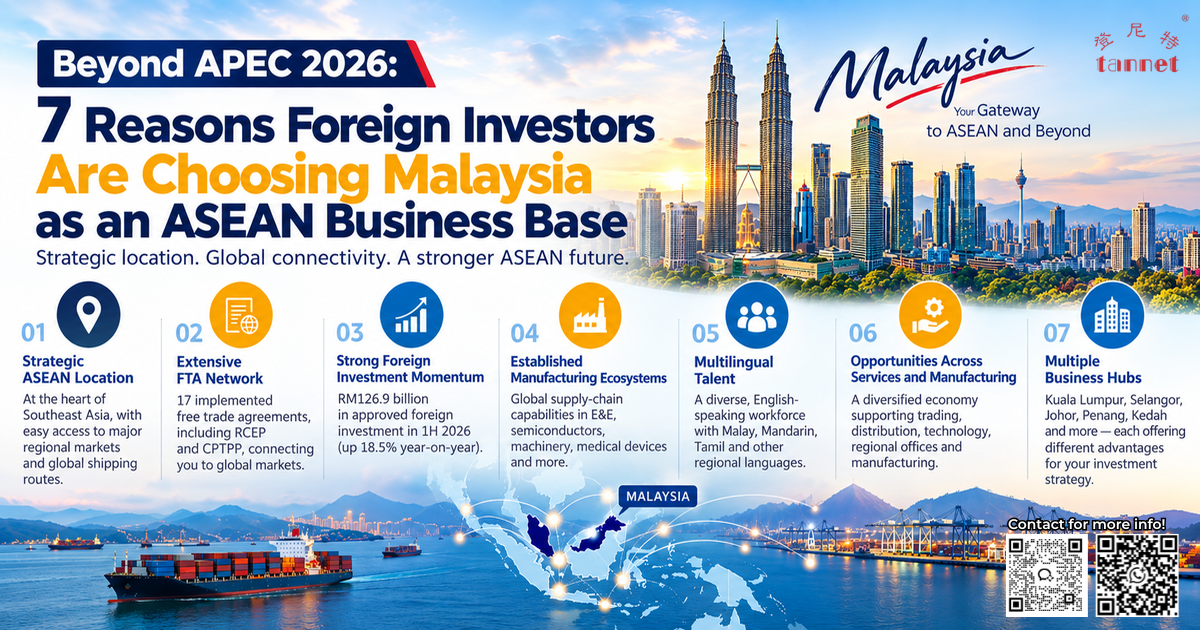
As APEC 2026 brings greater international attention to Asia-Pacific trade, investment and cross-border business opportunities, foreign companies are once again reviewing where they should establish their next regional presence.
For companies targeting Southeast Asia, however, the decision should go beyond a single event.
The more important question is:
Where can a foreign company establish a practical base for long-term ASEAN expansion?
Malaysia is increasingly part of that conversation.
In the first half of 2026, Malaysia recorded RM218.5 billion in approved investments across 2,746 projects, according to the Malaysian Investment Development Authority (MIDA). Foreign investments accounted for RM126.9 billion, or 58.1% of total approved investments, representing an 18.5% year-on-year increase.
The appeal is not based on one factor alone. Malaysia combines access to ASEAN, international trade agreements, established infrastructure, multilingual talent and mature industrial ecosystems.
For foreign investors considering an ASEAN business base, here are seven reasons Malaysia deserves attention.
1. Strategic Location at the Heart of ASEAN
Location remains one of Malaysia’s fundamental advantages.
Situated in Southeast Asia and connected to major international shipping routes, Malaysia provides convenient access to markets including Singapore, Indonesia, Thailand, Vietnam, the Philippines and Brunei.
Malaysia is also positioned along the Strait of Malacca, one of the world’s most important maritime trade routes.
This makes the country particularly relevant for companies involved in international trading, manufacturing, logistics, distribution, e-commerce and regional supply-chain management.
For foreign businesses adopting an ASEAN expansion, China + 1, or ASEAN + China strategy, a Malaysian entity can potentially function as more than a domestic operating company. Depending on the business model, it may become part of a broader regional corporate, trading or distribution structure.
2. Access to an Extensive Free Trade Agreement Network
Malaysia’s connectivity extends beyond its geographical location.
According to Malaysia’s Ministry of Investment, Trade and Industry (MITI), Malaysia has implemented 17 free trade agreements, including major regional frameworks such as the Regional Comprehensive Economic Partnership (RCEP) and the Comprehensive and Progressive Agreement for Trans-Pacific Partnership (CPTPP).
RCEP connects Malaysia with major Asian economies including China, Japan, South Korea, Australia and New Zealand, in addition to fellow ASEAN members.
CPTPP extends Malaysia’s trade relationships to another group of markets across the Asia-Pacific and beyond.
In 2025, Malaysia’s trade with its FTA partners reached approximately RM2.005 trillion, representing 65.5% of the country’s total trade.
For qualifying products and businesses that satisfy applicable rules of origin and other requirements, these agreements can provide opportunities for preferential tariff treatment and more integrated cross-border supply chains.
Foreign companies should therefore evaluate Malaysia not only based on the size of the domestic market, but also on how a Malaysian operation could fit into their wider international trade structure.
3. Strong Foreign Investment Momentum
Another important indicator is where international capital is already going.
During the first half of 2026, Malaysia secured RM126.9 billion in approved foreign investments, up 18.5% year-on-year.
Major sources included the United States, Singapore, Japan and China.
This follows Malaysia’s record RM426.7 billion in total approved investments in 2025, demonstrating continued investment activity across the country.
For a foreign investor, investment statistics do not automatically determine whether a market is suitable. However, sustained investment can support the development of supplier networks, professional services, infrastructure, talent pools and industry-specific ecosystems.
That is particularly relevant to companies entering a new country for the first time.
Rather than building every operational component from zero, investors may be able to enter an ecosystem where banks, accountants, company secretaries, logistics providers, industrial suppliers, professional advisers and other service providers are already familiar with international business.
4. Established Manufacturing and Supply-Chain Ecosystems
Malaysia has been integrated into international manufacturing networks for decades.
The country has developed capabilities across industries including electrical and electronics (E&E), semiconductors, machinery and equipment, medical devices, chemicals and other advanced manufacturing sectors.
In the first half of 2026 alone, the E&E sector recorded RM16.6 billion in approved manufacturing investments, according to MIDA.
Different Malaysian regions have also developed their own industrial strengths.
Penang is internationally recognised for its electronics and semiconductor ecosystem. Selangor offers extensive industrial and commercial infrastructure. Johor has become increasingly important for manufacturing, logistics, data centres and Singapore-linked investment. Kedah has also developed significant high-technology and manufacturing activity.
For companies seeking to diversify production or sourcing, Malaysia can therefore serve multiple functions: a manufacturing location, procurement base, regional distribution centre or coordination point for ASEAN supply chains.
5. Multilingual Talent for Regional Operations
Human capital is another practical consideration when establishing an ASEAN office.
Malaysia offers a multilingual workforce in which English is widely used in professional and business environments. Malay is the national language, while Mandarin, Cantonese, Tamil and other languages are also widely spoken among different communities.
For multinational businesses, this can be particularly useful.
A company managing customers in Southeast Asia, suppliers in China and international headquarters elsewhere may need employees who can communicate across different markets and business cultures.
This multilingual environment can support functions such as regional sales, customer service, business development, procurement, digital marketing, shared services and cross-border coordination.
Malaysia’s universities and technical and vocational education ecosystem also contribute to the country’s workforce pipeline.
6. Opportunities Across Both Services and Manufacturing
Malaysia’s foreign investment proposition is not limited to factories.
Of the RM218.5 billion in approved investments recorded in the first half of 2026, approximately RM149.6 billion went to the services sector, while manufacturing accounted for RM51.3 billion and the primary sector RM17.6 billion.
This matters because foreign investors enter ASEAN with very different business models.
Some companies need manufacturing facilities. Others require only a regional office, trading entity, consulting company, technology operation, distribution business or service centre.
Malaysia’s diversified economy gives international businesses more flexibility when considering how their local entity should function.
However, company registration alone does not automatically authorise every activity.
Depending on the proposed business, foreign investors may need to consider sector-specific licences, local authority approvals, foreign participation requirements, import and export requirements, employment approvals or other regulatory conditions before commencing operations.
7. Multiple Business Hubs for Different Investment Strategies
There is also no single location in Malaysia that suits every foreign investor.
Kuala Lumpur and Selangor are natural choices for companies requiring access to corporate services, customers, professional talent and major commercial infrastructure.
Johor is strategically positioned next to Singapore and has attracted substantial investment in manufacturing, logistics, technology and data-centre-related activities.
Penang remains a major destination for E&E, semiconductor and advanced manufacturing operations.
Other states, including Kedah and Sarawak, may also offer advantages depending on the investor’s sector, project requirements and supply chain.
In the first half of 2026, Malaysia’s five leading investment destinations by approved investment value were Selangor, Johor, Kuala Lumpur, Penang and Sarawak.
Instead of asking simply, “Should we register in Malaysia?”, foreign investors should therefore consider a more specific question:
Which Malaysian location best matches our customers, industry, workforce, supply chain and operating requirements?
Beyond APEC 2026: Build a Long-Term ASEAN Strategy
APEC 2026 can create new conversations around Asia-Pacific business opportunities, but a successful market-entry strategy should extend well beyond the event itself.
Malaysia’s value lies in the combination of several structural advantages: its ASEAN location, FTA network, manufacturing capabilities, multilingual workforce, international connectivity and established business ecosystem.
For foreign investors, however, incorporating a Malaysian company is only the beginning.
Before establishing operations, businesses should assess the proposed shareholding and corporate structure, business activities, registered address, local licensing requirements, corporate bank account, accounting and tax obligations, employment requirements and work permits for foreign personnel.
The appropriate structure will depend on the company’s industry, nationality of shareholders, planned activities, investment size and long-term ASEAN strategy.
Tannet provides one-stop corporate and business support for foreign investors entering Malaysia, including Sdn. Bhd. company registration, company secretarial services, registered business address, accounting and tax compliance, bank account opening support, work permit applications, business licences, trademark registration and other corporate services.
For companies looking beyond APEC 2026 and planning a longer-term ASEAN presence, Malaysia can be evaluated not simply as another market to enter, but as a potential regional platform connecting Southeast Asia, China and the wider Asia-Pacific economy.