As China hosts APEC 2026, international attention is once again turning toward the country’s role in Asia-Pacific trade, investment and cross-border business.
While Shenzhen is closely associated with APEC 2026, foreign companies assessing opportunities in southern China should also look beyond the host city.
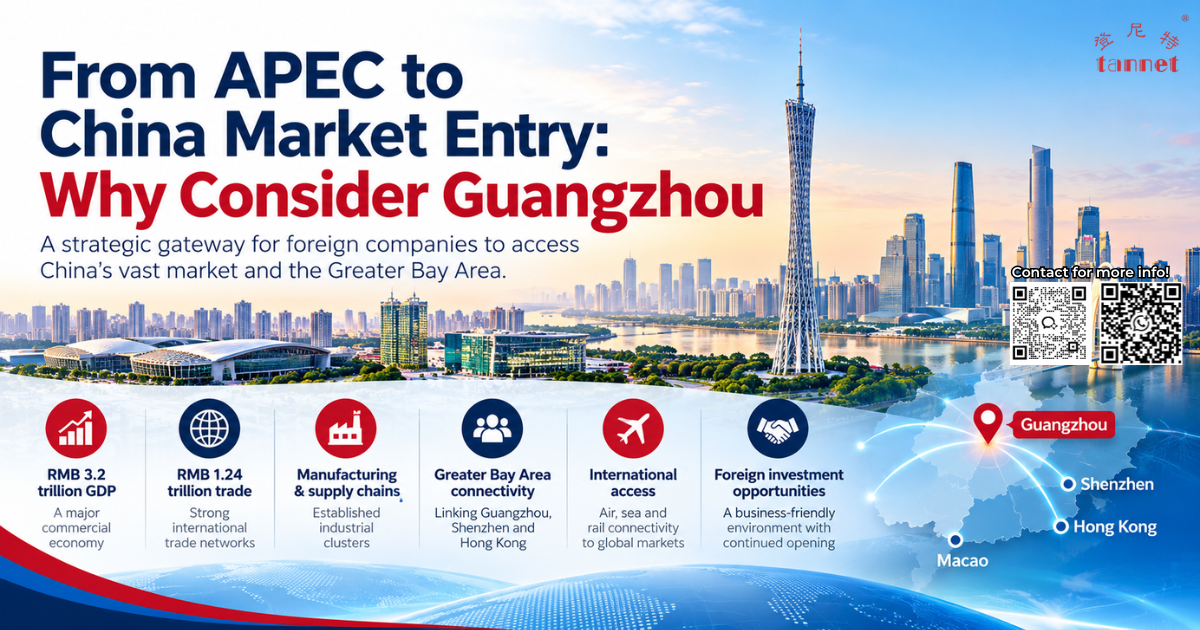
Why consider Guangzhou for China market entry? As the capital of Guangdong Province and one of the core cities of the Guangdong-Hong Kong-Macao Greater Bay Area (GBA), Guangzhou combines a large consumer market, established manufacturing and trading networks, international connectivity and access to one of China’s most economically active regions.
APEC 2026 Puts Southern China in the Spotlight
China has selected the theme “Building an Asia-Pacific Community to Prosper Together” for APEC 2026, with priorities focusing on openness, innovation and cooperation.
For international businesses, the renewed attention on southern China provides a useful opportunity to reassess how the Greater Bay Area fits into their Asia strategy.
Guangzhou’s value comes partly from its position within this wider economic network. Businesses operating there can potentially connect with Shenzhen’s technology ecosystem, Hong Kong’s international financial and professional-services infrastructure, and manufacturing clusters across Guangdong.
Instead of viewing Guangzhou as an isolated city market, foreign investors can consider it as one component of a broader Greater Bay Area strategy.
Why Guangzhou?
1. Access to a Major Commercial Economy
Guangzhou recorded GDP of approximately RMB 3.20 trillion in 2025, while total goods imports and exports reached approximately RMB 1.24 trillion.
Its economic base extends across services, manufacturing, trade, automotive, electronics, technology and other sectors.
For foreign companies, this creates opportunities not only to sell into Guangzhou itself, but also to build relationships with suppliers, distributors, customers and business partners across Guangdong.
2. Strong International Trade Infrastructure
Guangzhou has long been one of China’s major trading centres.
The city is also home to the China Import and Export Fair, commonly known as the Canton Fair, which has played an important role in connecting Chinese suppliers with international buyers.
Foreign businesses involved in consumer products, machinery, electronics, manufacturing, sourcing and cross-border trade can use Guangzhou as an operational base rather than simply visiting the city for exhibitions or supplier meetings.
3. Greater Bay Area Connectivity
One of Guangzhou’s biggest strategic advantages is its location within the GBA.
Companies can potentially structure their regional operations around the complementary strengths of Guangzhou, Shenzhen and Hong Kong.
For example:
Guangzhou can support trading, manufacturing, sourcing, distribution and access to the mainland consumer market.
Shenzhen offers a strong technology, innovation and advanced manufacturing ecosystem.
Hong Kong provides an international business environment with established financial, legal and professional-service infrastructure.
The right structure depends on the company’s activities, customers, supply chain and long-term objectives.
China’s Foreign Investment Environment Is Continuing to Open
China’s 2024 Negative List for Foreign Investment Access, effective from November 1, 2024, reduced restricted sectors from 31 to 29 and removed the remaining foreign-investment access restrictions in manufacturing.
For sectors outside the Negative List, foreign investment is generally administered according to the principle of equal treatment between domestic and foreign investors.
However, market access should not be confused with automatic operational approval.
Depending on the business, companies may still need industry licences, product approvals, customs registrations, tax arrangements or other regulatory procedures.
This makes pre-entry planning important.
How Can Foreign Companies Enter Guangzhou?
A foreign investor’s China market-entry structure will depend on what the company actually intends to do.
Common considerations include:
- Establishing a foreign-invested company in Guangzhou
- Selecting the appropriate business scope
- Determining the shareholder and management structure
- Arranging a compliant registered address
- Completing company registration and tax registration
- Opening a corporate bank account
- Handling customs and import-export requirements where applicable
- Registering trademarks and other intellectual property
- Obtaining industry-specific licences
- Arranging employment and work permit matters where necessary
Companies should determine these requirements before incorporation rather than treating company registration as the entire market-entry process.
Guangzhou as Part of a Wider China Strategy
In 2025, Guangzhou recorded 10,876 newly signed foreign direct investment projects, up 28.8% year-on-year, while actually utilized foreign investment reached RMB 25.19 billion.
These figures demonstrate continued international business activity in the city.
For companies entering China, however, location selection should ultimately follow the business model.
A technology company may prioritize proximity to innovation clusters. A trading company may focus on suppliers, logistics and customs infrastructure. A consumer brand may prioritize distribution and market access. A manufacturer may evaluate industrial zones, supply chains and operating costs.
Guangzhou can be particularly relevant where these requirements intersect.
From APEC Visibility to Actual Market Entry
APEC 2026 may bring greater international attention to southern China, but successful market entry requires more than identifying an attractive market.
Foreign investors need to determine where to establish, what entity to use, how to define the business scope and what licences, tax, banking and compliance requirements apply.
For companies considering Guangzhou, Shenzhen, Hong Kong or a broader Greater Bay Area strategy, early structural planning can help turn market interest into a workable operating presence in China.
TANNET can assist international investors with China and Hong Kong company registration, registered address arrangements, accounting and tax compliance, corporate bank account support, trademark registration, import-export arrangements and other business establishment services. Companies planning to enter Guangzhou or expand across the Greater Bay Area are encouraged to assess their corporate structure and regulatory requirements before commencing operations.
📞 Free 1-on-1 Consultation Now,
Official Service Hotline: +86-755-82148419
Cell: +86-13823131503;+60 19-309 2363
WeChat ID: 13823131503;
WhatsApp:+86-13823131503;+60 19-309 2363
Email: mytannet08@gmail.com; susiehu@citilinkia.com