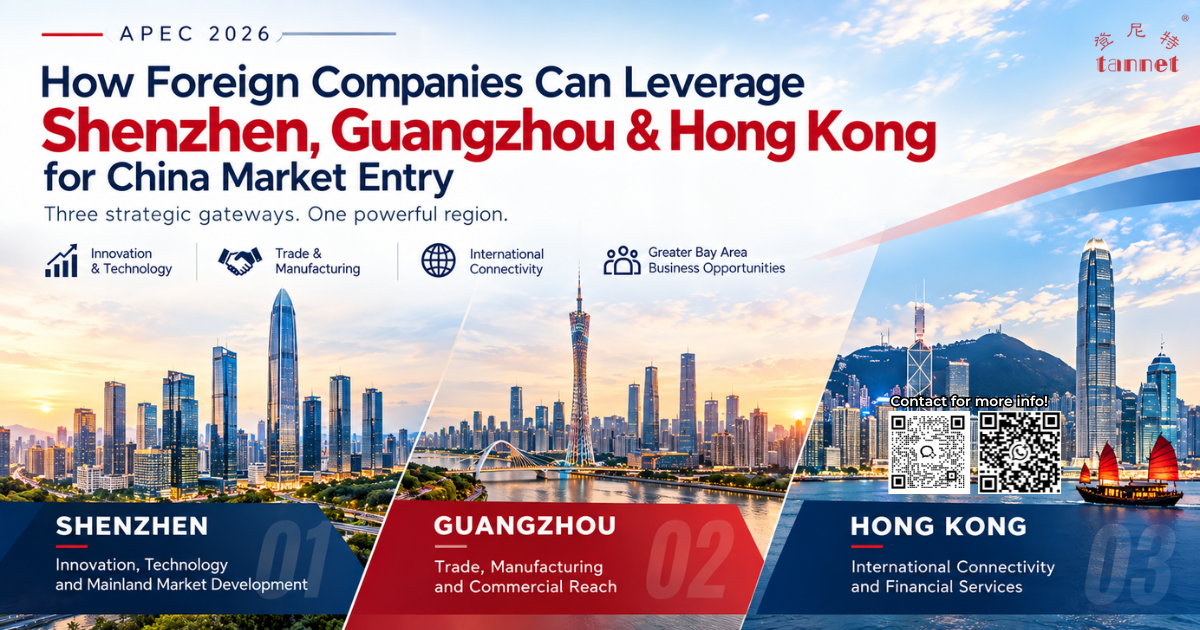
As China hosts APEC 2026, international attention is increasingly turning toward the country’s role in Asia-Pacific trade, investment, innovation and economic cooperation.
For foreign companies exploring China, one region deserves particular attention: the Guangdong-Hong Kong-Macao Greater Bay Area (GBA).
The GBA covers Hong Kong, Macao and nine cities in Guangdong Province. With a population exceeding 88 million and GDP of more than RMB 15 trillion in 2025, it represents one of China’s most important economic regions.
Within this ecosystem, three cities stand out for foreign investors: Shenzhen, Guangzhou and Hong Kong.
Rather than viewing them as competing destinations, international companies can consider how the three cities complement one another. Shenzhen provides access to innovation and technology ecosystems, Guangzhou offers deep commercial and manufacturing capabilities, while Hong Kong provides international financial, professional and cross-border business infrastructure.
For companies evaluating China market entry around APEC 2026, understanding these three cities can help turn a broad “China strategy” into a more practical Greater Bay Area strategy.
Why APEC 2026 Matters for Foreign Companies
China is hosting APEC for the third time in 2026 under the theme “Building an Asia-Pacific Community to Prosper Together.”
APEC’s 21 member economies collectively represent a significant share of global economic activity and trade. The 2026 agenda has placed renewed attention on openness, innovation and cooperation across the Asia-Pacific.
For businesses, this creates an opportunity to look beyond the meetings themselves.
APEC 2026 can serve as a timely reason to reassess where a company should establish its presence, meet partners, build supply chains or develop customers in China.
Shenzhen is particularly relevant because the city is playing a central role in APEC-related activities in 2026, including the November meetings.
But Shenzhen does not operate in isolation. It is closely connected with Guangzhou and Hong Kong, creating a broader commercial corridor that foreign investors can explore.
1. Shenzhen: A Gateway to Technology and Innovation
Shenzhen has developed from a Special Economic Zone into one of China’s most important technology and innovation centres.
For foreign businesses operating in technology, electronics, digital services, advanced manufacturing, artificial intelligence, hardware, professional services or cross-border commerce, Shenzhen can provide direct exposure to a highly developed innovation ecosystem.
The city also contains several important development platforms.
One of the most prominent is the Qianhai Shenzhen-Hong Kong Modern Service Industry Cooperation Zone, which has been positioned to support modern services and deeper Shenzhen-Hong Kong cooperation.
Qianhai focuses on areas including finance, modern logistics, information services, technology services and professional services.
This makes Shenzhen particularly relevant for companies that want to:
- access technology and innovation ecosystems;
- work with manufacturers and technology partners;
- establish a Mainland China operating entity;
- explore cross-border services;
- develop Greater Bay Area customers; or
- connect China operations with Hong Kong.
For an international company attending or following APEC 2026, Shenzhen can therefore be more than an event destination. It can become a practical starting point for assessing China market opportunities.
2. Guangzhou: Trade, Manufacturing and Commercial Reach
Around 130 kilometres from Shenzhen, Guangzhou offers another important dimension to a Greater Bay Area market-entry strategy.
Guangzhou is the capital of Guangdong Province and has a comprehensive industrial and commercial ecosystem. Its established strengths include automobiles, electronics and petrochemicals, alongside trade, logistics, professional services and emerging technology industries.
The city recorded approximately RMB 1.24 trillion in merchandise trade in 2025, illustrating the scale of its international commercial activity.
For foreign investors, Guangzhou can be particularly relevant when the business model depends on:
- import and export trade;
- sourcing and procurement;
- manufacturing relationships;
- wholesale and distribution;
- logistics;
- consumer market access; or
- participation in South China’s broader commercial ecosystem.
The city is also home to the Nansha area of the China (Guangdong) Pilot Free Trade Zone, another platform designed to support trade, investment and Guangdong-Hong Kong cooperation.
This creates a different value proposition from Shenzhen.
A technology business might look to Shenzhen for innovation partnerships, while a trading or product-focused company may find Guangzhou particularly useful for suppliers, distribution and commercial development.
3. Hong Kong: An International Platform Connecting China and the World
Hong Kong adds an international dimension to the Shenzhen-Guangzhou-Hong Kong combination.
As a major international financial, trade and professional-services centre, Hong Kong has long served as a bridge between Mainland China and international markets.
Its strengths include financial services, international trade, logistics, professional services, legal and dispute-resolution services, asset management and cross-border business connectivity.
For foreign companies, a Hong Kong entity may serve different purposes depending on the business model, including international contracting, regional operations, holding activities, financing, trading and coordination with Mainland China operations.
Hong Kong’s role becomes particularly interesting when combined with Shenzhen.
A company might maintain an international or regional platform in Hong Kong while establishing Mainland operations in Shenzhen to access customers, suppliers, employees and local business opportunities.
The appropriate structure, however, depends on factors such as business activity, tax exposure, licensing requirements, customer location, staffing and banking arrangements.
One Region, Three Complementary Business Functions
The real opportunity is not necessarily choosing Shenzhen vs Guangzhou vs Hong Kong.
For some foreign investors, the better question is:
How can these three locations work together?
A foreign company could potentially use:
Hong Kong for international connectivity and regional business functions;
Shenzhen for technology, innovation and Mainland market development;
and
Guangzhou for trade, manufacturing, sourcing and distribution.
This type of multi-city strategy allows businesses to take advantage of different capabilities within a geographically connected region.
The wider Greater Bay Area covers approximately 56,000 square kilometres and had a population of more than 88 million in 2025. Shenzhen, Guangzhou and Hong Kong are also recognised as three of the GBA’s four core cities, alongside Macao.
That scale makes the region relevant not only as a domestic Chinese market, but also as a platform connecting businesses with supply chains and customers across Asia.
What Should Foreign Investors Evaluate Before Entering?
Market opportunity alone should not determine where a company establishes operations.
Before entering Shenzhen, Guangzhou, Hong Kong or using a combination of these locations, foreign investors should evaluate several practical issues.
These include the proposed business scope, foreign ownership rules, company structure, registered capital, tax obligations, banking arrangements, import and export requirements, intellectual property protection, employment, work permits and industry-specific licences.
Companies should also determine whether they actually require separate entities in multiple cities.
In some cases, one entity may be sufficient initially. In others, a Hong Kong-plus-Mainland structure may better support cross-border operations.
The right answer depends on the company’s actual commercial model rather than simply choosing the most internationally recognised city.
From APEC 2026 to a Long-Term China Strategy
APEC 2026 is bringing renewed international business attention to China and particularly Shenzhen.
But the larger opportunity extends beyond the event itself.
Foreign investors can use this period to examine how Shenzhen, Guangzhou and Hong Kong fit into their longer-term China and Asia-Pacific strategies.
For technology and innovation, look at Shenzhen.
For trade, manufacturing and distribution, consider Guangzhou.
For international finance, professional services and cross-border connectivity, evaluate Hong Kong.
And for companies requiring several of these capabilities, consider how the three cities can work together.
TANNET provides business incorporation and corporate services across Shenzhen, Guangzhou and Hong Kong, including company registration, corporate secretarial support, tax and accounting coordination, trademark registration and market-entry assistance.
For foreign companies planning to enter China or establish a Greater Bay Area presence around APEC 2026, evaluating the right jurisdiction and corporate structure early can help create a more practical foundation for long-term expansion.
📞 Free 1-on-1 Consultation Now,
Official Service Hotline: +86-755-82148419
Cell: +86-13823131503;+60 19-309 2363
WeChat ID: 13823131503;
WhatsApp:+86-13823131503;+60 19-309 2363
Email: mytannet08@gmail.com; susiehu@citilinkia.com