Key Takeaway
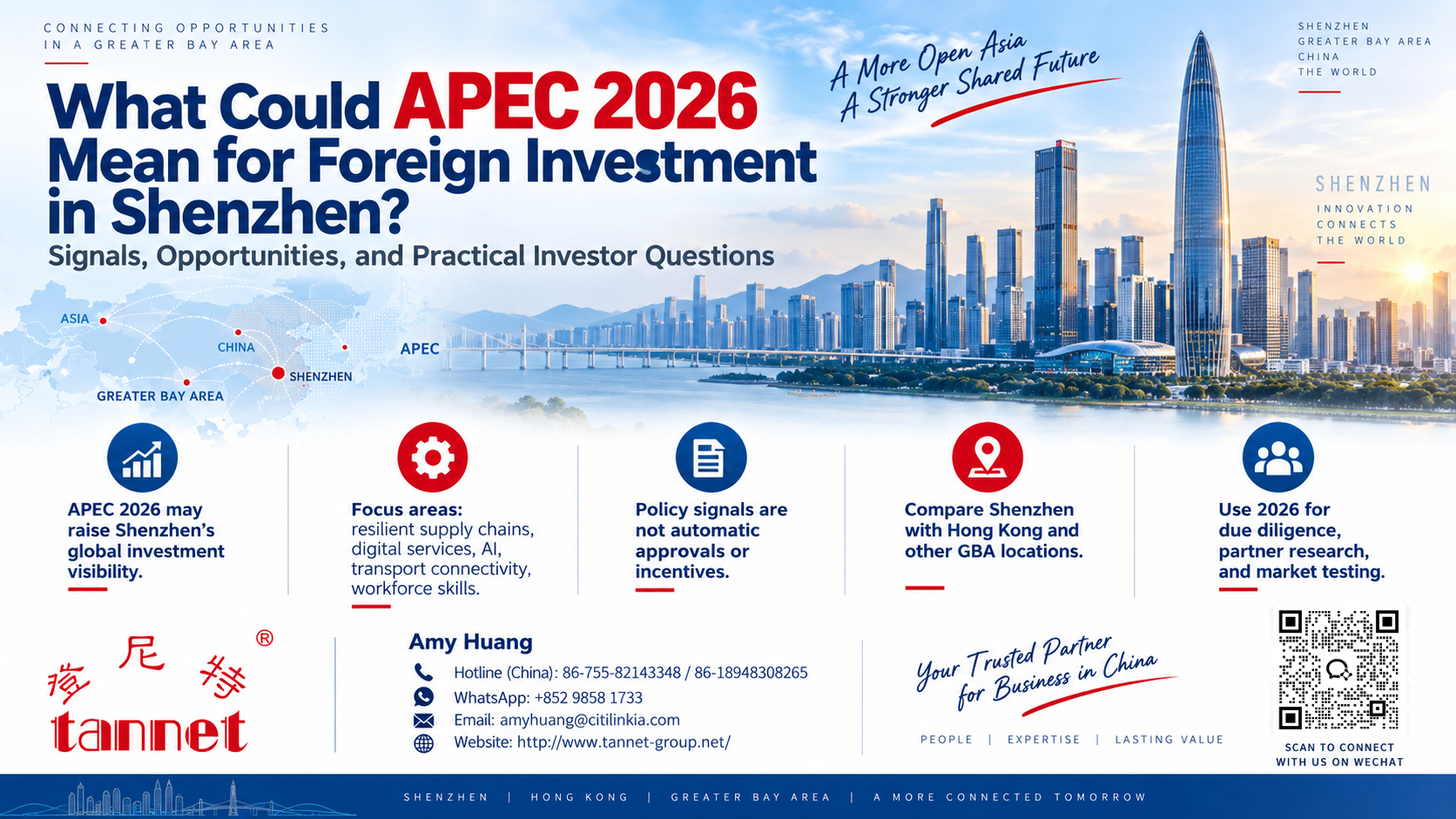
APEC 2026 could strengthen Shenzhen’s foreign-investment case by accelerating discussion on resilient supply chains, digital services, artificial intelligence, transport connectivity, and workforce skills. It is most relevant to manufacturers, technology companies, logistics operators, digital-service providers, and regional groups comparing Shenzhen with Hong Kong or other Greater Bay Area locations.
The key caution is that APEC creates policy signals, not investment approvals. Companies should use the host year to test demand, compare operating models, and monitor official policy announcements. They should not assume that conference visibility changes China’s market-access, tax, licensing, data, employment, or foreign-exchange rules.
The useful question is not whether APEC creates investment
APEC does not allocate factories, approve foreign-invested enterprises, or award tax benefits. Its decisions are voluntary and generally non-binding. The better question is whether the 2026 agenda changes the information available to an investor.
That information can still matter. Ministerial statements reveal shared problems. Business discussions identify bottlenecks. Host-city activity increases contact between officials, industry groups, advisers, suppliers, and investors. These signals can improve due diligence when they are tested against binding Chinese rules.
Five channels through which APEC could influence investment decisions
1. Supply-chain resilience becomes an investment criterion
The September 2026 APEC transportation statements emphasized resilient supply chains, modern transport infrastructure, secure digital solutions, intermodal connectivity, and wider use of artificial intelligence. This gives investors a clearer framework for evaluating Shenzhen beyond headline growth.
A manufacturer should examine port access, airport cargo links, supplier concentration, alternative routes, inventory strategy, cybersecurity, and recovery time after disruption. A logistics investor should assess whether a project solves a verified operational constraint rather than following a policy slogan.
APEC reported that Asia-Pacific rail networks expanded by 9 percent between 2015 and 2025. Airport and maritime connectivity increased by 3.8 percent and 12 percent. These regional figures support a connectivity thesis, but a Shenzhen project still needs site-level data and customer commitments.
2. Digital services become part of the investment thesis
APEC and UNCTAD stated in September that digital services require reliable infrastructure, predictable regulation, cross-border payments, trusted platforms, skills, and workable data rules. Digitally deliverable services now account for 56 percent of global services exports, according to the official announcement.
This matters to software companies, professional-service firms, cross-border platforms, cloud users, and technology-enabled manufacturers. Shenzhen offers customers and technical talent. Yet the investor must separately map cybersecurity, personal-information, important-data, licensing, tax, invoicing, and payment requirements.
3. AI changes both opportunity and employment cost
APEC’s digital agenda highlights AI infrastructure, security, scalability, and inclusive use. Its human-resources ministers also focused on job displacement, emerging occupations, vocational training, skills recognition, and protection for contract and platform workers.
An AI investment case should therefore include two budgets. One covers technology, computing, data, security, and product compliance. The other covers recruitment, training, employment contracts, social insurance, retention, and workforce transition. Ignoring the second budget can distort projected returns.
4. Shenzhen gains visibility as one part of a regional structure
Shenzhen combines advanced manufacturing, electronics, software, logistics, and proximity to Hong Kong. APEC 2026 may increase international awareness of that combination. It does not mean every regional function belongs in one Shenzhen entity.
A group may place mainland sales, engineering, procurement, or production support in Shenzhen. Hong Kong may support international financing, contracting, treasury, or holding functions. Guangzhou or another mainland city may suit manufacturing or distribution. The structure should follow real personnel, contracts, assets, risks, and management.
5. Policy attention can shorten research, not execution
More official briefings, industry events, and delegation visits can help investors identify questions and counterparties. They cannot replace negotiations, registrations, bank onboarding, premises, recruitment, customs setup, or regulatory approvals.
The practical gain is faster learning. An investor can use APEC-related information to reject weak assumptions earlier, narrow the location shortlist, and define which government or professional confirmations are still required.
Which sectors may have the clearest relevance?
Advanced manufacturing and industrial technology
The strongest connection is not ceremonial. Shenzhen already has dense supplier and engineering networks. APEC’s emphasis on resilience, digital transport, standards, and low-carbon development may support demand for industrial software, sensors, automation, energy management, and supply-chain visibility.
Logistics and mobility
Transport ministers highlighted intelligent systems, predictive maintenance, secure platforms, autonomous mobility, air and maritime routes, and public-private infrastructure financing. Investors should distinguish scalable commercial services from government procurement or pilot projects that require separate eligibility.
Digital and professional services
The new APEC services roadmap and digital-trade discussions support attention to software, design, finance, consulting, e-commerce enablement, and cross-border business services. Market access remains service-specific. Some activities require licenses, local qualifications, or limits on data movement.
Talent and training services
AI adoption creates demand for reskilling, technical recruitment, occupational certification, and workforce planning. Foreign providers should verify education, human-resources, online-platform, advertising, and data requirements before offering regulated or consumer-facing services.
A five-step investor response
- Define the commercial problem. Identify the customer, payment source, delivery model, and reason Shenzhen is relevant.
- Map regulatory boundaries. Review the foreign-investment negative list, sector permits, data rules, customs, employment, tax, and foreign exchange.
- Choose the footprint. Compare a Shenzhen entity, Hong Kong support functions, other mainland locations, distributors, or contractual market testing.
- Validate economics. Price premises, payroll, social insurance, logistics, professional services, banking, compliance, and working capital.
- Use APEC selectively. Attend only verified events, document useful contacts, and convert discussions into dated due-diligence actions.
What evidence should change the decision
Policy attention matters only when it produces evidence that affects projected cash flow, risk, or timing in practice. Useful evidence includes a published implementation measure, confirmed customer demand, a signed supplier arrangement, a workable licensing path, reliable cost quotations, or a financing commitment. General statements should remain assumptions in the investment model.
Investors should create a dated evidence register. Each claim should show its source, owner, verification status, financial effect, and next review date. This prevents conference commentary from becoming an unsupported board assumption. It also makes later advice easier to update when a ministry, Shenzhen authority, regulator, bank, customer, or landlord provides new information.
The decision threshold should be defined before the visit. For example, a company may require three qualified customers, two compliant suppliers, a confirmed banking path, and a total employment cost within an approved range. If the evidence does not meet the threshold, the investor can delay incorporation, reduce the initial footprint, or run a lawful market test. APEC can improve access to information, but disciplined thresholds determine whether capital is committed.
Common mistakes
- Treating an APEC policy statement as a binding Chinese incentive or approval.
- Choosing Shenzhen before confirming customers, licenses, and operating costs.
- Assuming a Hong Kong company automatically solves mainland tax or data issues.
- Budgeting for technology but not workforce compliance and training.
- Using event branding in a way that suggests official affiliation.
- Confusing temporary event demand with sustainable market demand.
Frequently asked questions
Q1. Will APEC 2026 directly increase foreign investment in Shenzhen?
It may improve visibility, policy dialogue, and business contact. Actual investment depends on market demand, regulation, financing, execution, and investor confidence.
Q2. Does APEC create new tax incentives?
No automatic incentive follows from APEC. A tax benefit requires a separate official legal basis, eligibility conditions, and application process.
Q3. Which foreign investors should watch the transport announcements?
Manufacturers, logistics operators, mobility companies, exporters, importers, and technology providers serving ports, airports, vehicles, warehouses, or supply chains.
Q4. Is Shenzhen suitable for a regional headquarters?
Possibly, but the answer depends on management location, customer markets, staffing, tax, banking, foreign exchange, data flows, and the functions retained in Hong Kong or elsewhere.
Q5. Can a company enter China only through a distributor?
Some companies can test demand contractually before forming an entity. The arrangement must match product, licensing, tax, customs, payment, and liability requirements.
Q6. Are APEC business events open to everyone?
No. Official meetings may require accreditation or invitation. Independently organized events have separate rules and should not be presented as official without verification.
Q7. What should an investor monitor after APEC?
Monitor binding Chinese measures, local implementation notices, sector rules, government procurement, data guidance, talent policies, and measurable market activity.
Conclusion
APEC 2026 is expected to increase international attention on Shenzhen and the Greater Bay Area. Overseas companies considering business visits, market research or long-term establishment should assess market access, company structure, tax, banking and compliance requirements separately.
Tannet can assist with market-entry comparison, entity setup, tax registration, accounting, corporate compliance, and coordination across Shenzhen, Guangzhou, and Hong Kong. The scope should reflect the investor’s sector, transactions, staffing, data flows, and timetable.
Official Sources
Written by: Tannet Business Services Team
Reviewed by: Consultant Amy Huang
First published: 23 Sep. 2026
Last reviewed: 23 Sep. 2026
————————————————Simplifying Business, Empowering Entrepreneurs————————————————