Key Takeaway
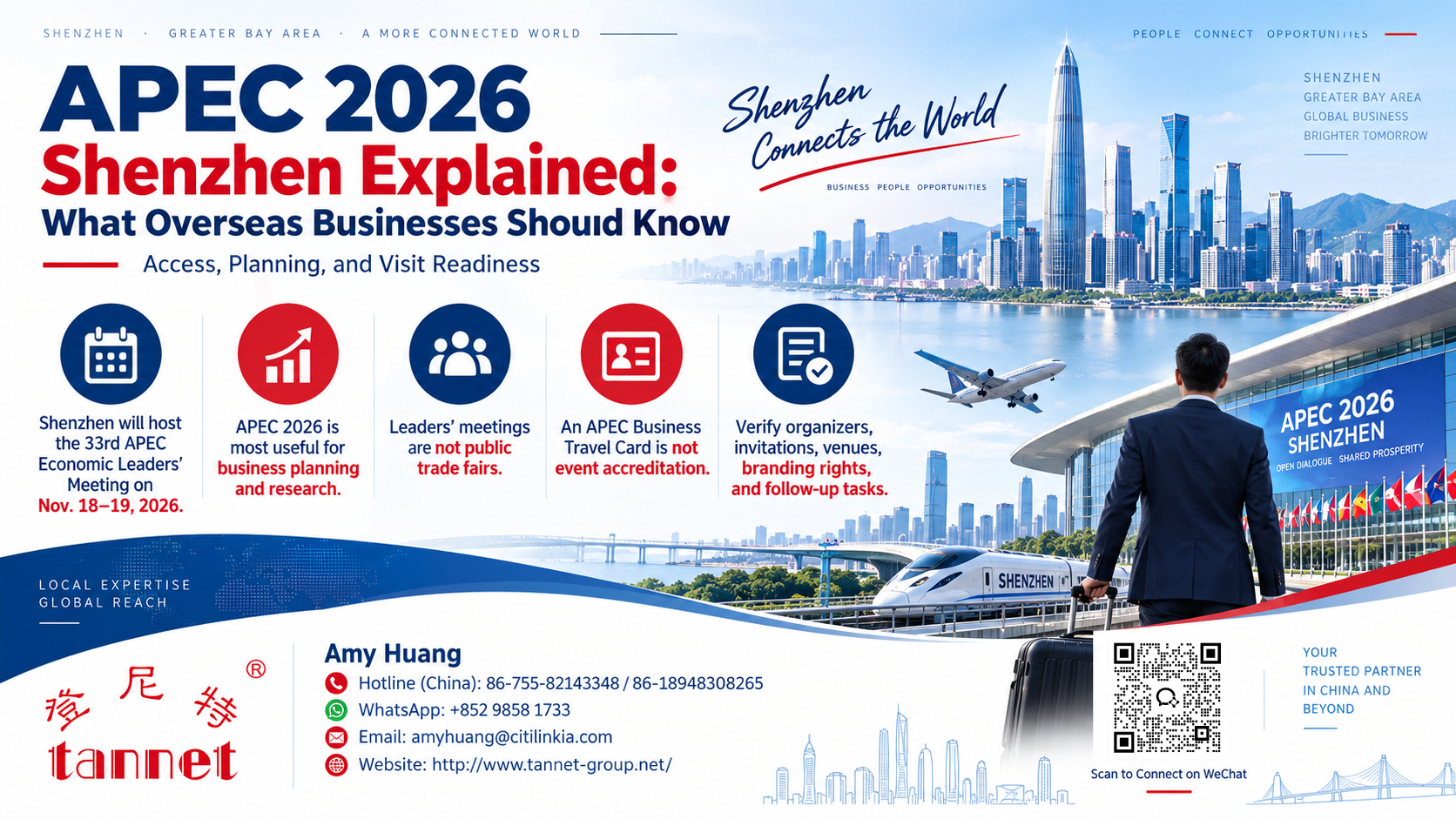
APEC 2026 places Shenzhen at the center of Asia-Pacific economic diplomacy, but overseas businesses should approach the host year as an operational planning exercise. It is most relevant to companies arranging executive visits, client meetings, partner searches, market-entry research, supplier reviews, or Greater Bay Area expansion.
The most important caution is access. The leaders’ meeting is not a public trade fair, an APEC Business Travel Card is not event accreditation, and a commercial event using APEC-related language may not be official. Verify organizers, invitations, visas, venues, branding rights, counterparties, data handling, and follow-up responsibilities before committing time or money.
Start with the confirmed facts
China is the host economy for APEC 2026. Shenzhen will host the 33rd APEC Economic Leaders’ Meeting on November 18 and 19, 2026. Shenzhen Government Online also states that the APEC CEO Summit and the joint ministerial meeting of foreign and trade ministers will accompany the leaders’ meeting.
The official theme is “Building an Asia-Pacific Community to Prosper Together.” The three priorities are openness, innovation, and cooperation. The APEC China Year includes meetings and activities in several Chinese cities, so not every APEC 2026 event will take place in Shenzhen.
APEC is a forum of 21 member economies. Its work is voluntary, consensus-based, and generally non-binding. APEC discussion can guide policy and business research, but it does not replace Chinese laws on foreign investment, immigration, company registration, tax, customs, employment, cybersecurity, data, or regulated industries.
Do not treat every APEC-related activity as the same
1. Official intergovernmental meetings
These meetings are part of the formal APEC process. Participation may be limited to delegations, accredited officials, approved observers, invited experts, media, or specified stakeholders. A public announcement does not mean general admission.
2. Official business events
Some business programs may operate alongside the formal process. They can have separate organizers, registration procedures, eligibility rules, fees, security checks, and deadlines. Businesses should use the official event page and written organizer confirmation.
3. Independently organized commercial events
A conference, dinner, roadshow, or networking program may discuss APEC themes without being part of APEC. Its commercial value may still be real, but the organizer should not imply endorsement that does not exist. Check the legal entity, venue, speakers, refund terms, privacy notice, and sponsorship claims.
4. Private business visits
Build the visit around a business decision
A trip should answer a short list of decisions. Examples include whether Shenzhen has suitable customers, whether a distributor is credible, whether a WFOE is necessary, whether product approval is required, or whether Hong Kong should perform genuine regional functions.
Define success before booking travel. Useful outputs include five qualified customer interviews, two verified supplier alternatives, a premises cost range, a license pathway, a staffing budget, or a documented comparison between Shenzhen, Guangzhou, and Hong Kong.
Verify access before paying
Check whether the event appears on APEC.org, the official APEC China 2026 website, China’s Ministry of Foreign Affairs, or Shenzhen Government Online. Compare the organizer name, domain, dates, venue, registration route, and contact details.
Request written confirmation of what the fee covers. Ask whether admission, interpretation, transport, meals, exhibition space, matchmaking, or refunds are included. Do not rely on a social-media message that promises access to leaders, ministers, or restricted venues.
An APEC Business Travel Card can facilitate eligible business travel in participating economies under applicable rules. It does not grant entry to an APEC meeting, waive event accreditation, or guarantee admission to a controlled venue.
Prepare travel and local operations separately
Confirm passport validity, visa or entry eligibility, invitation requirements, and permitted activities through official Chinese channels. Meeting registration and immigration permission are separate. A valid entry document does not create event access.
Reserve flexible accommodation and transport where possible. Leaders’ week can create security controls, route changes, and high demand. Keep alternative meeting locations and enough transfer time between Shenzhen, Hong Kong, Guangzhou, airports, and railway stations.
Protect brand identity and communications
The APEC name and logo are controlled. The APEC Secretariat publishes a branding manual and logo-use guidance. Do not place the logo on invitations, websites, booth materials, press releases, or social posts unless the required authorization exists.
Use precise language. “During APEC 2026” does not mean “official APEC event.” “APEC-related topic” does not mean “endorsed by APEC.” If a company hosts a private program, identify the organizer and avoid wording that could mislead attendees.
Verify counterparties before sharing information or money
Confirm the Chinese legal name, unified social credit code, registered representative, business scope, licenses, and bank account beneficiary. A familiar English brand name may not identify the contracting entity.
Check who has authority to sign. Ask how the proposed partner earns revenue, who owns customer relationships, which permits it holds, and whether subcontractors will perform critical work. Match invoices and payment instructions to the contract.
For distributors and suppliers, review ownership, litigation, sanctions exposure, quality controls, export-control issues, intellectual-property practices, and references. Enhanced checks may be needed for regulated products, public procurement, sensitive technology, or advance payments.
Control data, devices, samples, and intellectual property
Take only the information needed for meetings. Apply access controls, strong authentication, current software, and a clear incident contact. Avoid carrying unrestricted copies of customer databases, source code, technical drawings, or personal information.
Map what information will be collected from delegates, prospects, or partners. Identify where it is stored, who can access it, and whether it will cross a border. A conference badge scan or contact list can involve personal information.
Use confidentiality agreements where appropriate, but do not treat an agreement as the only protection. Stage disclosure, watermark sensitive materials, limit technical detail, and record what was shared.
Samples, demonstration equipment, batteries, radio devices, medical products, food, chemicals, and encryption items can trigger customs or regulatory questions. Confirm import, transport, safety, and return arrangements before shipment.
Turn meetings into an implementation record
Within 48 hours, record each contact’s legal entity, role, commitments, unanswered questions, documents requested, and next action. Separate factual statements from sales claims and personal impressions.
Within 30 days, verify licenses, costs, counterparties, tax assumptions, and customer demand. Stop weak leads early. Move credible opportunities into a documented workstream with an owner, budget, deadline, and decision criterion.
Within 60 to 90 days, select the operating model. Options may include export sales, a distributor, project delivery, representative activities, a Shenzhen WFOE, a Hong Kong company, or a combined Greater Bay Area structure. The structure should follow real contracts, people, management, assets, and risk.
Common mistakes
- Assuming a leaders’ meeting operates like a public exhibition.
- Treating an APEC Business Travel Card as meeting accreditation.
- Using the APEC logo or wording that suggests unauthorized endorsement.
- Sharing sensitive data or technical material before counterparty checks.
- Returning from Shenzhen without documented owners, deadlines, or decision criteria.
Frequently asked questions
Q1. Can any overseas company attend the APEC leaders’ meeting?
No. Access depends on the event and accreditation category. Official meetings may be restricted. Verify eligibility through the named official organizer.
Q2. Does an APEC Business Travel Card provide event entry?
No. The card concerns eligible business travel. It does not replace event registration, accreditation, security screening, or a venue pass.
Q3. How can we check whether an APEC-related event is official?
Check official APEC and government websites. Match the organizer, domain, venue, registration route, and contact details. Request written clarification if the status is unclear.
Q4. May our company use the APEC logo in a client invitation?
Do not use it without appropriate authorization. Review the APEC logo-use guidance and branding manual before publishing any material.
Q5. Should we establish a China company before visiting Shenzhen?
Usually not solely because of the event. First confirm customers, permitted activities, licenses, costs, staffing, banking, tax, and the intended transaction flow.
Q6. Can we collect attendee details for later marketing?
Collection and later use should follow applicable privacy rules and the event’s notice and consent arrangements. Limit collection and document the lawful purpose.
Q7. What should a business complete after the visit?
Complete contact verification, an evidence log, regulatory checks, a cost model, a proposed structure, and a dated go, pause, or stop decision.
Conclusion
APEC 2026 can make Shenzhen valuable for business research when access and follow-up are controlled. Tannet can assist overseas businesses with Shenzhen visits, counterparty checks, market-entry comparison, company formation, tax registration, accounting, and corporate compliance across Shenzhen, Guangzhou, and Hong Kong. The scope should follow the company’s sector, activities, needs, and timetable.
Official Sources
Written by: Tannet Business Services Team
Reviewed by: Consultant Amy Huang
First published: 23 Sep. 2026
Last reviewed: 23 Sep. 2026
————————————————Simplifying Business, Empowering Entrepreneurs————————————————