Key Takeaway
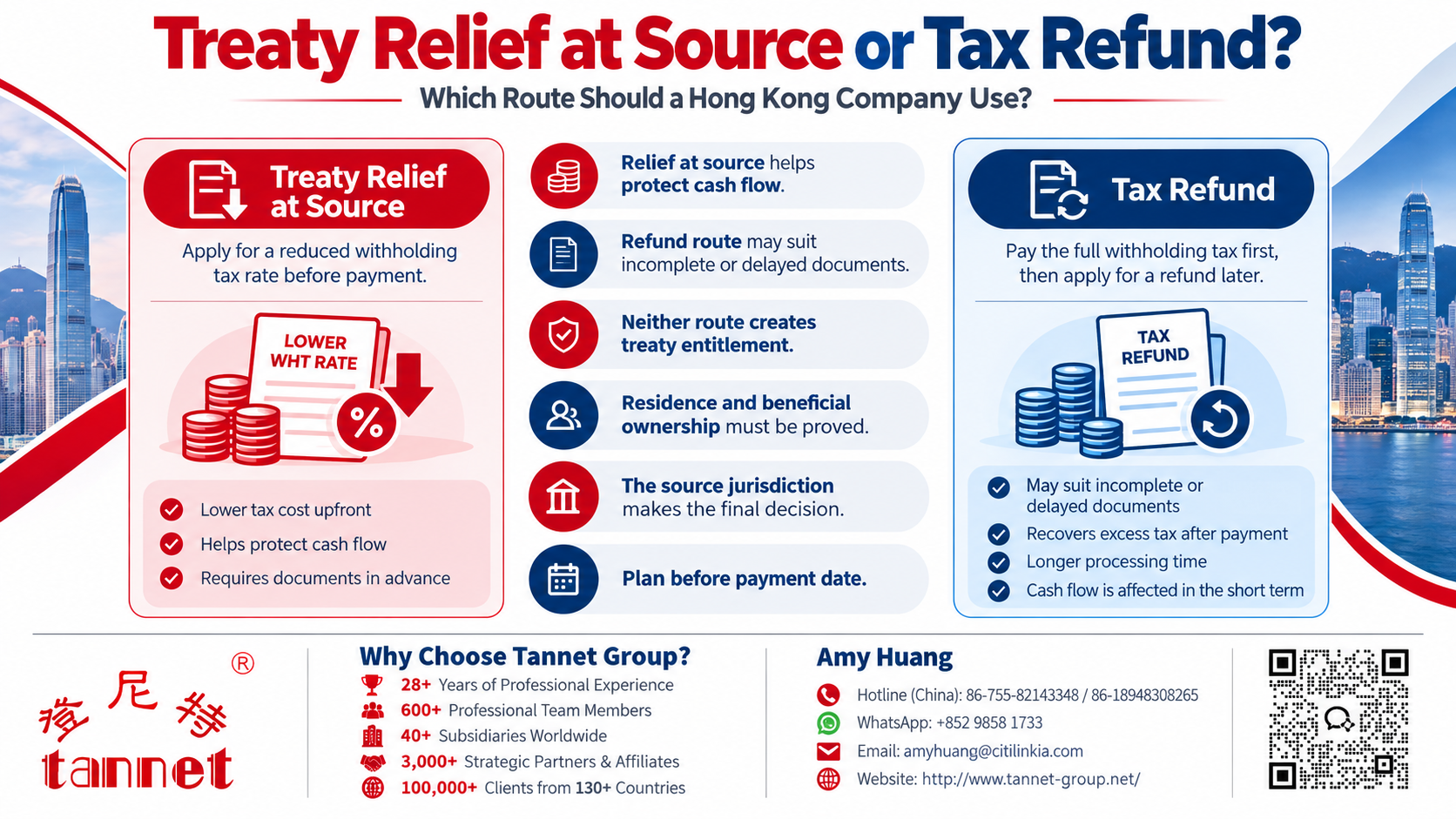
A Hong Kong company should normally seek treaty relief at source when the applicable tax treaty, source-country procedure and evidence are clear before payment. This protects cash flow and avoids a later recovery process.
A refund route is more suitable when documents are incomplete, the payer will not apply the treaty rate, eligibility requires review, or the domestic system requires tax to be paid first.
Neither route creates treaty entitlement. The company must prove treaty residence, income ownership, beneficial ownership where relevant, and compliance with anti-abuse rules.
The source jurisdiction, not Hong Kong’s Inland Revenue Department, makes the final decision on relief.
The two routes in practical terms
Treaty relief at source means the payer or withholding agent applies the treaty rate when making the payment. The recipient receives the net amount after reduced withholding, rather than after the full domestic rate.
A tax refund route starts differently. The payer withholds under domestic law. The Hong Kong recipient then claims back the excess after payment, either directly or through the withholding agent, according to the source jurisdiction’s procedure.
The economic result may eventually be similar. The timing, evidence burden, audit exposure and cash-flow effect are different. Those differences should determine the route.
Confirm that a treaty actually applies
The first question is not which procedure is faster. It is whether an effective double taxation agreement covers the income and taxpayer.
The Hong Kong Inland Revenue Department states that a DTA affects a person only if that person is resident in Hong Kong or the other treaty jurisdiction. The treaty then allocates taxing rights and may reduce withholding tax on dividends, interest, royalties or other income.
The company should identify the exact treaty article. A dividend article does not govern service fees. A royalty definition may differ from the contract label. Domestic characterization can also affect the filing route.
Check residence before choosing a procedure
A Certificate of Resident Status is commonly requested as evidence that a Hong Kong company qualifies as a Hong Kong resident under the relevant DTA. It is treaty-specific evidence, not a general certificate of good standing.
Hong Kong’s IRD says its target is to issue a certificate, request more information, or notify the applicant that the application cannot be accepted within 21 working days after receiving a properly completed application.
Timing matters. If the payer must file a withholding return next week, a certificate that has not been obtained may prevent relief at source. A planned distribution should therefore include a residence-certificate timetable.
A Hong Kong certificate does not approve the claim
The IRD’s application notes for Mainland China expressly state that issuing a Certificate of Resident Status does not guarantee treaty benefits. Mainland tax authorities decide whether the relevant conditions are satisfied.
That distinction applies more broadly as a risk principle. Hong Kong confirms residence. The source-country authority applies its treaty, domestic procedure and anti-abuse rules.
A company should not tell its payer that a Hong Kong certificate alone is sufficient. It should prepare a complete entitlement file.
When relief at source is usually preferable
Relief at source is often the stronger operational choice when five conditions are present.
- The payment date is known in advance.
- The applicable treaty article and rate are clear.
- The Hong Kong residence evidence is available.
- Beneficial ownership and commercial substance can be demonstrated.
- The payer is willing and legally able to apply the treaty rate.
The main benefit is cash flow. The company does not finance the source country while waiting for a refund. It also avoids currency exposure on a future refund and reduces the number of post-payment filings.
Relief at source still carries review risk. If the company was not eligible, the source authority may recover underpaid tax, interest or penalties under local law. The file should be defensible before the payer uses the lower rate.
When the refund route may be safer
A refund route can be sensible when eligibility is credible but not ready for immediate implementation. Examples include a first-time claim, a late residence certificate, a complex beneficial-owner analysis or a payer that follows a conservative internal policy.
Paying domestic withholding tax first reduces the payer’s immediate exposure. It does not solve the recipient’s evidence problem. The same residence, ownership and transaction documents will normally be tested during the refund review.
The cost is delayed cash. The company should model the gross payment, domestic withholding, expected treaty rate, recoverable amount, filing deadline and realistic processing period.
Mainland China example
China’s State Taxation Administration Announcement No. 35 of 2019 uses a self-assessment, reporting and document-retention system for non-residents claiming treaty benefits.
For withholding at source, the non-resident submits an Information Report Form to the withholding agent. If the information is complete, the agent may withhold under domestic law and the treaty. If the form is missing or incomplete, domestic rules apply.
The claimant must retain a residence certificate, contracts, resolutions, payment evidence and beneficial-ownership materials for dividends, interest and royalties. The tax authority may review the claim later.
Where eligible relief was not used and tax was overpaid, the non-resident or withholding agent may seek a refund. The measures state that the competent tax authority should verify the application within 30 days and process it when the treaty conditions are met. This is a verification target, not a promise that every case will conclude within 30 days.
Evidence required for either route
The evidence pack should connect the legal rule to the actual transaction. It commonly includes:
- the applicable DTA and protocol;
- a valid Hong Kong Certificate of Resident Status;
- the income contract and payment schedule;
- invoices, bank records and payment vouchers;
- shareholder or board resolutions for dividends;
- ownership charts and shareholder registers;
- proof that the Hong Kong company controls and enjoys the income;
- office, staff, management and operating records where substance is relevant;
- the source-country form, translation and authorization documents.
The company should update evidence for the relevant payment period. Old documents may not reflect changes in ownership, management or business operations.
Common mistakes
Treating incorporation as treaty residence. A Hong Kong registration certificate establishes legal incorporation. It does not complete a source-country treaty claim.
Applying the lowest treaty rate without checking conditions. Some rates depend on ownership percentage, holding period, income type or beneficial ownership.
Waiting until payment day. Residence applications, translations and payer review can take longer than expected.
Assuming a refund is automatic. A refund claim remains an eligibility review and may require supplementary documents.
Ignoring beneficial ownership. A conduit that must pass income onward may fail the treaty test even if it holds a residence certificate.
Using inconsistent documents. Contracts, invoices, board minutes and bank records should describe the same transaction and recipient.
Forgetting local deadlines. Refund periods, forms and submission channels come from source-country law, not the Hong Kong DTA page.
A route selection process
Start at least several weeks before payment. Confirm the payer, source country, income type, domestic rate and treaty article.
Next, test residence, beneficial ownership, anti-abuse provisions and any ownership or holding-period conditions. Request the Hong Kong residence certificate and local forms early.
Then ask the payer whether relief at source is operationally available. Record its document deadline and approval process.
Choose relief at source when eligibility is well supported and implementation is available. Choose refund when immediate relief is unavailable or the file needs further review. Record the reason for the choice.
Document the decision so later reviewers can follow the original reasoning.
Frequently asked questions
Q1. Is relief at source always better for cash flow?
Usually, because less tax is withheld. It is not better if the company cannot support eligibility and later faces recovery, interest or penalties.
Q2. Can a payer refuse to apply a treaty rate?
The answer depends on local law and the payer’s obligations. A conservative payer may apply domestic withholding when documents are late or incomplete.
Q3. Does a Hong Kong CoR guarantee the refund?
No. The IRD confirms residence for treaty purposes. The source-country authority decides whether all treaty conditions are met.
Q4. Can the claim cover dividends, interest and royalties?
Potentially, but each income category has its own treaty article, rate and conditions. Beneficial ownership is commonly important.
Q5. What happens if the lower rate was used incorrectly?
The source authority may recover the shortfall and apply interest or penalties under domestic law. Corrective filing may be required.
Q6. Can a refund be filed through the payer?
Some jurisdictions allow the withholding agent to file or assist. China’s Announcement No. 35 allows the non-resident or withholding agent to apply for overpaid tax refunds.
Q7. How early should planning begin?
Begin before the payment is approved. For a new claim, allow time for residence certification, document review, translation and payer coordination.
Conclusion
The correct route depends on the source country, treaty article, evidence readiness, payer procedure and cash-flow priorities. Tannet is suitable to assist when a Hong Kong company needs a treaty-residence application, transaction document checklist, Mainland China coordination, beneficial-ownership review support or a filing timetable. Legal eligibility and final tax approval remain with the relevant authorities and qualified advisers in the source jurisdiction.
Official sources
State Taxation Administration, Announcement No. 35 of 2019: https://www.chinatax.gov.cn/eng/c102962/c102967/c102997/c103016/c5245833/content.html
Written by: Tannet Business Services Team
Reviewed by: Consultant Amy Huang
First published: 10 Oct. 2026
Last reviewed: 10 Sep. 2026
30th Anniversary Offer: Preferential service pricing is now available. Contact consultant Amy Huang to enquire.
————————————————Simplifying Business, Empowering Entrepreneurs————————————————