Key Takeaway
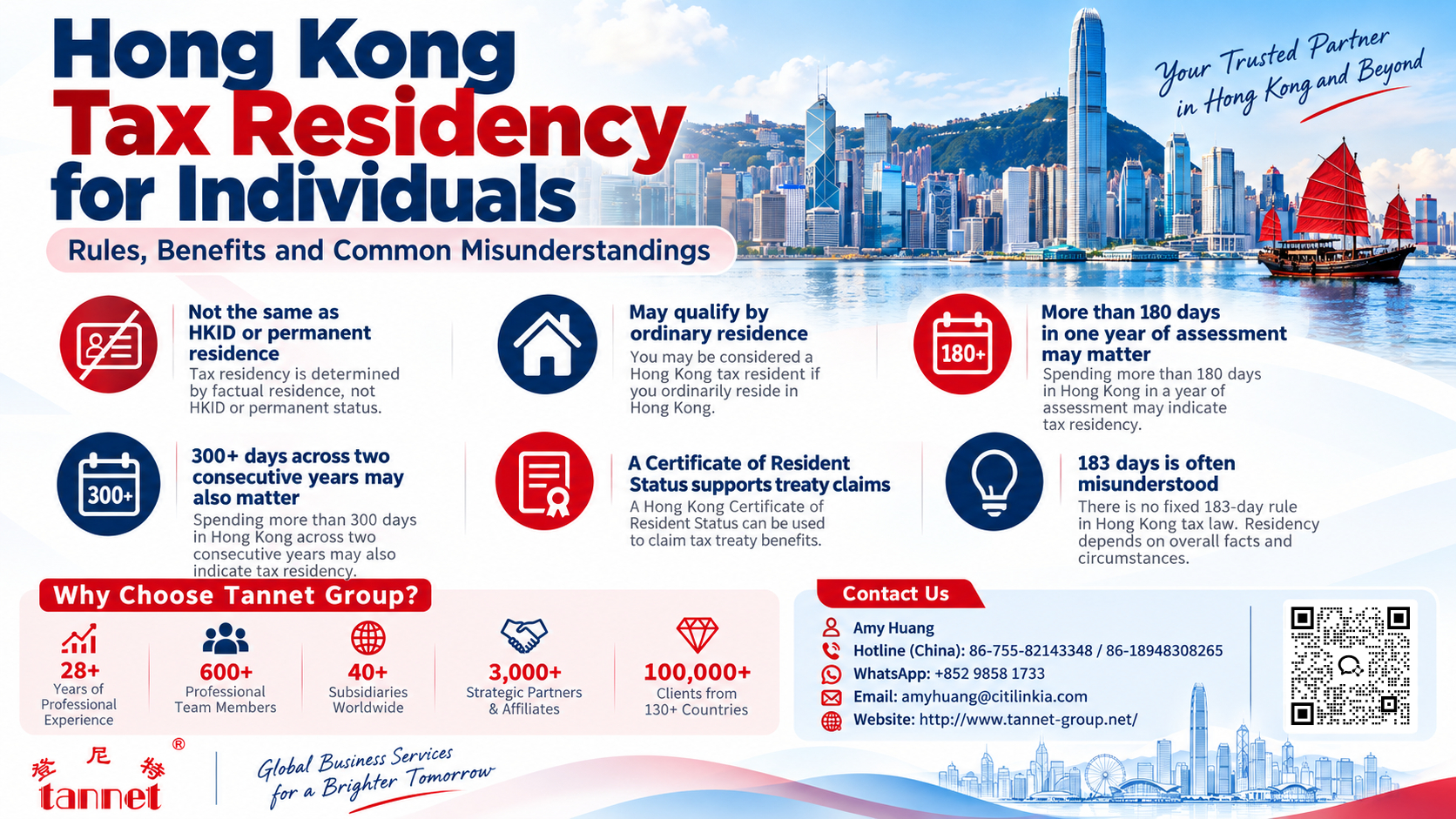
Hong Kong individual tax residency is a legal status used for tax treaties and financial-account reporting. It is not the same as holding a Hong Kong identity card, visa, permanent residence, property, employment, or a tax bill.
An individual may qualify by ordinarily residing in Hong Kong or by meeting the applicable day-count tests. This matters most to mobile executives, entrepreneurs, investors, cross-border families, and people receiving income from another jurisdiction.
The main caution is that residence can be multiple and purpose-specific.
A Hong Kong Certificate of Resident Status supports a treaty claim, but it does not guarantee relief or remove obligations elsewhere.
What Hong Kong tax residency means
Tax residence connects an individual to a jurisdiction for defined tax purposes. In Hong Kong, the concept appears in double taxation agreements, Automatic Exchange of Financial Account Information rules, and applications for a Certificate of Resident Status, or CoR.
A person may also qualify after staying in Hong Kong for more than 300 days in two consecutive years of assessment, one of which is the relevant year. The word “more” matters. Exactly 180 or 300 days does not satisfy the stated numerical threshold.
These rules should be applied to the correct Hong Kong year of assessment, which runs from 1 April to 31 March. They should not be replaced with a casual calendar-year count.
Ordinary residence is not only a day count
“Ordinarily resides” is a factual concept. It generally concerns whether Hong Kong is part of the person’s regular, settled pattern of life, apart from temporary or occasional absences.
Relevant evidence may include the availability of a home, family location, employment or business duties, travel history, local spending, bank activity, insurance, memberships, and the continuity of the person’s life in Hong Kong.
No single item proves the conclusion. Owning an apartment may support a connection, but an unused investment property says little about daily life. A local employment contract may help, but actual work patterns still matter.
Individuals should preserve contemporaneous records. Immigration movement records, leases, utility bills, employment documents, school records, medical coverage, and travel calendars are more persuasive when they tell a consistent story.
The 183-day rule is often misunderstood
Many people use “183 days” as shorthand for tax residence. That shorthand is unsafe. Hong Kong’s published AEOI and CoR criteria refer to more than 180 days in a year of assessment, not a universal 183-day rule.
Separately, individual tax treaties often use a 183-day condition in articles dealing with employment income. That rule may determine whether salary earned during a temporary assignment can be taxed in the work jurisdiction.
The employment-income test is not automatically the treaty residence test. Residence articles and employment articles serve different purposes. They may use different periods, conditions, and counting methods.
A person can therefore be a Hong Kong tax resident and still owe tax on employment income elsewhere. A person can also spend fewer than 183 days in a place but become resident under that place’s domestic law.
Tax residence is different from immigration status
Hong Kong permanent residence and right of abode are governed by immigration law. Tax residence is determined under tax rules and relevant treaties.
A permanent resident who lives and works abroad may have a weak current case for Hong Kong tax residence. A non-permanent resident on an employment or dependant visa may qualify if the tax-residence tests are met.
An HKID number is the tax identification number equivalent for a Hong Kong individual under AEOI. Possessing the card, however, does not by itself settle where the person is tax resident.
Paying Hong Kong Salaries Tax is also not conclusive. Tax liability may arise because income has a Hong Kong source, while treaty residence asks a different legal question.
Multiple residence and treaty tie-breakers
The IRD expressly notes that an individual may have more than one tax residence for AEOI purposes. When that happens, all jurisdictions of residence and corresponding taxpayer identification numbers should be reported in the self-certification.
Dual residence can arise when Hong Kong treats someone as resident while another country applies a home, domicile, nationality, day-count, or habitual-abode test.
A double taxation agreement may contain tie-breaker rules. Common factors include a permanent home, centre of vital interests, habitual abode, nationality, and agreement between the competent authorities.
The order and wording must be read in the applicable treaty. “Centre of vital interests” examines personal and economic relations. It is not decided by choosing the jurisdiction with the lower tax rate.
What benefits may be available
Hong Kong tax residence may allow an individual to request treaty treatment for foreign income. Depending on the treaty, this can affect withholding tax, employment income, pensions, director’s fees, capital gains, business profits, or relief from double taxation.
A treaty may assign taxing rights, cap a source jurisdiction’s tax, require a tax credit, or provide a mutual agreement procedure. The result depends on the income article and the claimant’s facts.
A CoR can provide official evidence of Hong Kong residence to a treaty partner. The IRD issues it only for claiming benefits under an effective comprehensive DTA or arrangement.
The IRD also warns that a CoR does not guarantee benefits. The foreign authority decides whether other treaty conditions and local procedural requirements are satisfied.
What Hong Kong residence does not do
Hong Kong residence is not a promise that worldwide income is tax-free. Hong Kong generally applies a territorial system, but each income category must still be analysed under the Inland Revenue Ordinance.
Residence also does not prevent another jurisdiction from taxing locally sourced income. Rental income, employment income, business income, or gains connected with another country may remain taxable there.
A CoR is not a clearance certificate, proof that all returns are filed, or confirmation that no tax is payable. It is issued for a specific treaty purpose and claim period.
Nor does residence eliminate CRS or AEOI reporting. Financial institutions may request a formal self-certification and supporting documents, especially after an address, phone number, or other circumstances change.
How to prepare an individual CoR application
First, identify the treaty partner, income type, payer, claim period, and relief requested. Confirm that a comprehensive DTA with Hong Kong is effective for that period.
Second, choose the correct individual application and use the current version. The IRD accepts CoR applications through the Individual Tax Portal, by post, or in person.
Third, prepare evidence of ordinary residence or day counts. Reconcile passport stamps, travel records, accommodation, employment, family, and financial information before filing.
Fourth, check the foreign claim procedure. Some jurisdictions apply relief at source. Others require tax to be paid first and reclaimed within a deadline.
Fifth, respond consistently to enquiries. The IRD’s published target is 21 working days after receiving a properly completed application, either to issue a certificate, request more information, or notify its decision.
Common mistakes
- Treating 183 days as a universal residence rule.
- Counting calendar-year days instead of the relevant year of assessment.
- Assuming an HKID, visa, or permanent residence proves tax residence.
- Reporting only Hong Kong on a CRS form despite another residence.
- Believing payment of Salaries Tax automatically proves residence.
- Applying for a CoR without an effective treaty or actual treaty claim.
- Assuming a CoR guarantees a lower foreign tax rate.
Frequently asked questions
Q1. Is an individual automatically resident after 183 days in Hong Kong?
No universal 183-day rule applies. Hong Kong’s published individual criteria include ordinary residence, more than 180 days in a year of assessment, or more than 300 days across two consecutive years with one being relevant.
Q2. Does Hong Kong permanent residence equal tax residence?
No. Permanent residence is an immigration status. It may provide factual evidence of connection, but tax residence must be tested separately under Hong Kong rules and any relevant treaty.
Q3. Can a person be tax resident in Hong Kong and another country?
Yes. Domestic laws can produce multiple residences. A treaty may resolve residence for treaty purposes, while AEOI self-certification may still require disclosure of every applicable jurisdiction.
Q4. Does paying Hong Kong Salaries Tax prove residence?
No. Salaries Tax concerns chargeable employment income. Residence concerns a person’s legal and factual connection for treaty or reporting purposes. The two analyses can overlap but are not identical.
Q5. Does a CoR guarantee treaty relief?
No. It evidences Hong Kong resident status for a DTA claim. The treaty partner decides whether the income, ownership, timing, documentation, and anti-abuse conditions support the requested benefit.
Q6. Can a non-permanent resident obtain a CoR?
Potentially. Immigration status is not the controlling test. A person who ordinarily resides in Hong Kong or satisfies the published stay thresholds may apply when a valid treaty claim exists.
Q7. Does Hong Kong tax every item of a resident’s worldwide income?
Not merely because the person is resident. Hong Kong’s territorial rules and the statutory treatment of each income category remain relevant. Foreign jurisdictions may apply different residence and source rules.
When Tannet can assist
Tannet can assist mobile executives, entrepreneurs, investors, and cross-border families with a residence fact review, day-count reconciliation, CoR application support, CRS self-certification review, and coordination of treaty documents. Legal or tax advice may also be needed in the other jurisdiction.
Written by: Tannet Business Services Team
Reviewed by: Consultant Amy Huang
First published: 10 Oct. 2026
Last reviewed: 10 Sep. 2026
30th Anniversary Offer: Preferential service pricing is now available. Contact consultant Amy Huang to enquire.
————————————————Simplifying Business, Empowering Entrepreneurs————————————————