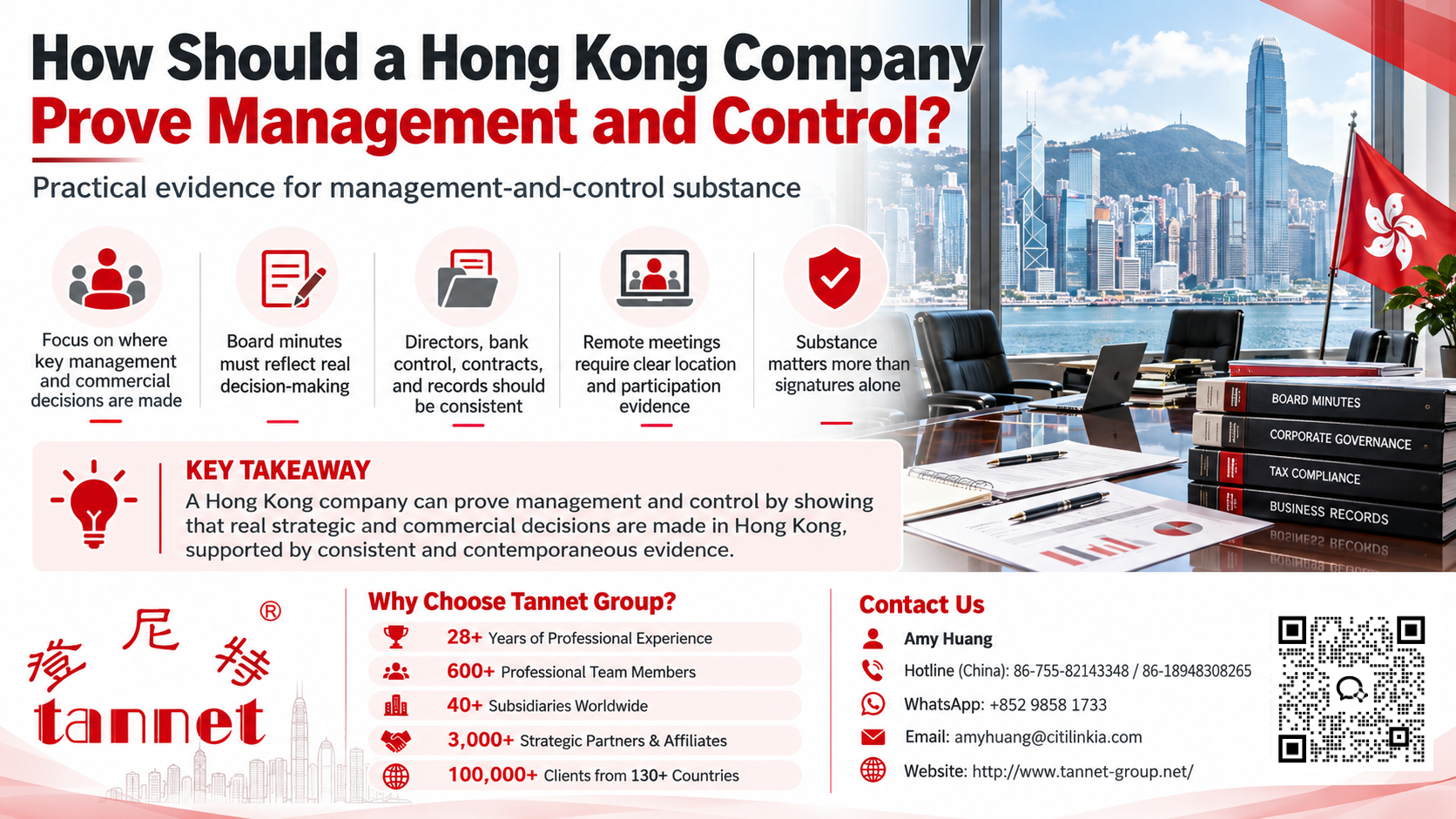
Key Takeaway
A Hong Kong company should prove management and control through a consistent chain of evidence showing who made important decisions, where those people acted, what information they considered, and how the decisions were implemented.
Board minutes are useful, but they are not enough when contracts, bank approvals, emails, budgets, or executive activity point elsewhere.
This matters most to holding companies, cross-border trading groups, financing vehicles, intellectual property owners, and businesses seeking a Hong Kong Certificate of Resident Status or treaty benefits.
The central caution is simple: evidence must reflect real conduct. A scheduled Hong Kong meeting cannot repair decisions already made overseas.
Start with the exact legal question
“Management and control” can arise in several contexts. A foreign-incorporated entity may need to show that it is normally managed or controlled in Hong Kong. A Hong Kong-incorporated company may need to address dual residence, a treaty tie-breaker, or questions from a foreign tax authority.
The wording and purpose of the test matter. Domestic residence rules, a double taxation agreement, the Multilateral Instrument, beneficial ownership requirements, and source-country claim procedures may each ask different questions.
The Hong Kong Inland Revenue Department states that a Certificate of Resident Status, or CoR, is evidence of resident status for a particular comprehensive double taxation agreement. Issuing a CoR does not guarantee that the treaty partner will grant relief.
Before assembling documents, identify the treaty partner, claim period, income type, payer, ownership chain, and residence provision. Evidence should answer that defined issue.
Prove a decision process, not an address
Management and control is usually tested through facts. A registered office, company secretary, postal address, or Hong Kong bank account does not establish where strategic decisions are made.
A defensible file connects four points: the decision-maker, the location, the information reviewed, and the subsequent action. These points should agree across corporate, commercial, banking, accounting, and tax records.
For example, a Hong Kong board may approve a major investment after reviewing a valuation, financing plan, and risk paper. The signed minutes should match meeting invitations, attendance records, the final contract, payment authority, and accounting entries.
If an overseas parent dictated the result before the meeting, the Hong Kong paperwork may show approval without genuine control. Authorities may examine substance beyond signatures.
Evidence pillar one: board governance
Keep complete minutes of directors’ meetings and written resolutions. Hong Kong Companies Ordinance section 481 requires companies to record minutes of directors’ meetings, directors’ resolutions, and sole-director decisions.
Minutes should identify participants, their locations, the documents considered, questions raised, conflicts disclosed, alternatives discussed, and the decision reached. They should not merely repeat a template.
Preserve notices, agendas, board packs, draft papers, video-meeting logs, signed resolutions, and follow-up reports. Together, these records show how the decision developed.
The Companies Registry confirms that directors’ resolutions and minutes may be kept at the registered office or another place in Hong Kong. If kept elsewhere in Hong Kong, notification rules may apply. Record keeping and tax residence are separate questions, but reliable records support both.
Evidence pillar two: directors and senior executives
Document who actually directs the business. Relevant materials include employment or service agreements, job descriptions, reporting lines, calendars, travel records, work locations, and evidence of authority.
A local director must understand the business and exercise judgment. A director who only signs documents prepared overseas provides weak evidence of genuine Hong Kong management.
Senior executives can also matter. Records should show who develops strategy, negotiates significant transactions, controls material risks, sets budgets, and supervises operations.
The evidence should be proportionate. A passive holding company may need fewer employees than an operating company, but it still needs capable decision-makers and a credible reason for its structure.
Evidence pillar three: authority and banking
Create a written authority matrix. It should state who may approve contracts, investments, borrowing, payments, hiring, litigation, and related-party transactions.
Bank mandates, payment workflows, token custody, signatory rules, and approval logs should follow that matrix. A Hong Kong board resolution is weakened if an overseas executive controls every account and releases every payment.
Delegation is normal. The board can assign operational tasks while retaining oversight. Delegation documents should define limits, reporting duties, and matters reserved for board approval.
Keep evidence that directors reviewed performance after delegation. Management accounts, exception reports, cash forecasts, and compliance updates can demonstrate continuing supervision.
Evidence pillar four: contracts and commercial execution
Material contracts should reveal a credible business process. Preserve negotiation records, due-diligence reports, pricing analysis, legal advice, approval papers, signed agreements, and implementation correspondence.
The place of signature is not decisive. Authorities may ask who selected the counterparty, negotiated key terms, accepted commercial risk, and authorised settlement.
Routine contracts may follow delegated procedures. Major acquisitions, financing, licensing, and restructuring usually deserve fuller board evidence.
Related-party transactions need particular care. The company should document commercial purpose, pricing, conflicts, and why the arrangement serves its own interests.
Evidence pillar five: premises, systems, and records
Physical presence can support the narrative when it matches activity. Useful evidence includes an office lease, access records, utility bills, staff payroll, local telephone use, and secure storage of company records.
A serviced office is not automatically unacceptable. The question is whether the facilities are suitable for the company’s actual functions and used by the people responsible.
Digital evidence also matters. System access logs, document metadata, electronic approval trails, and business email records can identify where work occurred.
Privacy and employment rules should be respected. Collect only relevant evidence and adopt a documented retention policy.
Evidence pillar six: tax and reporting consistency
Corporate records should agree with profits tax filings, financial statements, transfer-pricing documentation, payroll, Mandatory Provident Fund records, business registrations, and bank information.
For automatic exchange of financial account information, tax residence self-certifications are formal declarations. The IRD warns that knowingly or recklessly making a false or misleading self-certification is an offence.
A company should not describe itself as managed in one jurisdiction for a treaty claim and take an inconsistent position with banks or another tax authority without analysis.
Where two jurisdictions may treat the company as resident, obtain advice on dual residence and the applicable treaty tie-breaker before filing.
Remote and hybrid meetings
Remote meetings are common and are not automatically defective. They create a more complex location record.
Record where every director participated, who chaired the meeting, where supporting executives were located, and where the final decision was implemented. Preserve platform logs where appropriate.
Do not assume that a Hong Kong chairperson fixes the result. A pattern of overseas preparation, instruction, voting, and execution may carry greater weight than the chair’s location.
Adopt a remote-meeting protocol. It should cover identity, quorum, conflicts, document circulation, secure access, minutes, and post-meeting actions.
Build a recurring evidence calendar
Evidence should be created during ordinary business, not reconstructed after a tax enquiry. Use a monthly, quarterly, and annual calendar.
Monthly records may include bank approvals, management accounts, and delegated decisions. Quarterly records may include strategy, risk, performance, and compliance reviews. Annual records may cover budgets, auditors, financing, tax residence, and authority matrices.
Before a CoR application, reconcile the evidence with the application period and expected income. Explain unusual events, director travel, or temporary remote working instead of leaving contradictions unresolved.
The IRD’s published service target is 21 working days after receiving a properly completed CoR application, but additional questions can extend the process.
Common mistakes
- Treating a Hong Kong registered address as proof of management.
- Using generic minutes that do not show deliberation.
- Allowing an overseas parent to pre-approve every material decision.
- Ignoring director locations during video meetings.
- Keeping bank control entirely outside Hong Kong.
- Creating documents only after an enquiry begins.
- Taking inconsistent residence positions in tax, banking, and accounting records.
Frequently asked questions
Q1. Is one Hong Kong-resident director enough?
No. Residence, capability, participation, and actual authority all matter. One local director cannot outweigh evidence that strategic control rests overseas.
Q2. Must every board meeting occur in Hong Kong?
Not necessarily. The legal test and treaty must be reviewed. A consistent pattern of real Hong Kong decision-making is usually more persuasive than isolated meetings.
Q3. Can written resolutions support the case?
Yes, if they record genuine decisions. Keep the proposal, supporting papers, comments, approval trail, signatory locations, and implementation evidence.
Q4. Does a Hong Kong bank account prove control?
No. It is supporting evidence. Mandates and transaction logs should show who controlled material payments and under what authority.
Q5. What if the parent company sets group policy?
Group oversight is normal. The subsidiary’s directors should still assess local consequences, manage conflicts, and make decisions within their duties.
Q6. How long should evidence be kept?
Follow all applicable company, tax, accounting, privacy, and treaty-claim retention rules. A longer period may be sensible where foreign claims remain reviewable.
Q7. Will a CoR guarantee a reduced withholding rate?
No. The IRD issues the CoR, but the treaty partner decides whether all conditions for relief are satisfied.
When Tannet can assist
Tannet can assist when a company needs a management-and-control evidence review, governance calendar, CoR application file, cross-border structure assessment, or coordination of corporate, accounting, and tax records. Legal and tax conclusions should be confirmed for the relevant jurisdictions and transaction throughout the relevant period.
Official sources
Written by: Tannet Business Services Team
Reviewed by: Consultant Amy Huang
First published: 9 Oct. 2026
Last reviewed: 9 Oct. 2026
————————————————Simplifying Business, Empowering Entrepreneurs————————————————