Hong Kong Identity Applications: Main Applicants vs. Dependants
For families planning to move to Hong Kong, one of the first questions is who should apply as the main applicant and who can join as a dependant. This decision…

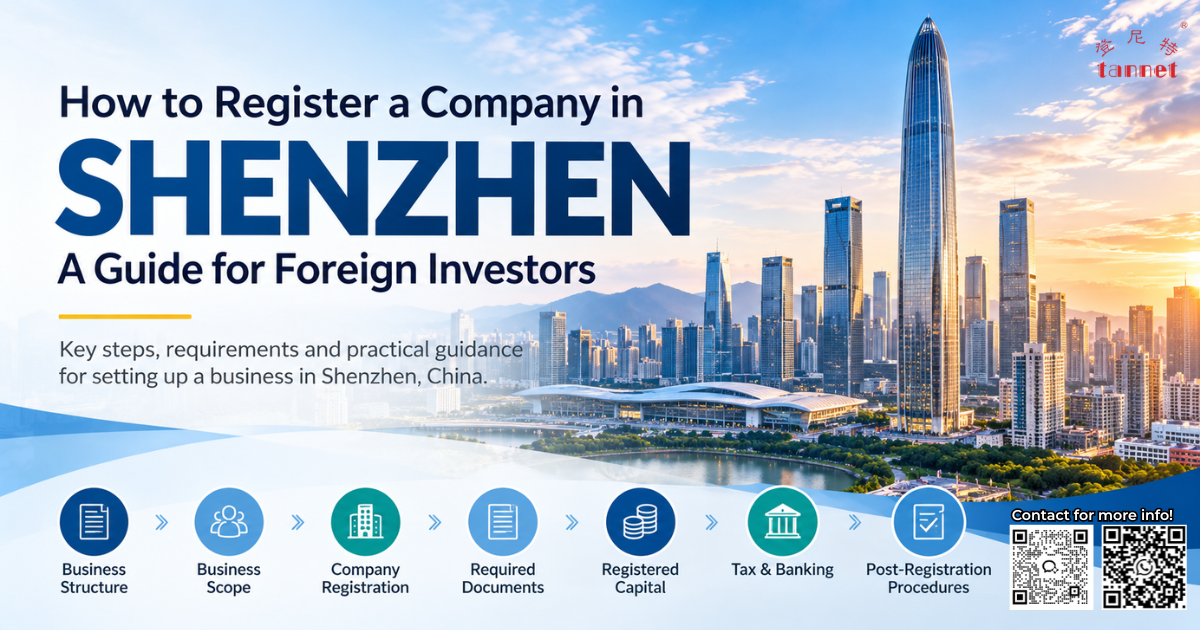
Shenzhen has developed from a manufacturing centre into one of China’s most important hubs for technology, cross-border trade, innovation, e-commerce and professional services. For international businesses entering China, Shenzhen company registration for foreign investors can provide a strategic base for accessing Mainland China and the Greater Bay Area.
Located in the Guangdong-Hong Kong-Macao Greater Bay Area (GBA) and directly connected with Hong Kong, Shenzhen offers foreign investors access to China’s domestic market while remaining closely linked to international business and capital flows.
For overseas companies planning to establish a presence in China, registering a company in Shenzhen can therefore be an important first step.
However, foreign investors need to consider more than simply obtaining a business licence. The company’s business scope, registered address, investment structure, registered capital, tax registration and banking arrangements should all be planned carefully.
Here is a practical guide to Shenzhen company registration for foreign investors.
For many foreign investors establishing an independent business in Shenzhen, a foreign-invested limited liability company is a common structure.
Depending on the proposed business and investment arrangement, the company may be:
The appropriate structure depends on the company’s intended activities, shareholders and applicable foreign-investment restrictions.
Before proceeding, investors should confirm whether their proposed industry is subject to China’s Special Administrative Measures for Foreign Investment Access, commonly known as the Foreign Investment Negative List.
Activities outside the Negative List are generally managed under the principle of national treatment for domestic and foreign investment.
China’s 2024 national Negative List, which took effect on 1 November 2024, reduced the number of restricted measures from 31 to 29 and removed the remaining foreign-investment access restrictions in the manufacturing sector.
The business scope is one of the most important elements of a Chinese company.
Investors should clearly identify what the Shenzhen company will actually do, such as:
Some activities may require additional licences, qualifications or regulatory approvals.
For this reason, the business scope should not simply be drafted as broadly as possible. It should reflect the company’s actual business model while taking future expansion into consideration.
The proposed company name must comply with China’s enterprise naming requirements and be accepted by the relevant market supervision authority.
Shenzhen’s current official enterprise-registration process includes preparing the establishment documents, completing the company-name approval process and obtaining the business licence from the Shenzhen Administration for Market Regulation.
Investors should prepare suitable naming options in case their preferred name is unavailable or cannot be approved.
A Shenzhen company needs a compliant business domicile.
The address arrangement should be considered early because the suitability of an address may depend on the company’s activities and the registration requirements applicable to the specific case.
Shenzhen’s official requirements for foreign-invested limited liability companies include having a business domicile.
Foreign investors should therefore verify whether the proposed office or registered-address solution is appropriate for their business before submitting the incorporation application.
This is particularly important for companies whose operations require physical premises, sector-specific licensing or subsequent regulatory approvals.
The exact documentation depends on whether the shareholder is an overseas individual or corporate entity and on the proposed company structure.
For a foreign-invested limited liability company, Shenzhen authorities identify documents including the company-registration application, articles of association, shareholder qualification documents, identification documents for relevant company personnel and, where applicable, approval documents or licences for activities requiring prior approval.
The company will also need to determine its governance arrangements, including relevant positions such as the legal representative, directors and management personnel according to the applicable structure.
Foreign-issued corporate and identity documents may also be subject to authentication, Apostille or other formalities depending on the document, issuing jurisdiction and registration requirements.
Preparing these documents correctly before filing can help reduce delays during the registration process.
Registered capital should be determined based on the company’s actual operational needs rather than selected as an arbitrary figure.
Investors should consider factors including:
The capital arrangement should also be consistent with the company’s articles of association and applicable company-law requirements.
For foreign investors, registered capital planning is particularly important because it affects the company’s funding structure after incorporation.
Once the structure, name, address, business scope and incorporation documents are ready, the company registration can be submitted to the Shenzhen market supervision authority.
According to Shenzhen’s official registration guidance, applications for foreign-invested limited liability companies may be processed through window, online or courier channels. The official guidance lists a statutory processing period of 20 working days and a commitment processing period of one working day for the registration procedure itself. Actual end-to-end establishment time can be longer because document preparation, authentication, sector approvals and other post-registration procedures may be required.
Once approved, the company receives its Business Licence (营业执照).
For foreign-invested enterprises, Shenzhen also requires the applicable foreign-investment information reporting obligations to be completed.
Beneficial ownership compliance has become another important part of company establishment in China.
Under China’s Measures for the Administration of Beneficial Owner Information, companies and certain other entities are generally required to file beneficial-owner information through the relevant registration system. The measures took effect on 1 November 2024 and provide specific filing rules and exemptions.
Foreign investors should therefore identify the company’s ownership and control structure clearly before registration, particularly where the shareholder is an overseas corporate entity with multiple ownership layers.
Obtaining the Business Licence does not necessarily mean the company is fully ready to conduct all operations.
Depending on the business model, additional procedures may include:
Shenzhen’s official registration guidance specifically notes that businesses requiring relevant industry administrative licences must complete the applicable approval procedures.
Companies involved in trading, manufacturing, food, education, telecommunications or other regulated sectors may therefore have additional compliance requirements.
For international businesses, Shenzhen offers more than access to one city.
Its location within the Greater Bay Area provides connections with Hong Kong, Guangzhou, Dongguan and other major commercial centres in southern China.
The city is particularly attractive to businesses operating in technology, electronics, advanced manufacturing, cross-border e-commerce, international trade, supply chains and professional services.
For foreign investors using Hong Kong as an international holding, financing or trading platform, Shenzhen may also serve as an operational base for accessing Mainland China.
This creates opportunities for companies to develop a broader Hong Kong-Shenzhen-Greater Bay Area business strategy rather than treating each market separately.
Registering a company in Shenzhen is relatively structured, but the decisions made before incorporation can have long-term consequences.
Foreign investors should carefully evaluate their:
business scope → investment structure → registered capital → registered address → licensing requirements → tax arrangements → banking requirements
before submitting the company-registration application.
A properly structured Shenzhen company can provide an effective platform for businesses seeking to enter Mainland China, develop Greater Bay Area operations or expand their presence across the Chinese market.
Tannet Group assists international investors with China market-entry planning, company registration, corporate compliance, accounting and taxation, banking support and related business services.
For companies considering Shenzhen as their next base in China, professional planning from the beginning can help establish a more compliant and practical foundation for long-term expansion.
📞 Free 1-on-1 Consultation Now,
Official Service Hotline: +86-755-82148419
Cell: +86-13823131503;+60 19-309 2363
WeChat ID: 13823131503;
WhatsApp:+86-13823131503;+60 19-309 2363
Email: mytannet08@gmail.com; susiehu@citilinkia.com