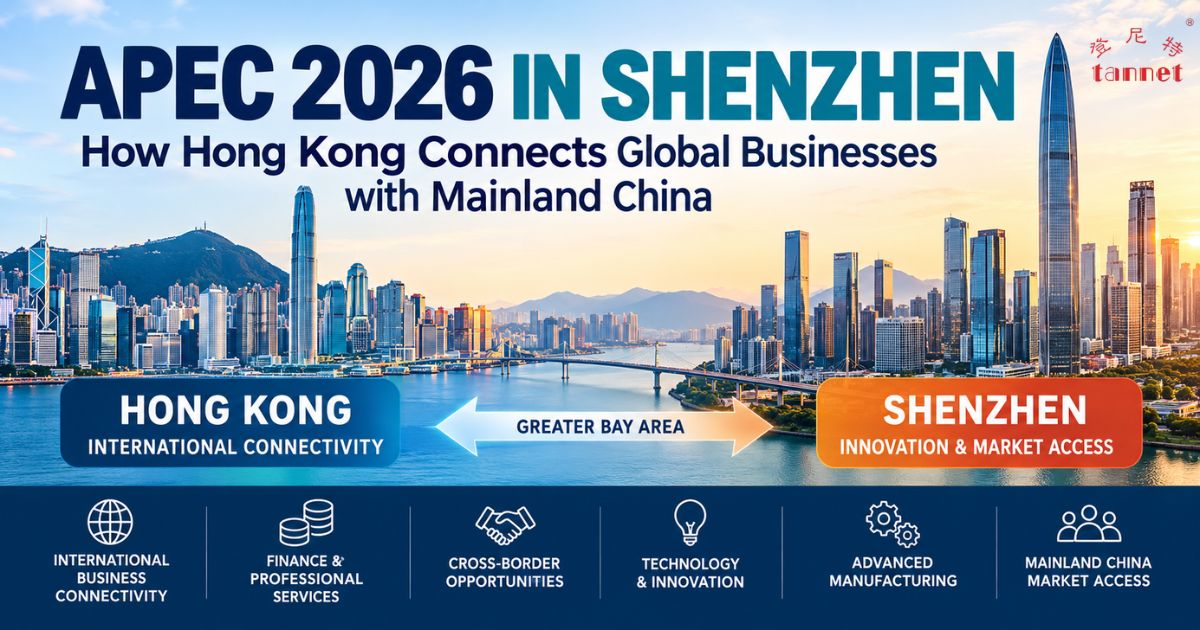
APEC 2026 Shenzhen is putting the Greater Bay Area firmly in the global business spotlight. For international companies looking at opportunities in China, however, Shenzhen is only one part of a much larger cross-border business ecosystem.
Just across the border, Hong Kong continues to play an important role in connecting international businesses, capital and professional services with Mainland China.
Rather than viewing Hong Kong and Shenzhen as competing business destinations, foreign investors can consider how the two markets complement each other: Hong Kong for international connectivity and Shenzhen for direct access to Mainland China’s innovation, supply chain and consumer markets.
APEC 2026 Brings Global Attention to Shenzhen
China will host the APEC Economic Leaders’ Meeting in Shenzhen on 18–19 November 2026.
As one of China’s leading technology and innovation centres, Shenzhen is home to major industries ranging from artificial intelligence and electronics to advanced manufacturing, new energy and digital technology.
Its location also matters.
Shenzhen forms part of the Guangdong-Hong Kong-Macao Greater Bay Area (GBA), an economic region connecting Hong Kong, Macao and nine cities in Guangdong Province.
For international businesses following APEC 2026, the opportunity therefore extends beyond Shenzhen itself.
The wider question is:
How can businesses use the Greater Bay Area as a platform for entering and expanding within China?
Hong Kong can be an important part of that strategy.
Why Hong Kong Matters for Mainland China Business
Hong Kong operates under its own legal, taxation and financial systems and remains a separate customs territory.
At the same time, its commercial relationship with Mainland China is extensive.
In 2025, Mainland China accounted for 51.4% of Hong Kong’s merchandise trade, with total merchandise trade between the two reaching approximately HK$5.62 trillion.
For international companies, Hong Kong can therefore serve as a bridge between overseas operations and the Mainland market.
Depending on the business model, companies may use Hong Kong for international contracting, regional management, financing or cross-border transactions while establishing a Mainland entity for domestic operations.
Hong Kong + Shenzhen: Two Roles, One Greater Bay Area Strategy
One of the most important considerations for foreign investors is understanding that Hong Kong and Shenzhen offer different advantages.
Hong Kong
Hong Kong can provide businesses with:
- International financial and banking connectivity
- A common-law legal environment
- International corporate and professional services
- Cross-border commercial capabilities
- Access to international investors and markets
- A platform for regional headquarters and holding structures
Shenzhen
Shenzhen offers direct access to:
- Mainland China’s domestic market
- Technology and innovation ecosystems
- Advanced manufacturing
- Electronics and hardware supply chains
- Chinese customers and business partners
- Mainland talent and operational resources
For some international companies, the most effective structure may therefore not be Hong Kong OR Shenzhen.
It may be Hong Kong AND Shenzhen.
How Can a Hong Kong + Mainland China Structure Work?
Consider an international technology, trading or professional-services company planning to enter China.
The business may establish a Hong Kong company to support international activities, while setting up a Mainland China company for operations that require a domestic legal entity.
The Mainland company could potentially handle activities such as:
- Employing local staff
- Signing domestic contracts
- Serving Mainland customers
- Issuing local invoices
- Renting offices or operational premises
- Applying for applicable business licences
Meanwhile, the Hong Kong company could support international business development, regional operations or other cross-border activities depending on the group’s commercial and tax structure.
The appropriate arrangement will depend on the company’s actual activities, customers, transaction flows and regulatory requirements.
CEPA Strengthens the Hong Kong-Mainland Connection
Another important element is the Mainland and Hong Kong Closer Economic Partnership Arrangement (CEPA).
CEPA provides preferential market-access arrangements for qualifying Hong Kong businesses across various service sectors in Mainland China.
Depending on the industry and applicable rules, eligible Hong Kong service suppliers may benefit from preferential arrangements involving areas such as market access, ownership or business scope.
However, there is an important distinction for investors:
Registering a Hong Kong company alone does not automatically provide CEPA benefits.
Businesses generally need to satisfy applicable qualification and substantive-operation requirements before accessing relevant preferential treatment.
Foreign investors considering Hong Kong as part of a China entry strategy should therefore evaluate CEPA eligibility based on their specific industry and operating model.
Greater Bay Area Integration Creates More Cross-Border Opportunities
The Hong Kong-Shenzhen relationship is part of a much larger regional strategy.
The Greater Bay Area connects:
Hong Kong | Macao | Shenzhen | Guangzhou | Zhuhai | Foshan | Huizhou | Dongguan | Zhongshan | Jiangmen | Zhaoqing
This creates a business environment where companies can potentially combine different strengths across multiple cities.
For example, a company might use:
Hong Kong for international connectivity,
Shenzhen for technology and innovation,
Dongguan for manufacturing and supply chains,
and Guangzhou for commercial operations and access to the wider South China market.
The opportunity is therefore not simply about choosing where to register a company.
It is about designing a cross-border business structure around the company’s actual operations.
Hong Kong Also Connects Mainland Businesses with the World
Hong Kong’s gateway role works in both directions.
While international companies use Hong Kong when exploring opportunities in Mainland China, Chinese companies also use Hong Kong as a platform for international expansion, financing and regional operations.
This two-way connectivity makes Hong Kong particularly relevant to businesses operating between China, ASEAN and international markets.
For companies building a broader Asia strategy, Hong Kong can therefore serve as one component of a multi-jurisdiction structure rather than a standalone destination.
What Should Foreign Investors Consider Before Entering China?
Before deciding between Hong Kong, Shenzhen or a combined structure, businesses should examine several practical questions:
Where are your customers?
International customers and Mainland Chinese customers may require different structures.
Where will your employees work?
Hiring employees in Mainland China generally requires an appropriate local operating structure.
Where will contracts be signed and revenue generated?
Transaction flows should reflect genuine commercial activities.
Does your industry require Mainland licences or approvals?
Market-access requirements differ significantly by sector.
Could your Hong Kong operations qualify for CEPA treatment?
Eligibility should be assessed before relying on CEPA advantages.
There is no single structure that works for every foreign investor.
Beyond APEC 2026: Building a Long-Term China Strategy
APEC 2026 will bring international attention to Shenzhen, but the longer-term opportunity is much broader.
Shenzhen’s position within the Greater Bay Area places it next to one of Asia’s leading international business and financial centres.
For global companies exploring Mainland China, this creates an important strategic combination:
Hong Kong connects businesses internationally.
Shenzhen connects businesses directly with Mainland China’s innovation and commercial ecosystem.
Used together, they can form part of a broader Greater Bay Area market-entry strategy.
For foreign investors, the question is no longer simply:
“Should we establish in Hong Kong or Mainland China?”
A better question may be:
“What role should each jurisdiction play in our China and Asia expansion strategy?”
Tannet Group supports international businesses with Hong Kong company registration, corporate secretarial services, Mainland China company establishment and cross-border business structuring.
Contact us to discuss the appropriate Hong Kong and Mainland China structure for your expansion plans.
📞 Free 1-on-1 Consultation Now,
Official Service Hotline: +86-755-82148419
Cell: +86-13823131503;+60 19-309 2363
WeChat ID: 13823131503;
WhatsApp:+86-13823131503;+60 19-309 2363
Email: mytannet08@gmail.com; susiehu@citilinkia.com