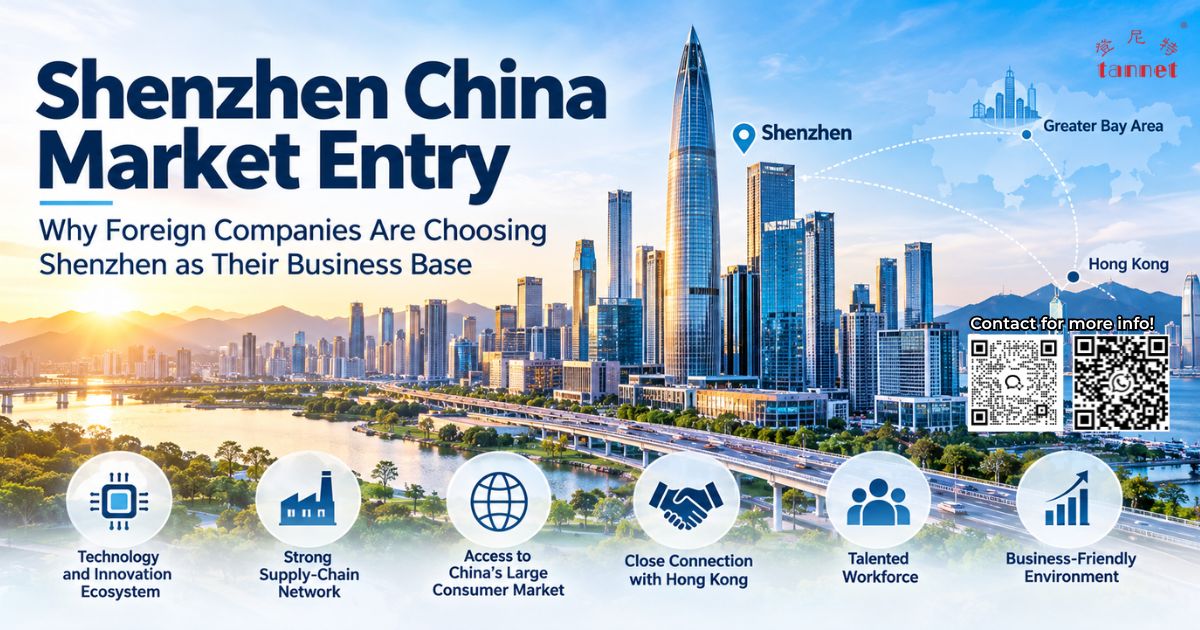
For international companies planning to expand into China, choosing the right entry point can significantly affect how efficiently they reach customers, suppliers, talent and the wider Chinese market.
Beijing and Shanghai remain major commercial centres, but Shenzhen has become an important China market entry location for technology, cross-border trade, e-commerce, advanced manufacturing and innovation-driven businesses.
Its position within the Guangdong-Hong Kong-Macao Greater Bay Area (GBA), proximity to Hong Kong and highly developed supply-chain ecosystem make Shenzhen particularly relevant for foreign companies looking for a practical base in southern China.
So, when does establishing a business presence in Shenzhen make sense?
Why Shenzhen Matters for China Market Entry
Shenzhen’s transformation from a small border city into one of China’s major economic centres has been driven by technology, manufacturing, entrepreneurship and international trade.
Today, the city is particularly associated with industries such as:
- Technology and software
- Electronics and hardware
- Artificial intelligence
- Robotics and automation
- Cross-border e-commerce
- New energy and electric vehicles
- Biotechnology
- Supply-chain and logistics services
- Professional and business services
For a foreign company, however, Shenzhen’s attraction is not simply the size of its economy.
Its real strategic value comes from connectivity.
A company operating from Shenzhen can access the manufacturing and supplier networks of the Pearl River Delta while remaining directly connected with Hong Kong and other Greater Bay Area cities.
Shenzhen + Hong Kong: A Powerful Cross-Border Combination
One of Shenzhen’s biggest advantages is its relationship with Hong Kong.
Rather than treating Hong Kong and Shenzhen as competing locations, international companies can consider how the two cities may perform different functions within the same regional structure.
For example, a business might use:
Hong Kong for international transactions, regional coordination, overseas commercial relationships or holding functions.
Shenzhen for mainland China operations, local employees, customer development, supplier management and domestic commercial activities.
The appropriate structure depends on the company’s actual operations, tax position, customers, transaction flows and regulatory requirements.
For companies entering China from overseas, this Hong Kong + Shenzhen model can therefore be worth evaluating before deciding where different business functions should sit.
Shenzhen vs Guangzhou: Which Location Fits Your Business?
Shenzhen is not automatically the right choice for every company entering South China.
Guangzhou is another major commercial centre within the Greater Bay Area and can be particularly relevant for traditional trading, consumer goods, wholesale, professional services and businesses connected with the wider Guangdong market.
Shenzhen, meanwhile, is especially attractive to businesses linked to technology, electronics, innovation, cross-border e-commerce and advanced manufacturing.
The decision should therefore be based on operational requirements rather than simply choosing the most recognisable city.
Consider:
Where are your customers?
A company targeting technology businesses may have different location requirements from one selling consumer products.
Where are your suppliers?
Proximity to manufacturing clusters can reduce communication and supply-chain friction.
Where will employees be located?
Talent requirements can influence the most appropriate city and district.
Will you conduct business directly in Mainland China?
If so, a mainland entity may eventually become necessary.
Do You Actually Need to Register a Shenzhen Company?
Not every company exploring the Chinese market needs to establish a mainland entity immediately.
Some foreign businesses initially enter China through distributors, suppliers, local partners or cross-border arrangements.
However, as operations become more substantial, establishing a local company may become relevant.
Typical reasons include:
- Hiring employees locally
- Signing domestic contracts
- Issuing Chinese invoices
- Receiving local RMB payments
- Leasing offices or operational premises
- Building a long-term local sales team
- Managing suppliers directly
- Applying for industry-specific licences or permits
- Developing a stronger permanent presence in China
The key question should therefore not simply be “Can we register a company in Shenzhen?”
It should be:
“What business activities do we intend to conduct in China, and what structure supports those activities?”
What Company Structure Can Foreign Investors Use?
For many international businesses establishing an independent mainland presence, a foreign-invested limited liability company may be considered.
Foreign ownership is permitted across many industries, but investment restrictions and licensing requirements still apply to certain sectors.
Before incorporation, investors should therefore confirm several important matters:
1. Business Scope
The company’s proposed activities need to be properly defined.
A technology consultancy, trading company, software developer and manufacturing business will have different operational and regulatory considerations.
2. Shareholding Structure
The investor may be an overseas individual or corporate entity, subject to the applicable requirements and industry.
The ownership structure should be planned carefully, particularly where the Shenzhen entity will form part of a larger international group.
3. Registered Address
A compliant registered address is generally required.
The appropriate solution can depend on the district, business activity and actual operational requirements.
4. Registered Capital
China operates a subscribed registered-capital system, but registered capital should not be treated as an arbitrary number.
Under the amended Company Law, shareholders of newly established limited liability companies are generally required to complete their subscribed capital contributions within five years from establishment, subject to applicable rules and exceptions.
Capital planning should therefore reflect the company’s expected operating requirements.
Where in Shenzhen Should You Set Up?
Shenzhen itself contains several major commercial districts and specialised development areas.
For example:
Qianhai is frequently considered by businesses interested in modern services, finance-related activities, technology, cross-border cooperation and links with Hong Kong.
Nanshan is strongly associated with technology, software and innovation companies.
Futian is a major financial and commercial district suitable for headquarters and professional-service functions.
Other districts may be more appropriate for logistics, manufacturing or cost-sensitive operations.
The best location therefore depends on what the company will actually do after registration.
Registration Is Only the Beginning
One of the biggest mistakes foreign investors can make is treating company incorporation as the final objective.
Receiving a business licence is only one part of establishing a functioning business.
Depending on the company’s circumstances, subsequent steps may include:
- Company seal arrangements
- Tax registration and reporting
- Corporate bank-account opening
- Foreign-exchange arrangements
- Accounting and bookkeeping
- Invoice-related arrangements
- Employee hiring and payroll
- Social insurance administration
- Work permits for foreign employees
- Customs registration for import/export activities
- Industry-specific licences or approvals
Companies planning their Shenzhen China market entry should therefore budget for both incorporation and ongoing compliance.
A Practical Shenzhen Market-Entry Roadmap
Foreign investors can approach Shenzhen expansion in several stages.
Stage 1 – Market validation
Confirm the target customer base, suppliers, business model and regulatory feasibility before committing to a structure.
Stage 2 – Location and structure planning
Determine whether Shenzhen is the most appropriate mainland base and whether Hong Kong or another Greater Bay Area city should also play a role.
Stage 3 – Company establishment
Confirm the shareholder structure, business scope, registered capital, registered address and management arrangements before incorporation.
Stage 4 – Operational setup
Complete banking, tax, accounting, employment and other required post-registration procedures.
Stage 5 – China expansion
Once the Shenzhen operation is established, the company can evaluate expansion into other Chinese cities based on customers, supply chains and commercial demand.
Shenzhen as a Gateway to More Than One Market
The strongest reason to consider Shenzhen is not simply the opportunity to establish a company there.
It is the city’s position within a much larger commercial ecosystem.
Shenzhen provides access to Mainland China’s enormous domestic market, the manufacturing capabilities of the Pearl River Delta, Hong Kong’s international connectivity and the wider Greater Bay Area.
For companies involved in technology, trade, manufacturing, e-commerce or professional services, this combination can make Shenzhen a practical starting point for a broader China strategy.
The right approach, however, depends on what happens after incorporation.
Before setting up, foreign investors should evaluate their intended activities, customers, transaction flows, staffing requirements, licences and long-term expansion plans.
A well-designed China market-entry structure should support the business—not simply create another company that needs to be maintained.
Planning Your China Market Entry?
Tannet supports international companies with business establishment and cross-border corporate services in Shenzhen, Guangzhou, Hong Kong and other major Chinese business centres.
From initial structure and location planning to company registration and ongoing corporate support, businesses can develop their China presence according to their actual operational requirements.
If your company is considering Shenzhen as its next business base, the first step is to determine what you want the China entity to accomplish—and build the structure around that objective.