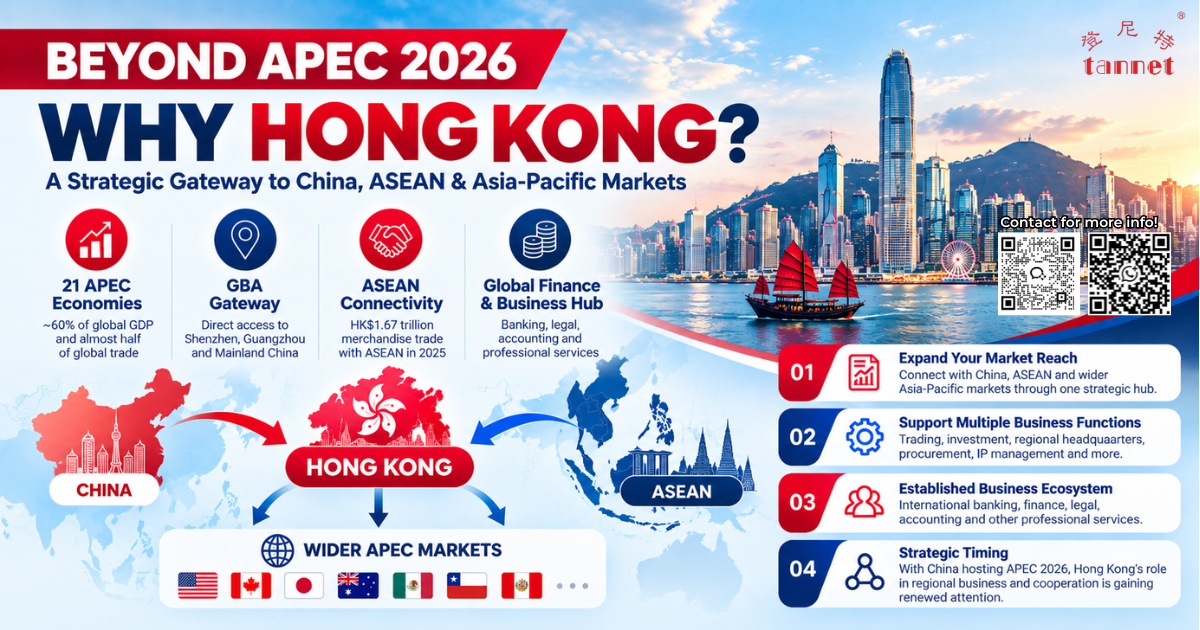
One company in Hong Kong. Business opportunities across Mainland China, ASEAN and the wider Asia-Pacific.
As Shenzhen prepares to host the APEC Economic Leaders’ Meeting in 2026, attention is turning to the wider Greater Bay Area and its role in Asia-Pacific business. Just across the boundary, Hong Kong offers international companies a strategic platform connecting Mainland China, ASEAN and wider Asia-Pacific markets.
But Hong Kong’s value goes far beyond its proximity to APEC 2026. With its international financial system, established professional-services ecosystem, strong ASEAN trade links and direct connection to the Greater Bay Area, Hong Kong can serve as a practical regional hub for companies planning cross-border expansion.
So, as APEC 2026 puts Shenzhen and the Greater Bay Area in the global spotlight, what role could Hong Kong play in your Asia-Pacific business strategy?
Where should you establish your regional business hub?
Hong Kong deserves serious consideration.
Hong Kong, China is one of APEC’s 21 member economies. More importantly for businesses, Hong Kong sits at the intersection of three major commercial networks: Mainland China, ASEAN and the international market.
That combination makes Hong Kong potentially valuable not simply as a place to incorporate a company, but as a platform for coordinating cross-border trade, investment and regional operations as a Hong Kong business hub.
1. Hong Kong Sits at the Centre of an Enormous Asia-Pacific Market
APEC brings together 21 economies across the Asia-Pacific, including Mainland China, Hong Kong, the United States, Japan, Australia, Canada, Singapore, Malaysia, Indonesia, Thailand, Viet Nam and Mexico.
Together, these economies account for around 60% of global GDP and almost half of global trade.
For businesses, this highlights the sheer economic importance of the Asia-Pacific.
But there is an important distinction.
APEC is not a single free-trade area.
Registering a Hong Kong company does not automatically give a business preferential access to all 21 APEC economies.
The strategic opportunity lies elsewhere: using Hong Kong’s international business infrastructure and regional connectivity to support operations across multiple markets.
2. Hong Kong + Shenzhen + Guangzhou: A Powerful GBA Combination
Hong Kong’s position becomes particularly interesting when combined with the Guangdong-Hong Kong-Macao Greater Bay Area (GBA).
Rather than viewing Hong Kong, Shenzhen and Guangzhou as three separate business locations, international companies can consider how their different strengths complement one another.
Hong Kong: international finance, professional services and cross-border business.
Shenzhen: technology, innovation and advanced manufacturing.
Guangzhou: commerce, manufacturing, logistics and access to the wider Guangdong market.
For foreign investors entering China, Hong Kong can therefore form part of a wider Greater Bay Area strategy.
For Mainland Chinese businesses, the same network can work in reverse — connecting domestic operations with international customers, investors and markets.
3. Hong Kong Can Be a Bridge Between China and ASEAN
One of Hong Kong’s most important regional advantages is its connection with Southeast Asia.
Malaysia, Singapore, Indonesia, Thailand, Viet Nam, the Philippines and Brunei participate in both ASEAN and APEC.
Hong Kong also has a Free Trade Agreement and Investment Agreement with ASEAN.
The commercial relationship is significant: ASEAN was Hong Kong’s second-largest merchandise trading partner in 2025, with total merchandise trade of approximately HK$1.67 trillion.
This creates two interesting expansion pathways:
Mainland China → Hong Kong → ASEAN
and
International Markets → Hong Kong → China + ASEAN
For Chinese companies pursuing overseas expansion, Hong Kong can therefore be considered as one component of an international corporate structure rather than simply another place to register a company.
4. More Than Company Registration: Build a Regional Platform
A common mistake is to think about Hong Kong only in terms of incorporation.
The better question is:
What will your Hong Kong company actually do?
Depending on the business model, a Hong Kong entity may potentially support:
- international trading;
- regional contracting;
- cross-border investment;
- sourcing and procurement;
- regional business development;
- intellectual property management;
- treasury and financing functions; or
- regional headquarters activities.
This distinction matters.
A company incorporated without a clear commercial purpose is very different from a Hong Kong entity designed around actual customers, suppliers, investments and regional operations.
5. International Finance Meets Cross-Border Business
Expanding across several countries creates practical challenges.
Companies need to consider banking, currencies, contracts, financing, accounting, taxation, legal compliance and movement of funds between different jurisdictions.
Hong Kong has built a mature ecosystem around these requirements.
Its international financial sector is supported by established banking, legal, accounting, insurance and other professional-service industries.
For a business dealing with customers, suppliers or subsidiaries across several Asia-Pacific economies, this infrastructure can be one reason to consider Hong Kong as a regional coordination point.
6. A Competitive Tax Environment — But Structure Matters
Hong Kong’s tax environment also attracts international businesses.
Under its two-tiered profits tax regime, qualifying corporations are generally taxed at:
8.25% on the first HK$2 million of assessable profits; and
16.5% on assessable profits above HK$2 million.
Hong Kong also does not impose a general VAT or sales tax.
But businesses should avoid a common misconception:
Hong Kong incorporation does not automatically mean low or zero tax.
Tax treatment depends on the company’s actual activities and circumstances. Cross-border businesses may also need to consider territorial taxation, foreign-sourced income rules, transfer pricing, tax residency and reporting obligations.
The corporate structure should therefore follow the commercial reality of the business.
7. Trade, Logistics and the Greater Bay Area Supply Chain
Hong Kong’s geographical position also matters for companies involved in physical trade.
Immediately across the boundary is Shenzhen, while the wider Pearl River Delta contains one of the world’s most developed manufacturing and supply-chain ecosystems.
This makes the Hong Kong–GBA combination particularly relevant for industries such as:
technology · electronics · consumer goods · e-commerce · sourcing · manufacturing · import/export · logistics
A company may, for example, maintain manufacturing or sourcing operations in Mainland China while using Hong Kong for selected international commercial functions.
The appropriate setup will depend on where contracts are signed, goods move, employees work and revenue is generated.
8. Why APEC 2026 Makes the Timing Relevant
China’s hosting of APEC 2026 puts renewed attention on Asia-Pacific economic cooperation.
Hong Kong is also scheduled to host the APEC Finance Ministers’ Meeting in October 2026.
For businesses, the opportunity is not simply the events themselves.
The bigger theme is the continuing importance of regional connectivity.
Companies increasingly need to think beyond a single-market strategy and ask how different locations can work together.
For example:
Hong Kong — international commercial and financial platform
Shenzhen / Guangzhou — Mainland China operations and supply chains
Malaysia / Singapore / ASEAN — Southeast Asian expansion
Wider APEC economies — additional international markets
This is where Hong Kong’s strategic position becomes particularly relevant.
Who Should Consider a Hong Kong Regional Hub?
Hong Kong may be worth evaluating if your company is:
A Mainland Chinese company going global and exploring ASEAN or other international markets.
A foreign company entering China and considering Hong Kong alongside Shenzhen or Guangzhou.
A cross-border trading business dealing with customers and suppliers in several jurisdictions.
A technology or professional-services company looking for an internationally connected Asian base.
An international investor considering a wider regional corporate or investment structure.
Don’t Just Register a Hong Kong Company — Build an Asia-Pacific Strategy
The question for 2026 is not simply:
“Should we establish a Hong Kong company?”
It should be:
“How can Hong Kong connect our business with China, ASEAN and the wider Asia-Pacific?”
Hong Kong’s real value lies in this connectivity.
As APEC 2026 brings renewed attention to Asia-Pacific economic cooperation, companies planning their next stage of international expansion have an opportunity to look beyond individual markets and build a more integrated regional strategy.
Hong Kong can be the starting point — but the strategy should extend far beyond Hong Kong.
📞 Free 1-on-1 Consultation Now,
Official Service Hotline: +86-755-82148419
Cell: +86-13823131503;+60 19-309 2363
WeChat ID: 13823131503;
WhatsApp:+86-13823131503;+60 19-309 2363
Email: mytannet08@gmail.com; susiehu@citilinkia.com