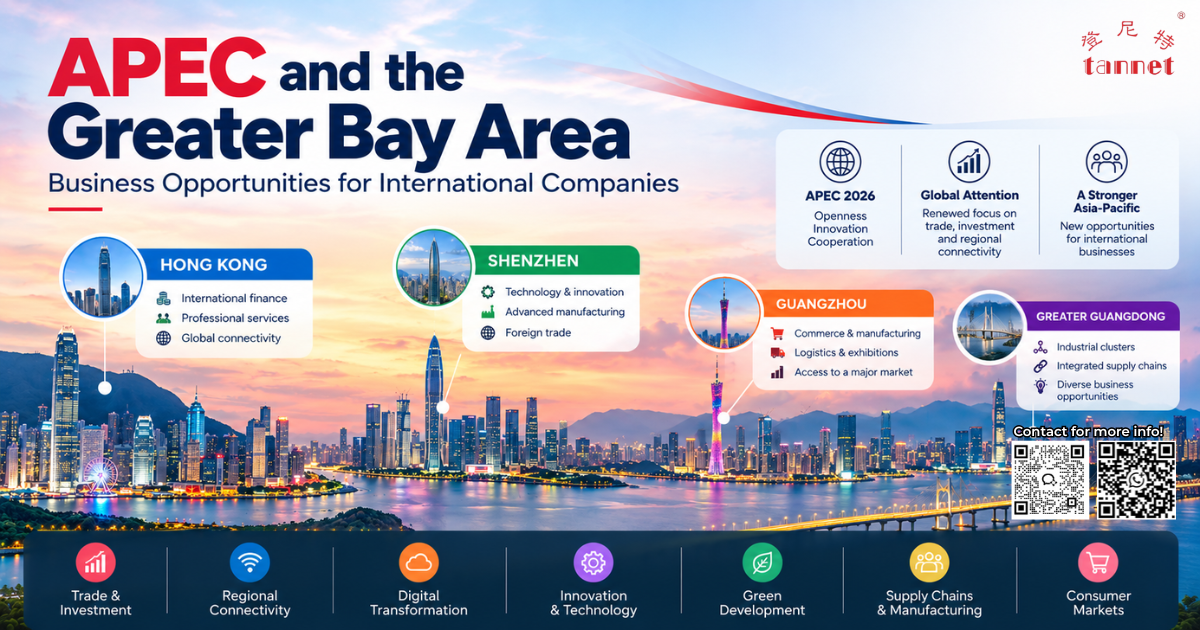
As China hosts APEC in 2026, international attention is increasingly focused on one of Asia’s most dynamic economic regions: the Guangdong-Hong Kong-Macao Greater Bay Area (GBA).
This connection is particularly significant because Shenzhen will host the APEC Economic Leaders’ Meeting in November 2026, while Guangzhou hosted the first APEC Senior Officials’ Meeting earlier in the year. Hong Kong is also part of the 2026 APEC calendar.
For international companies, however, the opportunity extends well beyond the meetings themselves.
APEC 2026 is bringing renewed attention to regional connectivity, digital transformation, innovation, trade and investment — areas that closely align with the GBA’s development.
For businesses looking to enter China, establish an Asian headquarters, build supply chains or expand across the Asia-Pacific, the Greater Bay Area deserves serious consideration.
Discover APEC 2026 Greater Bay Area business opportunities in Hong Kong, Shenzhen and Guangzhou for international companies expanding into China.
What Is the Greater Bay Area?
The Guangdong-Hong Kong-Macao Greater Bay Area connects Hong Kong, Macao and nine cities in Guangdong Province:
- Guangzhou
- Shenzhen
- Zhuhai
- Foshan
- Huizhou
- Dongguan
- Zhongshan
- Jiangmen
- Zhaoqing
Rather than viewing these cities as interchangeable locations, international investors should understand the GBA as an interconnected business ecosystem.
Different cities offer different advantages.
Hong Kong provides international financial, professional and commercial services and strong connectivity with global markets.
Shenzhen has developed into a major technology, innovation, advanced manufacturing and foreign-trade centre.
Guangzhou combines a large consumer market with established strengths in commerce, manufacturing, professional services and transportation.
Other GBA cities contribute specialised manufacturing capabilities, industrial supply chains and supporting infrastructure.
The opportunity is therefore not simply about choosing one city. Companies can potentially build a cross-city strategy based on their operational requirements.
Why APEC 2026 Matters to the GBA
China has identified openness, innovation and cooperation as the three priorities for APEC 2026.
The agenda includes areas such as trade and investment, regional connectivity, digital transformation, services, customs modernisation and innovation.
These priorities have clear relevance to companies evaluating the Greater Bay Area.
APEC itself does not create a special company-registration route or automatic market-access privilege for foreign investors. Instead, its significance is broader: APEC 2026 is placing greater international attention on economic integration and the business infrastructure connecting China with the wider Asia-Pacific.
For investors, this creates a useful moment to reassess how the GBA could fit into a long-term Asia strategy.
Opportunity 1: Use Hong Kong as an International Business Gateway
Hong Kong can play a distinctive role within a broader GBA structure.
Its international financial system, professional-services ecosystem and connections with both Mainland China and overseas markets make it relevant for companies involved in cross-border investment, financing, trading and regional management.
An international business, for example, may consider using Hong Kong for certain regional or international functions while establishing separate Mainland operations where local execution is required.
The appropriate structure depends on business activities, customers, tax considerations, licensing requirements and where substantive operations actually take place.
The key point is that Hong Kong and Mainland GBA cities can perform complementary rather than competing roles.
Opportunity 2: Access Shenzhen’s Innovation Ecosystem
Shenzhen will be particularly visible internationally as the host city of the 2026 APEC Economic Leaders’ Meeting.
But its commercial relevance goes much deeper.
Shenzhen has developed into a major centre for technology, advanced manufacturing, digital industries and international trade.
For companies involved in areas such as artificial intelligence, electronics, smart hardware, digital services, clean technology or advanced manufacturing, establishing relationships in Shenzhen can provide access to a dense ecosystem of suppliers, technology companies, talent and potential commercial partners.
APEC’s 2026 emphasis on innovation makes this especially timely.
International companies should nevertheless distinguish between exploring the ecosystem and actually operating in the Mainland market. Establishing a Chinese company, employing personnel, signing local contracts, importing or exporting goods and conducting regulated activities may involve separate corporate, tax, customs and licensing requirements.
Opportunity 3: Explore Guangzhou for Commerce and Market Expansion
Guangzhou should not be overlooked.
The city hosted APEC’s first Senior Officials’ Meeting and related meetings in February 2026, placing it directly within this year’s APEC agenda.
For businesses, Guangzhou combines a substantial domestic market with manufacturing, wholesale trade, logistics, exhibitions and professional services.
It can therefore be particularly relevant to international companies seeking customers, distributors, suppliers or a physical presence in South China.
Depending on the industry, companies may also consider Guangzhou alongside Shenzhen rather than treating them as alternatives.
One city may be better suited to technology and product development, while another supports sales, sourcing, distribution or broader commercial operations.
Opportunity 4: Build More Flexible Supply Chains
The GBA is also strategically relevant to companies rethinking Asia-Pacific supply chains.
A company does not necessarily need to place every business function in a single jurisdiction.
For example, a regional structure might involve international commercial functions in Hong Kong, technology or product development in Shenzhen, commercial operations in Guangzhou and manufacturing relationships elsewhere in Guangdong.
This type of structure can provide access to different capabilities across the region.
However, cross-border operations require careful planning. Companies need to consider customs, transfer pricing, taxation, banking, foreign exchange, contracts, intellectual property, employment and regulatory compliance.
A multi-city strategy only creates value when the legal and operational structure supports the commercial model.
Opportunity 5: Tap into Digital and Innovation-Driven Growth
Digitalisation is another important connection between APEC 2026 and the GBA.
APEC discussions in 2026 have included digital transformation, digital services, AI and innovation as important areas of regional cooperation.
For international technology companies, this makes the GBA particularly relevant.
Opportunities may exist across:
- Artificial intelligence
- Digital services
- E-commerce
- Fintech
- Smart manufacturing
- Robotics
- Green technology
- Advanced electronics
- Cross-border professional services
The strongest opportunities will depend on the company’s technology, target customers, regulatory requirements and market-entry model.
From APEC Visibility to a Long-Term GBA Strategy
APEC 2026 is creating a period of heightened international attention around China and the Greater Bay Area.
International companies should use that attention strategically.
Rather than asking only, “How can our company participate in APEC-related opportunities?”, a more useful question may be:
“How can the Greater Bay Area support our long-term Asia-Pacific strategy?”
For some companies, the answer may involve establishing a Hong Kong company.
For others, it may involve a Mainland Chinese entity in Shenzhen or Guangzhou.
Businesses with more complex operations may eventually use multiple locations for different functions.
The right structure depends on the company’s industry, customers, supply chain, staffing requirements, tax position and long-term objectives.
Preparing for the Greater Bay Area Opportunity
Before entering the GBA, international companies should assess several practical issues:
Market entry: Which jurisdiction and entity structure best match the planned activities?
Business scope: Will the company trade, manufacture, provide services, develop technology or hold investments?
Location: Should operations be based in Hong Kong, Shenzhen, Guangzhou or another GBA city?
Banking and capital: What banking, foreign exchange and capital requirements apply?
Tax and compliance: How will the proposed cross-border structure affect corporate tax, customs and ongoing compliance?
Licensing: Does the industry require additional approvals?
Intellectual property: How should trademarks, patents, software or other IP be protected across relevant jurisdictions?
Looking Beyond APEC 2026
APEC 2026 is putting Shenzhen, Guangzhou, Hong Kong and the wider Greater Bay Area in the international spotlight.
But the real opportunity is not limited to one summit or one year.
The GBA brings together international finance and professional services, technology and innovation, manufacturing capabilities, major consumer markets and extensive regional connectivity.
For international companies planning their next stage of Asia-Pacific expansion, understanding how these different advantages can work together may be far more valuable than approaching each city independently.
APEC may bring the world’s attention to the Greater Bay Area in 2026. The business opportunity is what companies choose to build there afterwards.
📞 Free 1-on-1 Consultation Now,
Official Service Hotline: +86-755-82148419
Cell: +86-13823131503;+60 19-309 2363
WeChat ID: 13823131503;
WhatsApp:+86-13823131503;+60 19-309 2363
Email: mytannet08@gmail.com; susiehu@citilinkia.com