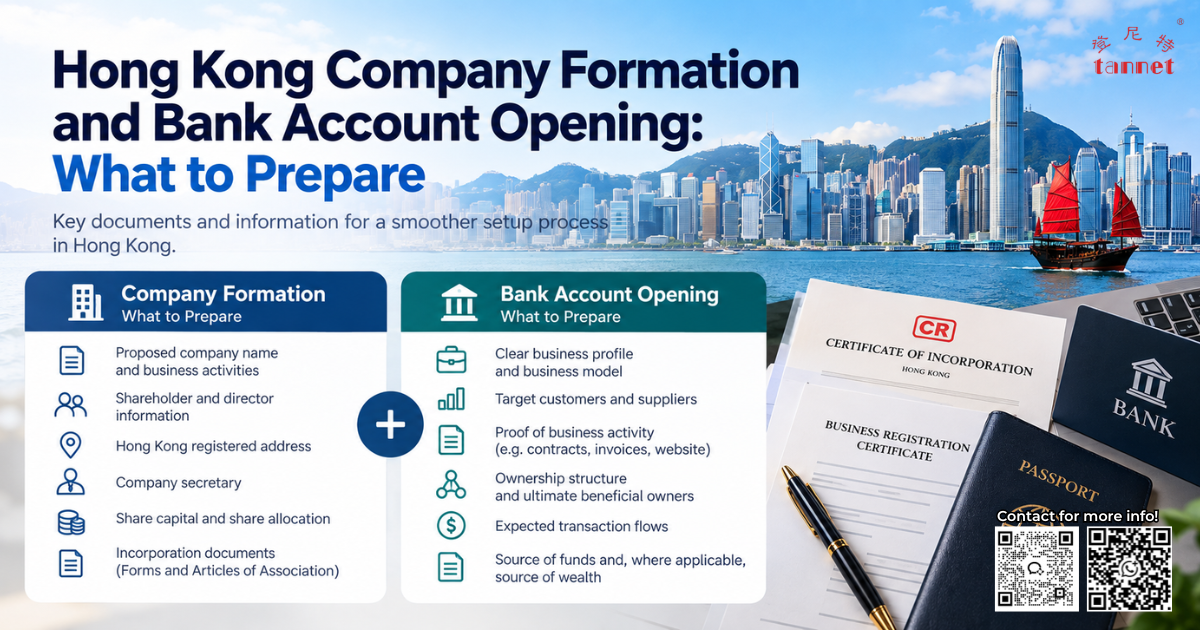
Hong Kong company formation and bank account opening are two important steps for foreign entrepreneurs and international companies looking to establish a business presence in Hong Kong. While company incorporation can be relatively straightforward, corporate banking involves a separate KYC and compliance assessment.
Hong Kong’s established legal system, international business environment and connectivity with Mainland China and other Asian markets make it a practical option for cross-border businesses.
However, there is one important point that foreign investors should understand before getting started:
Hong Kong company formation and corporate bank account opening are two separate processes.
Successfully registering a company does not automatically mean that a bank account will be approved. Banks conduct their own Know Your Customer (KYC), due diligence and compliance assessments.
Preparing for both processes from the beginning can therefore make your Hong Kong business setup much smoother.
1. Proposed Company Name and Business Activities
The first step is deciding on your proposed company name and clearly defining what the company will do.
Your business activities could include areas such as:
- International trading
- Consulting
- Technology services
- E-commerce
- Professional services
- Investment-related activities
Your business description should accurately reflect the company’s intended operations.
This becomes particularly important during bank account opening, when the bank may ask for more details about how the business operates, where its customers are located and how money will flow through the account.
2. Shareholder and Director Information
A Hong Kong private company limited by shares must have at least one shareholder and at least one director.
At least one director must be a natural person.
Foreign individuals can generally act as shareholders and directors, meaning that establishing a Hong Kong company does not necessarily require a local Hong Kong shareholder or director.
You should prepare relevant identification and personal information for the parties involved, which may include:
- Passport or identification document
- Residential address
- Contact details
- Nationality
- Shareholding percentage
If the shareholder is another company, additional corporate and ownership documents may be required.
3. Hong Kong Registered Office Address
Every locally incorporated Hong Kong company must maintain a registered office in Hong Kong.
The registered office is used for official correspondence and statutory communications.
Foreign entrepreneurs who do not maintain their own physical office in Hong Kong can consider arranging an eligible registered office service as part of their company formation package.
The registered office requirement should not be confused with banking requirements. A bank may separately ask questions about where the company’s actual business operations are conducted.
4. Company Secretary
A Hong Kong company must appoint a company secretary.
If the company secretary is an individual, the person must ordinarily reside in Hong Kong. If a corporate entity is appointed, it must have its registered office or place of business in Hong Kong.
The company secretary supports the company in maintaining its statutory records and handling ongoing corporate compliance matters.
For overseas investors, arranging the company secretary is therefore an important part of the incorporation process.
5. Share Capital and Ownership Structure
You should determine the company’s share capital and how shares will be allocated among the shareholders.
For a straightforward company with one shareholder, the structure may be relatively simple.
For companies involving several investors, overseas parent companies or corporate shareholders, it is particularly important to establish a clear ownership structure.
This also matters for banking.
Banks may need to identify the individuals who ultimately own or control the Hong Kong company. If several companies are involved in the ownership chain, you may be asked to provide an ownership chart and supporting corporate documents.
6. Incorporation Documents
The incorporation process requires the relevant company information and statutory documents to be submitted to the Hong Kong Companies Registry.
For a company limited by shares, key incorporation documents include the incorporation form and Articles of Association.
Business registration is also handled as part of the company setup process.
Once the incorporation requirements are completed and the application is approved, the company can receive its incorporation and business registration documents.
However, this is where another stage begins if the business requires a corporate bank account.
7. Prepare a Clear Business Profile for Banking
When opening a corporate bank account, the bank will want to understand the commercial purpose of the company.
You should be able to clearly explain:
- What products or services you provide
- Who your target customers are
- Who your main suppliers are
- Which countries or regions you operate in
- How customers will pay the company
- What types of outgoing payments are expected
- The expected scale of transactions
Your explanation should be consistent with the company’s actual business model and supporting documentation.
A vague description such as “international business” may not provide enough information for a bank to understand the nature of the company’s operations.
8. Prepare Proof of Business Activity
Depending on the bank and circumstances, supporting evidence may be requested to demonstrate genuine or expected commercial activity.
Examples can include:
- Customer contracts
- Supplier agreements
- Purchase orders
- Invoices
- Quotations
- Business plans
- Company website
- Business correspondence
- Existing company records
For a newly established Hong Kong company, it is understandable that the company may not yet have an extensive transaction history.
In this situation, documents demonstrating the founders’ existing business activities, commercial relationships or planned operations may help explain the business model.
The exact documents required will depend on the bank and applicant profile.
9. Understand Your UBO Structure
Banks and regulated service providers need to understand who ultimately owns and controls the company.
This is commonly referred to as identifying the Ultimate Beneficial Owner (UBO).
For a simple company owned directly by one individual, this may be straightforward.
A more complex structure could look like:
Individual UBO → Overseas Holding Company → Hong Kong Company
Where corporate shareholders or multiple holding companies are involved, additional documentation may be required to establish the complete ownership chain.
Foreign investors should therefore prepare a clear and transparent ownership structure before beginning the banking process.
10. Expected Transaction Flows
Another important banking consideration is how money is expected to move through the corporate account.
The bank may ask about:
- Expected monthly turnover
- Typical transaction amounts
- Main incoming payment countries
- Main outgoing payment countries
- Transaction currencies
- Major customers
- Major suppliers
- Purpose of incoming and outgoing payments
For example, an international trading company may receive payments from overseas customers and make payments to suppliers in other jurisdictions.
The transaction pattern should make commercial sense based on the company’s stated business activities.
11. Source of Funds and Source of Wealth
Banks may also conduct checks on the source of funds used to establish or operate the business.
Depending on the circumstances, funds may originate from:
- Existing business income
- Shareholder capital
- Employment income
- Investment proceeds
- An overseas parent company
- Other legitimate sources
For some applications, the bank may also request information relating to the source of wealth of shareholders or beneficial owners.
Supporting documents can therefore be important.
12. Company Formation Does Not Guarantee Bank Approval
This is one of the most important points for anyone planning a Hong Kong business setup.
Receiving a Hong Kong Certificate of Incorporation does not automatically guarantee that a corporate bank account will be opened.
The Companies Registry is responsible for company incorporation, while banks conduct their own onboarding, KYC, compliance and risk assessments.
Banking requirements may differ depending on factors such as:
- Business activities
- Ownership structure
- Nationalities and jurisdictions involved
- Target markets
- Expected transaction patterns
- Source of funds
- Supporting commercial documentation
There is therefore no universal document checklist that can guarantee approval.
Plan Company Formation and Banking Together
Foreign investors often focus first on incorporating the company and only begin thinking about banking afterwards.
A more effective approach is to plan both simultaneously.
Before incorporation, consider:
Company Structure → Business Activities → Ownership → Incorporation → Banking Preparation → Ongoing Compliance
This can help identify potential documentation or structural issues earlier and ensure that the company setup reflects how the business will actually operate.
Final Thoughts
Hong Kong can provide an effective corporate platform for entrepreneurs and international companies conducting business across Asia and other global markets.
But successful setup involves more than registering a company.
Foreign investors should prepare their corporate structure, ownership information, business model, commercial documents, expected transaction flows and source of funds before beginning the banking process.
Most importantly, remember that Hong Kong company formation and bank account opening are separate procedures with different approval requirements.
Preparing for both from the beginning can help create a more efficient and compliant Hong Kong business setup.