Hong Kong Identity Applications: Main Applicants vs. Dependants
For families planning to move to Hong Kong, one of the first questions is who should apply as the main applicant and who can join as a dependant. This decision…

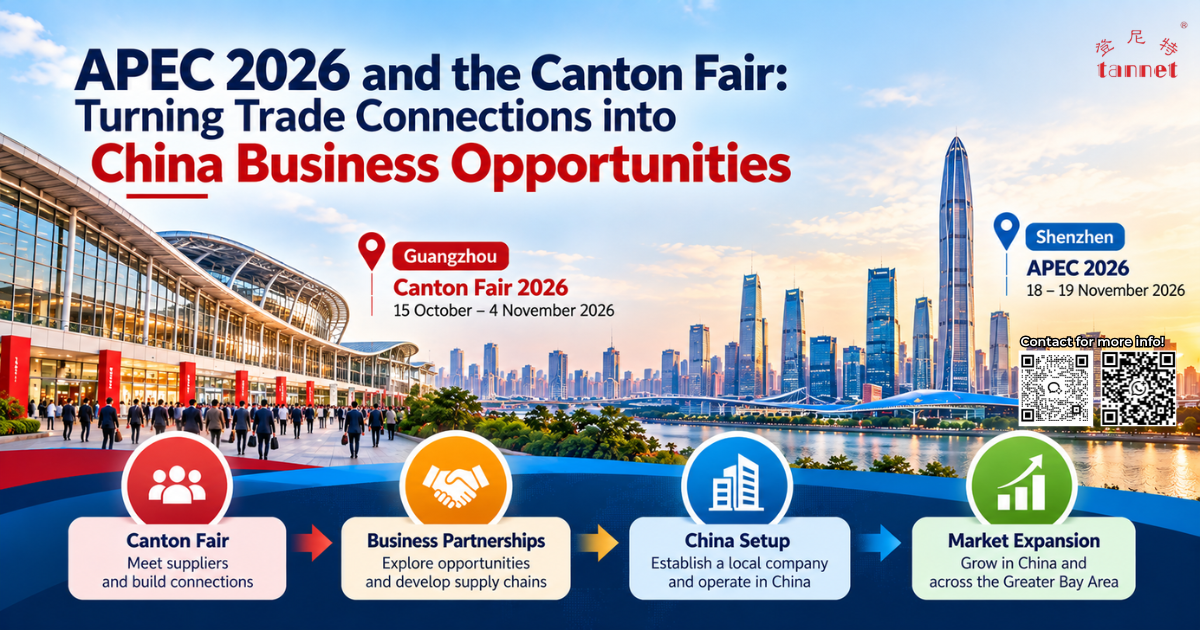
For international investors, APEC 2026 & Canton Fair: China business opportunities create a timely window for exploring trade, sourcing, investment and longer-term market entry in China. With the Canton Fair taking place in Guangzhou this October and the APEC Economic Leaders’ Meeting following in Shenzhen in November, international attention is increasingly focused on South China and the Greater Bay Area.
The 140th China Import and Export Fair, widely known as the Canton Fair, will take place in Guangzhou from 15 October to 4 November 2026. Shortly afterwards, Shenzhen will host the APEC Economic Leaders’ Meeting on 18–19 November 2026.
Although the two events serve very different purposes, together they place significant international business attention on South China and the Greater Bay Area.
For foreign companies visiting China to source products, meet suppliers or explore partnerships, there is a bigger question to consider:
How can trade connections be turned into long-term China business opportunities?
The Canton Fair is one of China’s most established international trade platforms, connecting manufacturers and suppliers with buyers from around the world.
The 140th Canton Fair will be organised across three phases:
Phase 1: 15–19 October 2026
Electronics, electrical appliances, industrial manufacturing, machinery, vehicles, new energy, hardware and related industries.
Phase 2: 23–27 October 2026
Household products, building materials, furniture, gifts, decorations and related products.
Phase 3: 31 October–4 November 2026
Textiles, fashion, healthcare, food, sports products, personal care, toys and other consumer goods.
For many international businesses, attending the Canton Fair begins with a straightforward objective: identify suppliers, compare products, negotiate prices and develop new sourcing relationships.
But the opportunity does not necessarily end when the exhibition finishes.
A successful supplier relationship can become the starting point for a much broader China strategy.
An overseas company may initially work with China entirely through cross-border purchasing.
As its business grows, however, operations can become more complex.
The company may need to coordinate several manufacturers, improve quality control, manage contracts, recruit local employees, develop a permanent sourcing team or explore selling directly into the Chinese market.
At this stage, companies should consider whether their existing cross-border structure remains suitable.
Questions may include:
This is the point where a trade connection can develop into a genuine market-entry strategy.
China’s hosting of APEC in 2026 adds another dimension to the business environment.
The APEC 2026 theme is “Building an Asia-Pacific Community to Prosper Together,” with Openness, Innovation and Cooperation identified as key priorities.
Most importantly for companies exploring South China, Shenzhen will host the APEC Economic Leaders’ Meeting in November 2026.
This brings further international attention to a region that already contains several major commercial centres.
Guangzhou is a major centre for international trade, manufacturing, sourcing and the Canton Fair.
Shenzhen is internationally recognised for technology, innovation, advanced manufacturing and entrepreneurship.
Hong Kong provides an international financial and professional-services environment with strong global connectivity.
Together, these cities form an important part of the Guangdong-Hong Kong-Macao Greater Bay Area and can offer international companies different options for structuring their regional operations.
International investors do not necessarily need to choose between Guangzhou, Shenzhen and Hong Kong as completely separate business destinations.
Depending on the company’s business model, the three locations can perform complementary functions.
A company may develop manufacturing and supplier relationships around Guangzhou, establish technology or operational functions in Shenzhen, and use Hong Kong for selected international business, financing or professional-service requirements.
The appropriate structure will depend on several factors, including:
Companies attending the Canton Fair should therefore evaluate more than products and prices.
They can also use their time in South China to understand the broader business environment and determine whether a more permanent presence could support future growth.
Not every overseas buyer attending the Canton Fair needs to establish a company in mainland China.
For businesses conducting occasional sourcing activities, working directly with suppliers from overseas may remain sufficient.
However, establishing a local company may become worth considering when China begins to represent a substantial part of the company’s operations.
For example, a local entity may be considered when a business plans to:
Foreign investors considering company incorporation should plan the structure carefully before registration.
Key matters can include the proposed company name, business scope, registered address, registered capital, shareholders, legal representative and applicable industry requirements.
Foreign investment access restrictions and sector-specific licensing requirements should also be reviewed before proceeding.
Thousands of supplier contacts, WeChat connections, catalogues and business cards can be exchanged during a major trade exhibition.
The real commercial value comes from what happens afterwards.
Which suppliers should you work with?
How should your contracts and payments be structured?
Do you need a local company?
Where should that company be established?
How will banking, accounting, taxation, employment and ongoing compliance be handled?
For international businesses attending the Canton Fair in 2026, the opportunity is not limited to finding another supplier.
With Guangzhou hosting one of the world’s major trade exhibitions and Shenzhen taking centre stage for APEC 2026 shortly afterwards, this is also an opportunity to look at South China from a broader strategic perspective.
The Canton Fair can help you make the connection.
A well-planned China market-entry strategy can help turn that connection into a sustainable business.
Whether you are visiting the Canton Fair, evaluating suppliers or considering a longer-term presence in China, understanding the appropriate business structure from the beginning can help reduce unnecessary complications later.
Tannet supports international investors with China company incorporation, registered address arrangements, accounting and tax compliance, corporate banking assistance, business consulting and ongoing corporate services.
From initial market exploration to company establishment and ongoing compliance, businesses can develop a structure aligned with their operational and expansion objectives.
📞 Free 1-on-1 Consultation Now,
Official Service Hotline: +86-755-82148419
Cell: +86-13823131503;+60 19-309 2363
WeChat ID: 13823131503;
WhatsApp:+86-13823131503;+60 19-309 2363
Email: mytannet08@gmail.com; susiehu@citilinkia.com