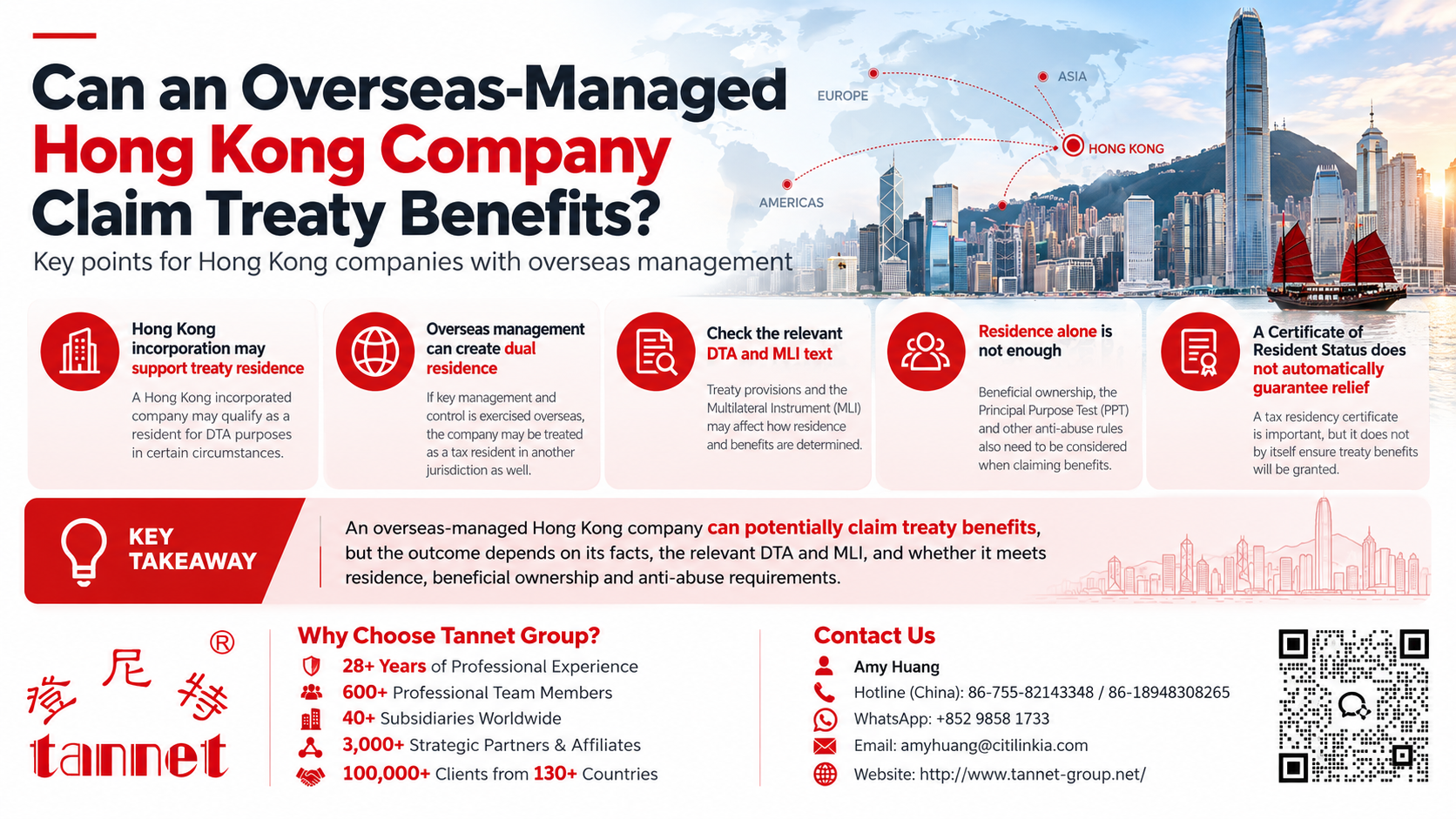
Key Takeaway
Yes, an overseas-managed Hong Kong company may qualify for tax treaty benefits, because many Hong Kong double taxation agreements treat a company incorporated in Hong Kong as a Hong Kong resident.
However, incorporation is only the starting point. Overseas management may also make the company resident in another jurisdiction, creating dual residence.
The applicable treaty, any Multilateral Instrument modifications, beneficial ownership, the principal purpose test, and source-country procedures must then be reviewed.
This issue is most relevant to holding, trading, licensing, financing, and investment companies whose directors or senior decision-makers operate outside Hong Kong. A Certificate of Resident Status does not guarantee relief.
The answer starts with the relevant treaty
There is no universal treaty result for every Hong Kong company. Each claim must begin with the comprehensive double taxation agreement, or DTA, between Hong Kong and the jurisdiction taxing the payment.
Many Hong Kong DTAs define a Hong Kong resident company by incorporation. They may also cover a company incorporated elsewhere if it is normally managed or controlled in Hong Kong.
This means overseas management does not automatically remove the Hong Kong residence limb for a Hong Kong incorporated company. However, the wording of the specific residence article, protocol, and synthesised MLI text must be checked.
A group should not rely on a summary, an old rate table, or the wording of a different DTA.
Why overseas management can create dual residence
The country where directors or senior executives manage the company may treat it as locally resident under domestic law. Tests may refer to central management and control, place of effective management, management seat, or similar concepts.
The same company may therefore be resident in Hong Kong because it was incorporated here and resident overseas because key management occurs there. That is a dual-resident company.
Dual residence does not automatically mean the company can choose the more favourable treaty position. The relevant tie-breaker must resolve which jurisdiction is treated as residence for that treaty.
Under Article 4 of the OECD Multilateral Instrument, where it applies, competent authorities endeavour to determine treaty residence by mutual agreement. They consider the place of effective management, place of incorporation, and other relevant factors.
If the authorities do not reach agreement, treaty relief may be unavailable except to the extent they agree otherwise. The precise outcome depends on the DTA, each jurisdiction’s MLI choices, and the applicable synthesised text.
What effective management means in practice
Effective management focuses on where the key management and commercial decisions necessary for the business as a whole are made in substance. It is not decided by one document or one board meeting.
Relevant evidence may include where strategic decisions are developed and approved, where senior executives work, who controls bank accounts, who negotiates material contracts, and where business risks are monitored.
Video meetings do not create a simple answer. Authorities may consider where participants are located, who prepared the proposals, where the decision was implemented, and whether the board exercised independent judgment.
Formal minutes should reflect real events. Moving signatures to Hong Kong after overseas decisions have already been made does not change the underlying management facts.
Applying for a Hong Kong CoR
The Inland Revenue Department defines a Certificate of Resident Status, or CoR, as proof of Hong Kong residence for claiming benefits under a DTA. It is not a general certificate of tax status.
A Hong Kong incorporated company can generally apply. The company must identify the treaty partner, claim period, relevant income, and treaty purpose.
The current application for jurisdictions other than the Mainland asks operational questions. These include where the business is normally carried on and whether income is passive or derived outside Hong Kong.
The IRD may request ownership, management, personnel, premises, income, and transaction information. Its published target is 21 working days after receiving a properly completed application, either to issue the certificate, request information, or notify a decision.
The IRD also states that a CoR does not guarantee treaty benefits. The treaty partner makes the final decision after applying the treaty and its domestic claim procedure.
Residence is only one treaty condition
Dividends, interest, and royalties often require the recipient to be the beneficial owner. This test asks whether the company has the right to use and enjoy the income without a legal or contractual obligation to pass it onward.
An overseas-managed Hong Kong company may still be the beneficial owner. Conversely, a Hong Kong-managed company may fail if it acts as a conduit. The payment flow, financing, risk, discretion, and contractual duties matter.
Some benefits require a minimum ownership percentage or holding period. Others depend on the payer, instrument, intellectual property, or nature of the income.
The principal purpose test may deny a benefit when obtaining that benefit was one of the principal purposes of an arrangement and granting it would conflict with the treaty’s object and purpose.
Commercial rationale should therefore be documented before the transaction. A group should explain why the Hong Kong entity owns the asset, what functions it performs, what risks it controls, and how the structure supports business operations.
Hong Kong tax still needs separate analysis
Treaty residence does not decide Hong Kong profits tax by itself. Hong Kong generally taxes profits arising in or derived from Hong Kong from a trade, profession, or business carried on here.
For profit source, the IRD looks at the operations that produced the profit and where they occurred. The place of management is a factor, but it is not always decisive.
An overseas-managed company may still earn Hong Kong-sourced profits. A Hong Kong-managed company may have foreign-sourced profits, subject to the facts and statutory rules.
Members of multinational groups should also review the foreign-sourced income exemption regime. Certain foreign-sourced dividends, interest, intellectual property income, and disposal gains received in Hong Kong may be deemed taxable unless an applicable exception is satisfied.
A practical review process
Step one is to identify the payment. Record the payer, recipient, jurisdiction, income type, amount, expected date, and domestic withholding rate.
Step two is to read the current DTA, protocol, and synthesised MLI text. Confirm the residence definition, tie-breaker, income article, beneficial-owner wording, principal purpose test, ownership threshold, and holding period.
Step three is to test domestic residence in both jurisdictions. Map incorporation, director locations, executive functions, decision-making, and implementation.
Step four is to review the Hong Kong CoR requirements and source-country claim procedure. Determine whether relief is available at payment or only through a refund.
Step five is to build evidence. Keep contemporaneous board papers, minutes, contracts, authority matrices, bank mandates, employee records, premises evidence, correspondence, and transaction files.
Step six is to resolve inconsistencies before filing. Tax returns, audited accounts, AEOI self-certifications, transfer pricing documentation, and treaty applications should tell the same factual story.
Common mistakes
- Assuming Hong Kong incorporation automatically secures treaty relief.
- Ignoring possible tax residence in the management jurisdiction.
- Reading the original DTA without checking MLI modifications.
- Treating a CoR as proof of beneficial ownership.
- Moving signatures without moving real decision-making.
- Creating generic board minutes after the payment.
- Ignoring source-country forms, deadlines, and refund procedures.
Frequently asked questions
Q1. Can a Hong Kong company managed entirely overseas apply for a CoR?
It can generally apply if it is incorporated in Hong Kong and needs residence proof for an effective DTA. The IRD will consider the relevant treaty and information supplied. Application does not guarantee issue or foreign relief.
Q2. Does overseas management automatically cancel Hong Kong treaty residence?
Not necessarily. Many DTAs include Hong Kong incorporation in the residence definition. Overseas management may instead create residence in a second jurisdiction, requiring a tie-breaker analysis.
Q3. What happens if the company is dual resident?
The applicable treaty determines the result. If an MLI mutual-agreement tie-breaker applies, competent authorities may need to agree the treaty residence. Relief can be restricted while the issue remains unresolved.
Q4. Is a Hong Kong director required?
Hong Kong company law does not generally require every director to reside in Hong Kong. Treaty entitlement depends on the DTA and actual facts, not a single director’s address.
Q5. Are Hong Kong board meetings enough?
No. Authorities examine who made the key decisions, where they were made, and whether directors exercised real judgment. Formal meetings cannot replace substantive control.
Q6. Does a CoR prove beneficial ownership?
No. Residence and beneficial ownership are separate conditions. The source jurisdiction may examine contracts, payment obligations, financing, risk, and use of funds.
Q7. Should management be moved to Hong Kong before claiming relief?
Only if that reflects genuine business operations. Artificial relocation creates risk. The group should assess commercial needs, governance, tax residence, compliance costs, and timing before changing the structure.
Conclusion
An overseas-managed Hong Kong company may claim treaty benefits, but the claim is not based on incorporation alone. Dual residence, beneficial ownership, anti-abuse rules, and procedure can change the result.
Tannet can assist where a group needs DTA mapping, CoR preparation, corporate governance records, accounting support, or coordination of cross-border evidence. Dual-residence disputes, legal opinions, and final foreign tax treatment should be handled with the relevant qualified advisers and competent authorities.
Official sources
Written by: Tannet Business Services Team
Reviewed by: Consultant Amy Huang
First published: 9 Oct. 2026
Last reviewed: 9 Sep. 2026
————————————————Simplifying Business, Empowering Entrepreneurs————————————————