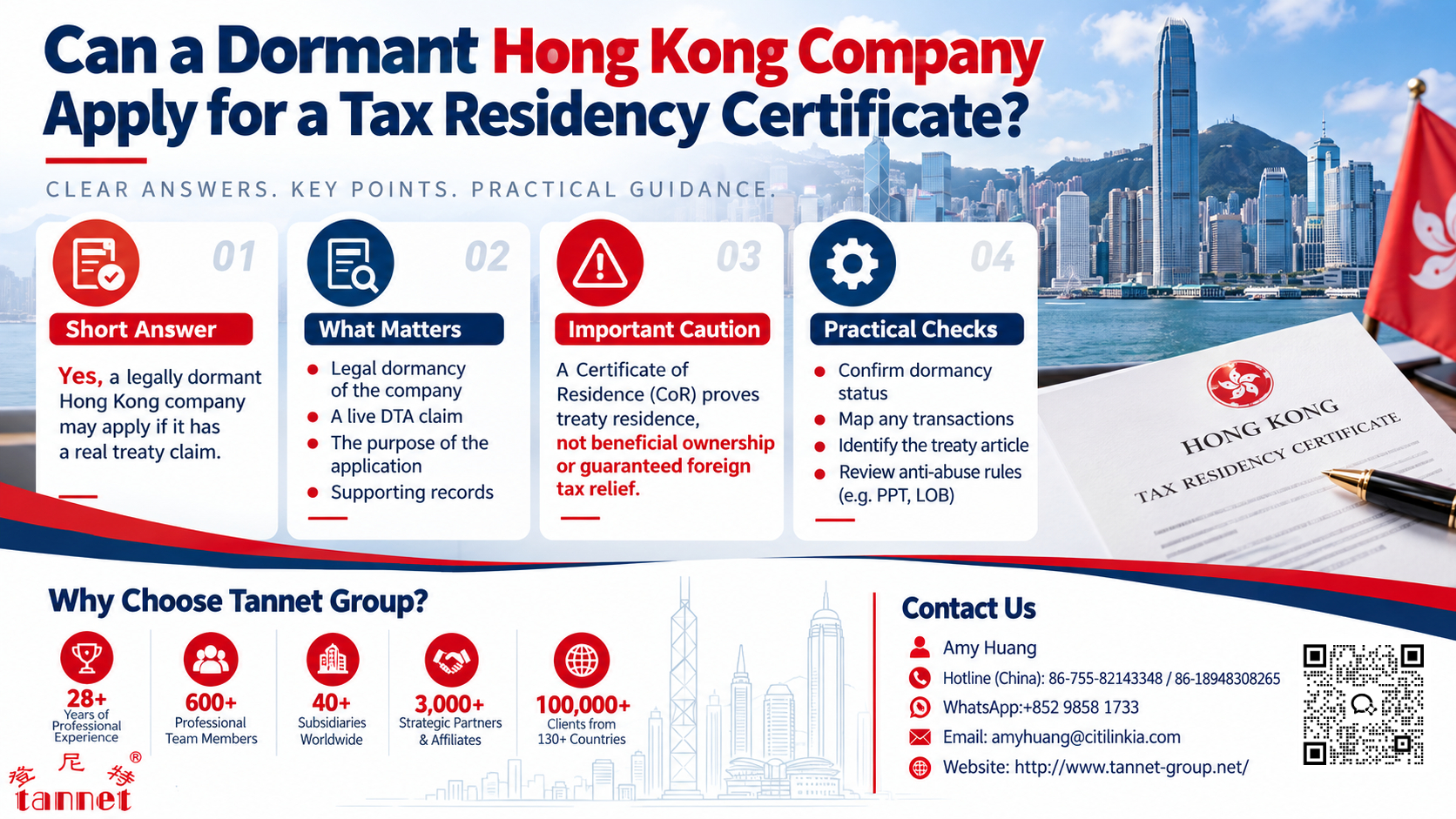
Key Takeaway
Yes, a Hong Kong incorporated company that is legally dormant may apply for a Certificate of Resident Status, or CoR, when it needs proof of residence to claim benefits under a tax treaty. Dormancy does not create an automatic statutory ban. However, approval is not automatic. The Inland Revenue Department examines the relevant treaty, the purpose of the claim, and the facts supplied. A dormant company may also face a practical contradiction: receiving income, paying expenses, or entering transactions can end its dormant status. Before applying, confirm whether the company is formally dormant, whether a treaty claim actually exists, and whether beneficial ownership or anti-abuse rules also apply.
The short answer depends on three separate tests
The first test is company law status. A private Hong Kong company becomes dormant under section 5 of the Companies Ordinance after passing and delivering the required special resolution. A company that simply stopped trading is not necessarily a dormant company in law.
The second test is treaty residence. The Hong Kong Inland Revenue Department, or IRD, states that a company incorporated in Hong Kong can generally apply for a CoR. The definition in the relevant comprehensive double taxation agreement, or DTA, ultimately controls.
The third test is treaty entitlement. A CoR proves residence for a treaty claim. It does not, by itself, prove that the company is the beneficial owner of income or that an anti-abuse test has been satisfied.
These tests should not be merged. A company can be dormant under company law, resident under a treaty definition, and still fail to obtain the requested foreign tax relief.
What dormant means under Hong Kong company law
The Companies Registry explains that an eligible private company may declare itself dormant by special resolution. Dormancy takes effect when the resolution is delivered to the Registrar, or on a later date stated in that resolution.
A dormant company is generally exempt from filing annual returns while dormancy continues. Timing matters. If dormancy starts more than 42 days after the incorporation anniversary, the annual return for that year may still be required.
Dormant companies also receive relief from certain accounting and audit requirements. This does not erase the company. Its legal personality continues, and it must still report changes to its registered office, directors, and company secretary.
The key restriction concerns accounting transactions. The Companies Registry says a dormant company ceases to be dormant if it enters an accounting transaction. An accounting transaction is broadly one that must be entered in the company’s accounting records, subject to limited statutory exclusions.
This means “dormant” is not a convenient label for a holding company that still receives dividends, pays advisers, settles bank charges, signs loans, or transfers funds. Those events require review before anyone describes the company as dormant.
What a Certificate of Resident Status does
The IRD defines a CoR as a document issued to a Hong Kong resident that needs proof of residence to claim benefits under a DTA. It is not a general certificate of good standing, business activity, or tax compliance.
The IRD will not issue a CoR merely because a bank, investor, or commercial partner asks for one. There must be a relevant DTA and a treaty-related purpose. The applicable treaty must also have entered into force.
The IRD generally accepts applications from companies incorporated in Hong Kong. It may also accept applications from non-Hong Kong entities managed or controlled in Hong Kong and from companies that have completed Hong Kong re-domiciliation.
The application can be submitted through the Business Tax Portal, through an appointed service agent, by post, or in person. The IRD states a target of 21 working days after receiving a properly completed application. Within that period, it may issue the certificate, request more information, or notify the applicant that the application cannot be accepted.
Why dormancy can complicate the application
A dormant company may satisfy the basic incorporation limb in a treaty definition. Yet the commercial narrative can still be weak. A tax authority will reasonably ask why an entity with no accounting transactions needs treaty relief on income.
The answer may be legitimate. For example, a company could be preparing for a future payment, resolving a historic claim, or applying before a transaction that will also end dormancy. The timeline must be explained accurately.
Problems arise when records conflict. An application may describe management, financing, investment review, or income collection in Hong Kong while Companies Registry filings say the company is dormant. Those statements need reconciliation, not cosmetic wording.
Artificial activity is not a solution. Renting a desk, signing generic minutes, or opening an account only to create an appearance of substance may create more risk. Evidence should follow real governance and real functions.
Beneficial ownership is a separate issue
Reduced withholding tax on dividends, interest, or royalties often depends on beneficial ownership. A dormant or pass-through company may have difficulty showing that it controls and enjoys the income.
Relevant facts may include who decides how the income is used, whether the company must pass funds to another person, who bears investment risk, and whether the company has real functions related to the asset.
The principal purpose test may also apply under a treaty or the Multilateral Instrument. Relief can be denied where obtaining a treaty benefit was one of the principal purposes of an arrangement and granting the benefit would be inconsistent with the treaty’s object and purpose.
A CoR should therefore be treated as one document within a wider treaty file. It is not a substitute for beneficial-owner analysis, commercial rationale, or transaction evidence.
A practical decision process
Step one is to verify legal status. Search the Companies Registry record and confirm the effective dormancy date. Do not rely on an internal description such as “inactive.”
Step two is to map every transaction since that date. Include receipts, payments, bank charges, professional fees, intercompany entries, dividends, loans, and asset transfers. Determine whether dormancy has already ended.
Step three is to identify the exact treaty claim. Confirm the DTA, income article, claim year, foreign filing procedure, and required evidence.
Step four is to test entitlement beyond residence. Review beneficial ownership, the principal purpose test, ownership thresholds, holding periods, and any domestic anti-avoidance rule in the source jurisdiction.
Step five is to decide whether the company should remain dormant. If genuine investment or treasury activity will begin, formally ending dormancy and maintaining proper records may be the coherent path.
Step six is to submit a complete application and answer follow-up questions promptly. Do not make the filing before the board, tax, bank, and corporate records agree.
Common mistakes
- Applying without identifying a live DTA claim.
- Ignoring small bank charges or adviser payments that may be accounting transactions.
- Assuming incorporation guarantees the CoR or the foreign tax benefit.
- Using generic substance documents that do not match actual decisions.
- Failing to analyse beneficial ownership and anti-abuse provisions.
- Describing the company differently in tax, banking, and corporate records.
Frequently asked questions
Q1. Does dormancy automatically disqualify a Hong Kong company from a CoR?
No. The IRD’s general eligibility includes companies incorporated in Hong Kong. However, the relevant treaty and the purpose of the claim control. Dormancy may also trigger questions about the expected income and the company’s real role.
Q2. Can a company apply only for banking or compliance purposes?
The IRD says a CoR is issued for claiming benefits under a DTA. It is not issued simply for a commercial request when no treaty claim exists.
Q3. Will receiving a dividend end dormancy?
It may. A receipt that must be entered in accounting records is likely to be an accounting transaction. The company should obtain case-specific company law and accounting advice before the payment.
Q4. Is a CoR enough to obtain a reduced withholding rate?
No. The source jurisdiction may examine beneficial ownership, holding percentage, holding period, purpose, and local claim procedures. It makes the final decision on relief.
Q5. Must the company have employees and an office?
There is no universal checklist that automatically determines treaty residence. The treaty definition and actual facts matter. Employees, premises, management, and functions can still be relevant to beneficial ownership and anti-abuse analysis.
Q6. How long does the IRD take?
The IRD states a target of 21 working days after receiving a properly completed application. A request for further information can extend the overall process.
Q7. Should the company end dormancy before applying?
Not in every case. The decision depends on what the company will do and when. If it will receive income or undertake investment activity, the corporate status should align with that real activity.
Conclusion
A dormant Hong Kong company may be eligible to apply for a CoR, but the filing must tell one consistent story. Legal dormancy, treaty residence, and entitlement to relief are separate questions.
Tannet can assist where a group needs a dormancy status review, treaty mapping, CoR document preparation, corporate record updates, or coordination among company secretarial, accounting, and tax workstreams. Legal opinions and foreign tax decisions should be handled with the relevant qualified advisers and authorities.
Official sources
Written by: Tannet Business Services Team
Reviewed by: Consultant Amy Huang
First published: 8 Oct. 2026
Last reviewed: 8 Sep. 2026
————————————————Simplifying Business, Empowering Entrepreneurs————————————————