Key Takeaway
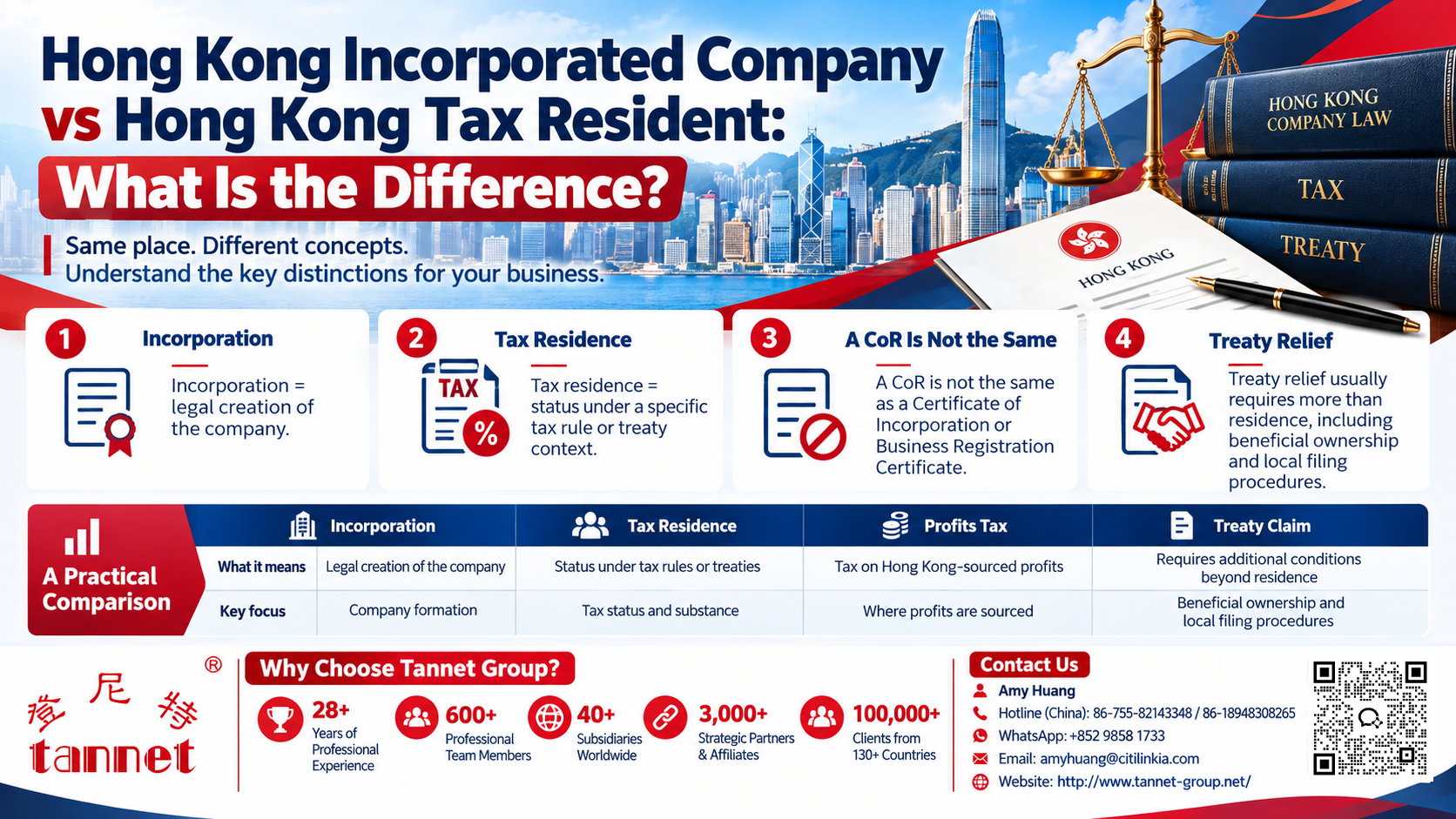
A Hong Kong incorporated company is a legal entity formed under Hong Kong company law.
A Hong Kong tax resident is a person or entity treated as resident under a particular tax framework, such as a double taxation agreement or the automatic exchange of information rules.
The concepts overlap, but they are not interchangeable. This distinction matters to founders, holding companies, multinational groups, banks, and businesses claiming treaty relief.
The main caution is simple: incorporation does not automatically secure a Certificate of Resident Status or reduced foreign withholding tax, while tax residence does not automatically make worldwide profits taxable in Hong Kong.
Incorporation answers a company law question
Incorporation asks where a company was legally formed. The Hong Kong Companies Registry issues a Certificate of Incorporation after approving an application under the Companies Ordinance.
The certificate establishes the company’s legal existence. It does not state that the company qualifies for tax treaty benefits, has paid tax, conducts substantial business in Hong Kong, or beneficially owns income.
A Hong Kong company must maintain its registered office, directors, company secretary, significant controllers register, accounting records, and statutory filings. These obligations arise from its corporate status, even when it has no taxable profits.
Business registration is another administrative requirement. The Business Registration Certificate records a business for registration purposes. It is not a ruling on treaty residence, profit source, or tax liability.
Tax residence depends on the purpose
“Tax resident” does not have one universal meaning. The correct test depends on why the classification is needed.
For automatic exchange of financial account information, or AEOI, the Inland Revenue Department states that a company incorporated in Hong Kong is regarded as a Hong Kong tax resident. A foreign-incorporated company may also be resident if it is normally managed or controlled in Hong Kong.
For a double taxation agreement, the residence article in the relevant agreement controls. The IRD says companies incorporated in Hong Kong can generally apply for a Certificate of Resident Status, or CoR. Foreign entities managed or controlled in Hong Kong may also apply.
These statements do not make the CoR automatic. The applicant must identify an effective treaty and a genuine treaty claim. The IRD may request details about ownership, management, activities, income, personnel, premises, and transaction flows.
A CoR is not the same as incorporation evidence
A Certificate of Incorporation proves that the Registrar created the company. A CoR is issued by the Hong Kong competent authority to prove residence for claiming benefits under a comprehensive double taxation agreement.
The IRD will not issue a CoR merely for a bank, tender, or general commercial purpose. Its FAQ states that the document is available when residence evidence is required for a DTA claim.
Generally, one CoR is issued for each treaty and year. The IRD’s current target is to issue a certificate, request further information, or notify its decision within 21 working days after receiving a properly completed application.
Even an issued CoR does not guarantee relief. The treaty partner decides whether the income, recipient, ownership, holding period, anti-abuse requirements, and local procedures satisfy the treaty.
Tax residence does not determine Hong Kong profits tax alone
Hong Kong generally applies a territorial source principle. The IRD explains that profits tax is charged on profits arising in or derived from Hong Kong from a trade, profession, or business carried on in Hong Kong.
Therefore, a Hong Kong incorporated and treaty-resident company is not automatically taxed on every profit earned worldwide. The operations that produced each profit and where those operations occurred remain important.
The reverse is also possible. A foreign-incorporated company can have Hong Kong profits tax exposure if it carries on business in Hong Kong and earns Hong Kong-sourced profits. Incorporation outside Hong Kong does not create a blanket exemption.
The foreign-sourced income exemption regime adds another layer. Certain foreign-sourced dividends, interest, intellectual property income, and disposal gains received in Hong Kong by members of multinational groups may be deemed taxable unless an applicable exception is satisfied.
Residence, source, and exemption should therefore be analysed separately. One label cannot replace the full tax analysis.
Treaty entitlement requires more than residence
Many treaties reduce source-country withholding tax on dividends, interest, or royalties. Residence is normally the entry condition, not the final condition.
The recipient may need to be the beneficial owner. It may need to meet an ownership percentage, holding period, limitation provision, or principal purpose test. Domestic procedures in the payer’s jurisdiction may require forms, supporting records, or post-payment refund applications.
A Hong Kong company that immediately passes income to its parent may face questions about control and enjoyment of that income. The analysis considers legal obligations, financing, risk, decision-making, and the company’s actual functions.
Substance is not a fixed headcount formula. Relevant evidence can include where directors make key decisions, who negotiates material contracts, where records are maintained, whether qualified people perform core functions, and whether expenditure matches those functions.
A practical classification process
Step one is to define the question. Decide whether the evidence is needed for company registration, a bank self-certification, Hong Kong profits tax, a foreign withholding claim, or another regulatory purpose.
Step two is to identify the controlling rule. Use the Companies Ordinance for incorporation, AEOI guidance for financial account reporting, the Inland Revenue Ordinance for profits tax, and the relevant DTA for treaty residence.
Step three is to map real operations. Record who manages the company, where contracts are negotiated, where services are performed, where assets and risks are controlled, and how income is used.
Step four is to analyse each income stream. Determine source, recipient, applicable treaty article, beneficial ownership, withholding procedure, and any FSIE consequence.
Step five is to align documents. Corporate records, tax returns, bank self-certifications, transfer pricing files, agreements, invoices, and CoR applications should describe the same commercial reality.
How to describe the company accurately
Use complete statements instead of broad labels. “Incorporated in Hong Kong” describes legal formation. “Hong Kong tax resident for AEOI purposes” describes a financial account reporting position. “Applicant for a Hong Kong CoR under the treaty with Jurisdiction X” describes a specific treaty process.
The same discipline should appear in contracts and onboarding forms. If a form asks for tax residence, identify its purpose before selecting a jurisdiction. If it asks for a taxpayer identification number, use the identifier prescribed for that reporting regime.
Board minutes should record actual decisions. They should identify the commercial issue, information considered, people participating, conflicts managed, and action approved. Repeated template minutes signed after the event provide weaker evidence than timely records supported by correspondence.
Finally, review changes annually and before material payments. A conclusion reached for one year or income stream should not be copied automatically into the next claim.
Common mistakes
- Treating the Certificate of Incorporation as a tax residency certificate.
- Using the Business Registration Certificate as proof of treaty entitlement.
- Assuming Hong Kong incorporation guarantees lower foreign withholding tax.
- Assuming tax residence creates worldwide Hong Kong taxation.
- Ignoring the separate source test for profits tax.
- Using AEOI residence wording as if it decides every DTA claim.
- Overlooking beneficial ownership, anti-abuse rules, and source-country procedures.
Frequently asked questions
Q1. Is every Hong Kong incorporated company a Hong Kong tax resident?
For AEOI purposes, the IRD generally regards a Hong Kong incorporated company as resident. For treaty purposes, the relevant DTA applies, and obtaining a CoR requires a treaty-related application. Context must always be stated.
Q2. Does incorporation automatically produce a CoR?
No. The company must apply. It must identify an effective DTA and provide the information requested by the IRD. Incorporation is evidence of eligibility, not automatic approval.
Q3. Can a foreign company be a Hong Kong tax resident?
Yes, in some contexts. The IRD recognises that a foreign-incorporated company managed or controlled in Hong Kong may qualify. Its Hong Kong business and profits tax position must still be assessed separately.
Q4. Does a Hong Kong tax resident pay tax on worldwide income?
Not automatically. Hong Kong’s profits tax system is primarily territorial. Source rules apply, subject to special provisions such as the FSIE regime for specified foreign-sourced income received in Hong Kong by MNE entities.
Q5. Is a CoR enough to claim a treaty rate?
No. The treaty partner makes the final decision. It may test beneficial ownership, holding periods, ownership thresholds, anti-abuse rules, and local filing requirements.
Q6. Is a Business Registration Certificate proof of residence?
No. It shows business registration. It does not replace a CoR or determine residence under a treaty.
Q7. Which records should a company keep?
Keep board minutes, contracts, bank records, invoices, staffing and premises evidence, ownership charts, tax filings, and records showing who controlled the relevant income and business risks.
Conclusion
Hong Kong incorporation establishes a company. Hong Kong tax residence classifies a person under a specified tax rule. Profits tax, treaty residence, and treaty entitlement are related but distinct.
Tannet can assist when a business needs incorporation support, company secretarial compliance, tax residence mapping, CoR application preparation, accounting records, or coordination of treaty evidence. Legal conclusions and overseas tax relief should be confirmed with the relevant qualified advisers and authorities.
Official sources
Written by: Tannet Business Services Team
Reviewed by: Consultant Amy Huang
First published: 8 Oct. 2026
Last reviewed: 8 Sep. 2026
————————————————Simplifying Business, Empowering Entrepreneurs————————————————