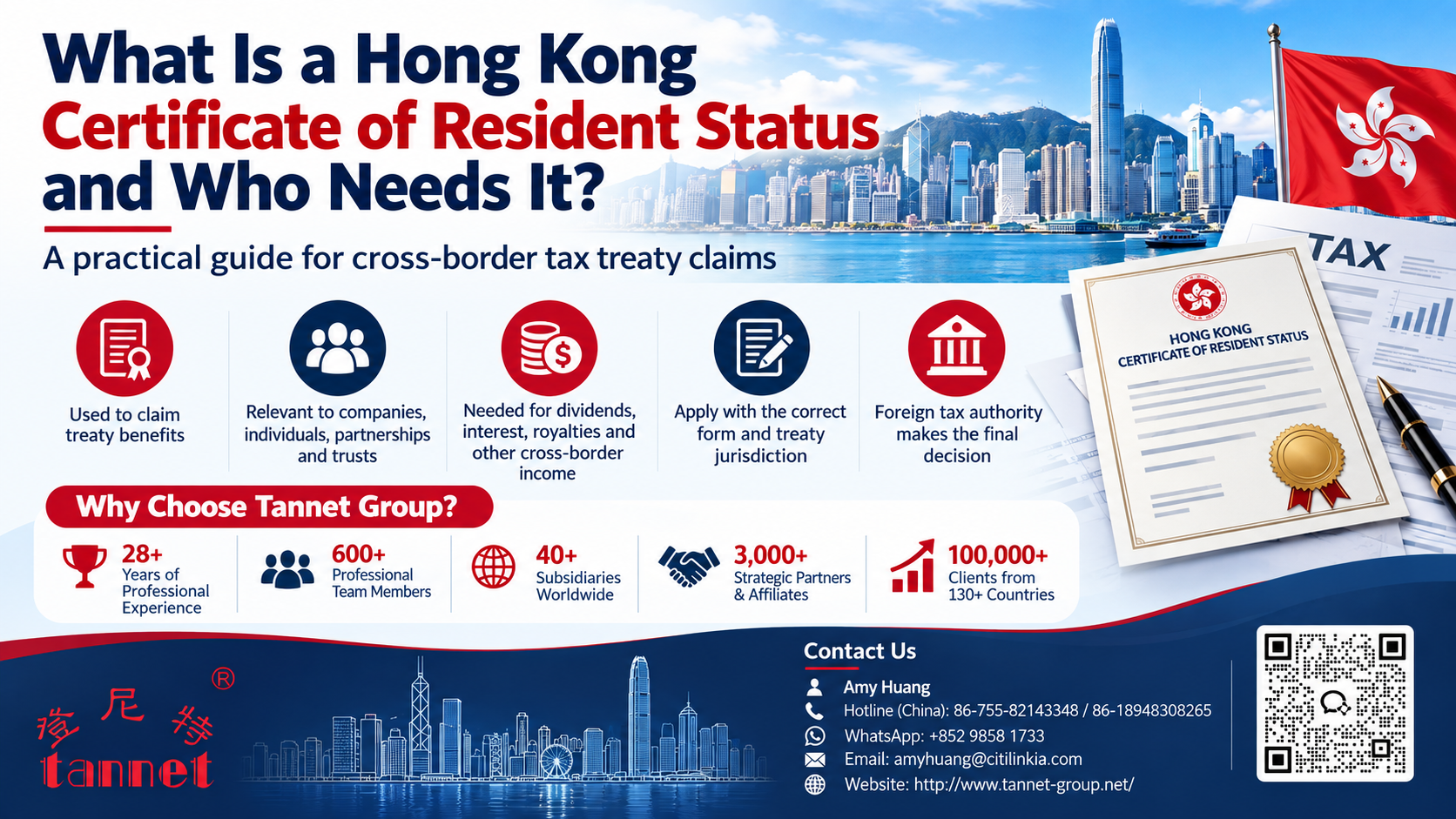
KEY TAKEAWAY
A Hong Kong Certificate of Resident Status, often called a CoR, is issued by the Hong Kong competent authority to an eligible Hong Kong resident that needs evidence to claim benefits under an effective comprehensive double taxation agreement or arrangement. It is relevant to companies, individuals, partnerships, trusts and other bodies receiving cross-border income or facing treaty-based tax questions. Incorporation alone does not settle every claim.
The applicant must use the correct form, identify the treaty partner and claim years, and provide accurate facts. The foreign tax authority still decides whether reduced withholding, exemption or another treaty benefit is available.
What the certificate actually proves
A CoR confirms Hong Kong resident status for a specific treaty claim. The Hong Kong Inland Revenue Department, or IRD, does not issue it as a general certificate of good standing. It is not a substitute for a Certificate of Incorporation, Business Registration Certificate, tax return, audit report or tax clearance letter.
The document matters because a treaty benefit normally depends on residence in one contracting jurisdiction. The payer, withholding agent or overseas tax authority may ask for formal proof before applying a reduced tax rate, exemption, tax credit procedure or treaty dispute mechanism.
Hong Kong had signed comprehensive double taxation agreements with 57 tax jurisdictions by mid-April 2026, according to the IRD. The relevant agreement must still be effective before a CoR is issued.
Who may qualify as a Hong Kong resident
The IRD lists several general categories. An individual may qualify by ordinarily residing in Hong Kong. An individual may also qualify by staying in Hong Kong for more than 180 days during a year of assessment, or more than 300 days across two consecutive years of assessment when one is the relevant year.
A company, partnership, trust or other body may qualify if it is incorporated or constituted in Hong Kong. An overseas-formed entity may also qualify if it is managed or controlled in Hong Kong. A company that has completed re-domiciliation into Hong Kong may apply after meeting the Companies Registry requirements, including the required deregistration step in its former place of incorporation.
The exact treaty definition controls the application. Dual residence and unusual management arrangements may require a tie-breaker or competent-authority procedure.
Who normally needs a CoR
Hong Kong companies receiving foreign income
A Hong Kong company may need a CoR when it receives dividends, interest, royalties or technical fees from a treaty jurisdiction. The certificate supports the residence element of a request for the treaty withholding rate shown in the applicable agreement.
The company should first compare the domestic withholding rate with the treaty rate. It should then check ownership thresholds, holding periods, beneficial ownership and anti-abuse provisions. A certificate cannot cure failure to meet those separate conditions.
Hong Kong companies investing in Mainland China
A Hong Kong investor may be asked to prove residence when seeking benefits under the Mainland and Hong Kong arrangement. The correct company form is IR1313A. Individual applicants use IR1314A. The claim should match the income type, calendar year and Mainland filing procedure.
The Mainland tax authority decides whether the claimant satisfies the arrangement, including beneficial ownership and applicable anti-avoidance requirements.
Individuals with cross-border income
An individual may need a CoR when a foreign employer, payer or tax authority asks for treaty residence evidence. Common cases include employment income, director fees, pensions, professional income, investment income or a residence tie-breaker issue.
Hong Kong permanent residence and treaty residence are different concepts. A permanent identity card does not automatically answer the treaty test for a particular year. Travel days, home, family and economic links may still matter.
Overseas entities managed from Hong Kong
An entity incorporated outside Hong Kong may apply if it is managed or controlled in Hong Kong. Such an application usually attracts closer factual questions. The applicant should be ready to explain where strategic decisions are made, where directors and senior managers work, and where business records and personnel are located.
The current IRD form requires an appendix for many overseas-formed applicants. Evidence should describe actual management and conduct, not only constitutional powers.
Who usually does not need a CoR
A business does not normally need a CoR merely to open a Hong Kong bank account, renew business registration, file a profits tax return or maintain a company. Banks may request separate tax residence self-certifications under automatic exchange of financial account information rules. Those forms serve a different purpose.
A CoR is unavailable where no effective DTA exists. The IRD will not issue one for a non-treaty purpose.
How to decide whether to apply
Step 1 Identify the payment and jurisdiction
Record the payer, source jurisdiction, income type, payment date and gross amount. Confirm whether tax will be withheld and whether a refund or pre-approval process applies. The answer affects timing and evidence.
Step 2 Confirm the treaty is effective
Use the IRD list of comprehensive agreements. Check the entry-into-force and effective dates. Do not rely only on an announcement that an agreement was signed.
Step 3 Test every treaty condition
Read the relevant article for dividends, interest, royalties, employment or other income. Check residence, beneficial ownership, ownership percentage, holding period, permanent establishment and principal purpose provisions as applicable.
Step 4 Select the correct form
For Mainland claims, entities use IR1313A and individuals use IR1314A. For other jurisdictions, entities use IR1313B and individuals use IR1314B. The current IRD page identifies the July 2025 editions.
Step 5 Build a consistent evidence file
Corporate applicants should align incorporation records, business registration, tax filings, financial statements, board records, contracts, bank activity, office arrangements and staff information. Individuals should reconcile travel records, accommodation, employment, family and other residence facts.
Step 6 Submit and manage enquiries
Applications can be submitted online through the Individual Tax Portal, Business Tax Portal or Tax Representative Portal. Paper filing by post or in person remains available. A properly completed application has a target processing time of 21 working days, but an enquiry for additional information pauses any practical planning assumption.
Documents and information commonly required
The exact evidence depends on the applicant and treaty. A company application commonly includes the relevant form, incorporation document and any change-of-name document. Re-domiciled companies should include the certificate of re-domiciliation and proof of deregistration from the former jurisdiction.
Partnerships, trusts and other bodies may need governing documents and participant details. The entity form also asks about headquarters, branches, directors, senior management, staff and business operations. Extra evidence may be required when the facts are complex.
An individual application normally requires identification, contact details, claim years and residence information. The IRD may request evidence of physical presence, ordinary residence, employment, accommodation or other connections to Hong Kong.
One application may cover up to three calendar years for the same jurisdiction. The applicant should still confirm that the facts remain accurate for every year included.
Common mistakes
- Applying because the company is incorporated in Hong Kong, without identifying an actual treaty claim.
- Using a CoR as a general tax certificate for banking, licensing or tender purposes.
- Selecting a Mainland form for another jurisdiction, or using an outdated form.
- Describing board control in Hong Kong when meetings and decisions occur elsewhere.
- Ignoring beneficial ownership, holding-period or principal-purpose requirements.
- Filing after the overseas withholding or refund deadline has passed.
- Giving inconsistent information across the CoR form, tax returns, accounts and corporate records.
Frequently asked questions
Q1 Is every Hong Kong company automatically entitled to a CoR
No. Hong Kong incorporation places a company within a general eligibility category, but the IRD reviews the application under the resident definition in the relevant treaty. The application must identify a valid treaty purpose and provide sufficient information.
Q2 Does a CoR guarantee the reduced withholding tax rate
No. The IRD form expressly warns that issuance does not guarantee treaty relief. The treaty partner decides whether all conditions are met.
Q3 Can a new company apply before earning income
The company must show a genuine treaty purpose and facts for the claim period. A new company should first confirm the payer, income, relevant agreement and expected procedure. Limited operating history may lead to additional questions.
Q4 Does a virtual office prevent approval
There is no single address rule stated as an automatic refusal. However, the overall facts must support the claimed residence and any treaty conditions. Management, staff, operations and decision-making evidence may be important.
Q5 How long does the application take
The IRD target is 21 working days after receiving a properly completed application. The result may instead be an enquiry or a notice that the application cannot be accepted.
Q6 Is there an application fee
The IRD states that no fee is charged for a CoR application. Professional service fees, document certification or translation costs may still arise.
Q7 Can an agent submit the application
Yes. An appointed company secretary or tax representative can use the relevant tax portal when properly authorised. The applicant remains responsible for accurate and complete information.
Practical conclusion
A CoR should follow a treaty analysis. The applicant should know which income article applies, what foreign procedure must be completed and which facts support Hong Kong residence.
Tannet is suitable for cases that require treaty mapping, form selection, evidence coordination, submission support or alignment between Hong Kong corporate records and tax filings. Legal or disputed treaty issues may also require advice from qualified tax counsel in the jurisdictions concerned.
Written by: Tannet Business Services Team
Reviewed by: Consultant Amy Huang
First published: 28 Sep. 2026
Last reviewed: 28 Sep. 2026
————————————————Simplifying Business, Empowering Entrepreneurs————————————————