KEY TAKEAWAY
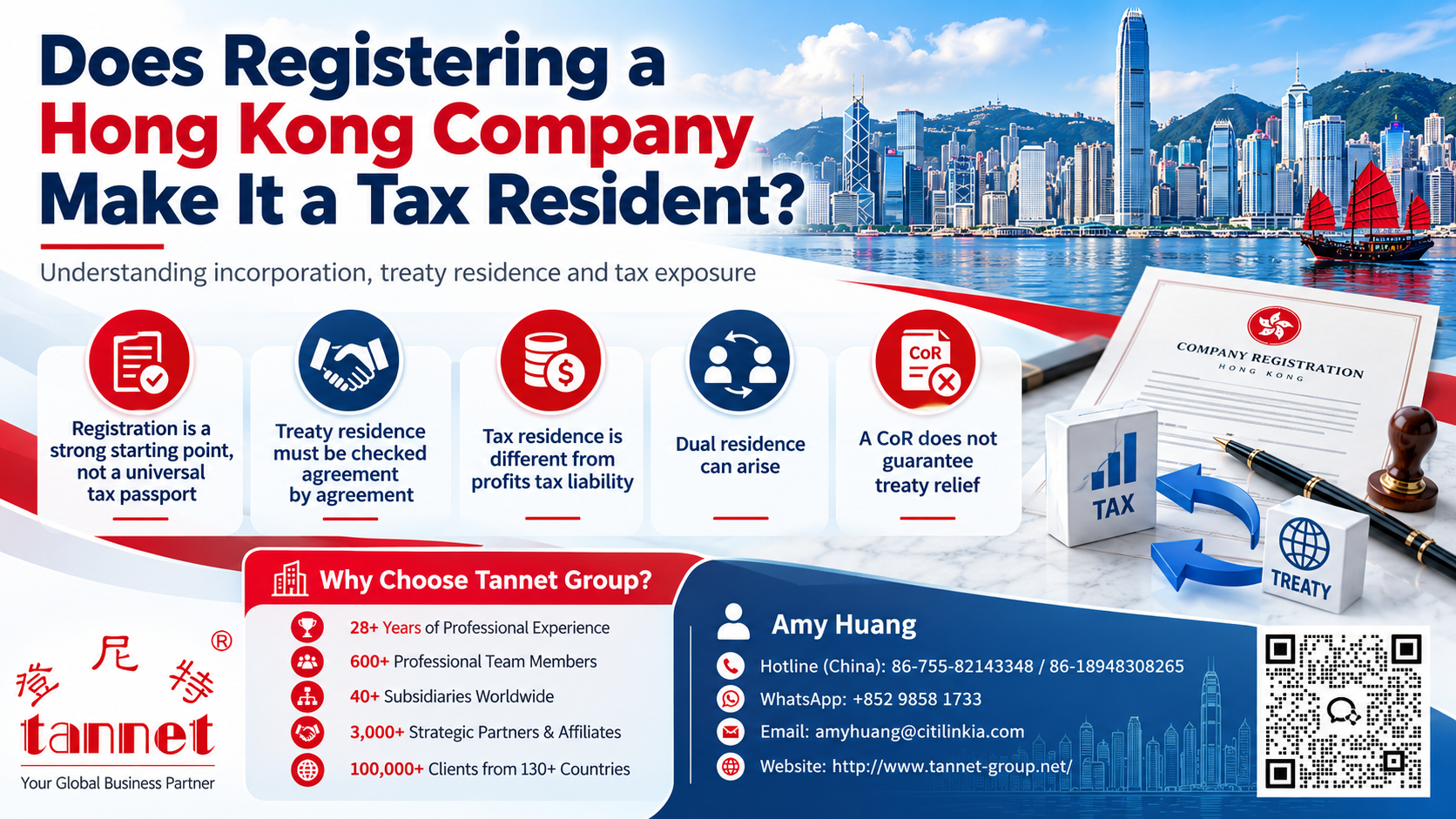
Registering a company in Hong Kong can make it a Hong Kong tax resident for certain legal and reporting purposes, including Hong Kong’s AEOI rules.
However, registration does not automatically secure a Certificate of Resident Status or a benefit under every tax treaty. It also does not decide whether the company’s profits are taxable in Hong Kong.
Foreign founders, holding companies and cross-border groups should separate three questions: the applicable residence definition, eligibility for treaty relief, and the source or deemed source of income.
The main caution is that each treaty, reporting regime and income stream must be tested independently.
The short answer
Hong Kong incorporation is an important residence connection. Under the Inland Revenue Department’s guidance for automatic exchange of financial account information, a company incorporated in Hong Kong is regarded as a Hong Kong tax resident.
Tax residence can serve different purposes. A treaty may contain its own resident definition. A foreign country may also regard the same company as resident under its domestic law.
Registration therefore creates a strong starting point, not a universal tax passport. The correct result depends on the question being asked.
Four questions founders often combine
Is the company resident for financial account reporting
For AEOI purposes, the IRD states that a Hong Kong-incorporated company is a Hong Kong tax resident. An overseas-incorporated company may also be resident if it is normally managed or controlled in Hong Kong.
This classification is relevant when a bank requests a tax residence self-certification and taxpayer identification number. For an entity, the first eight digits of its Business Registration number are generally the Hong Kong TIN equivalent for AEOI purposes.
Is the company resident under a tax treaty
The relevant comprehensive double taxation agreement or arrangement controls this question. The resident article may refer to incorporation, constitution, normal management or control, or another connecting factor.
The IRD tells applicants to read the relevant treaty article and protocol. A conclusion under one agreement should not be copied automatically to another agreement.
Can the company obtain a Certificate of Resident Status
A Hong Kong-incorporated company is among the categories that may apply for a Certificate of Resident Status, or CoR. Yet the CoR is issued only for claiming benefits under an effective DTA.
The applicant must identify the treaty partner and claim period. The IRD may issue the certificate, request more information or decline the application.
Are the company’s profits taxable in Hong Kong
This is a separate source question. Hong Kong generally applies a territorial source principle. Registration or residence alone does not make every worldwide profit taxable in Hong Kong.
Profits arising in or derived from Hong Kong may be chargeable. Specific deeming rules can also apply, including the foreign-sourced income exemption regime for certain income received in Hong Kong by members of multinational enterprise groups.
What incorporation establishes
Incorporation establishes that the company exists under Hong Kong law. It creates corporate filing, accounting, tax return and business registration obligations.
It can also satisfy a residence definition that expressly uses place of incorporation. This is why incorporation matters for AEOI and may matter under a particular DTA.
Incorporation does not prove where directors make decisions. It does not prove beneficial ownership of dividends, interest or royalties. It does not show that anti-abuse conditions have been met.
The certificate of incorporation should therefore be treated as one fact in a wider tax analysis.
Why treaty residence must be checked agreement by agreement
Before claiming relief, identify the source jurisdiction, income type, recipient and payment period. Then read the treaty’s resident article, the relevant income article and any protocol.
Also confirm whether the Multilateral Instrument modifies the agreement. The IRD’s DTA list identifies entry-into-force dates, effective dates and MLI status.
Why a CoR is not automatic treaty relief
The CoR proves residence for a treaty claim. It does not decide every other treaty condition.
The IRD states that the treaty partner makes the final decision on foreign tax relief. The foreign authority may examine beneficial ownership, shareholding percentage, holding period, permanent establishment exposure and anti-abuse provisions.
A Hong Kong holding company may be legally resident but still fail a reduced-rate claim if it acts as a conduit. Contractual obligations to pass income onward can be relevant.
Management and control still matter
Management and control matter most clearly for an overseas-incorporated company seeking Hong Kong residence. They also matter when a Hong Kong company could be resident in another jurisdiction.
Relevant facts can include where board meetings occur, who approves material contracts, where senior managers work, and who controls bank accounts. Formal minutes should match actual conduct.
A registered address and company secretary provide corporate compliance support. They do not by themselves show where strategic decisions are made.
Dual residence can arise
A company may satisfy Hong Kong’s residence rule and another jurisdiction’s rule at the same time. Another country may focus on central management, effective management or director location.
When dual residence arises, the applicable DTA may contain a tie-breaker. Some treaties use competent-authority agreement rather than a simple mechanical test.
Until the treaty position is resolved, access to benefits may be uncertain. Founders should not assume that Hong Kong incorporation overrides the other country’s domestic rule.
Tax residence is different from profits tax liability
Hong Kong does not generally tax a company merely because it is resident. The key profits tax questions are whether it carries on a trade, profession or business in Hong Kong and whether relevant profits arise in or derive from Hong Kong, subject to statutory rules.
The source analysis looks at the operations that produced the profit. Contract negotiation, purchasing, sales, service delivery and decision-making can be relevant depending on the income.
An offshore claim requires evidence. Incorporation outside Hong Kong does not automatically make income offshore, and incorporation in Hong Kong does not automatically make all income onshore.
For an MNE entity, specified foreign-sourced interest, dividends, IP income and disposal gains received in Hong Kong may fall within the FSIE regime. Economic substance, participation, nexus or intra-group relief conditions may then matter.
A practical decision process
- Define the purpose of the residence question.
- Identify every jurisdiction that may claim the company as resident.
- Check Hong Kong’s rule for that purpose.
- Read the relevant DTA and protocol.
- Confirm the agreement’s effective date and MLI status.
- Analyse the income source and any deeming provisions separately.
- Test beneficial ownership and anti-abuse requirements.
- Reconcile board, banking, tax and accounting records.
- Apply for a CoR only when a genuine treaty claim exists.
Documents that support the analysis
Keep the Certificate of Incorporation and Business Registration Certificate. Also retain articles, ownership records, tax returns and financial statements.
Governance evidence may include board minutes, management reports, director calendars and approval policies. Banking records should identify authorised signatories and payment approval steps.
Transaction evidence may include contracts, invoices, licence agreements, loan documents and dividend resolutions. The records should explain the income flow and the commercial role of the Hong Kong company.
Consistency is more persuasive than volume. Contradictory documents can weaken both residence and treaty claims.
Common mistakes
Treating incorporation as automatic treaty approval
Incorporation may satisfy a residence definition. The treaty partner can still deny relief if other conditions are not met.
Confusing a bank self-certification with a CoR
A bank self-certification supports financial account reporting. A CoR supports a claim under an effective DTA.
Using residence to answer the source question
Tax residence and profit source are separate concepts under Hong Kong’s system.
Ignoring another country’s residence rule
Foreign management activity can create dual residence or foreign filing exposure.
Relying on a registered address as substance
An address does not prove who controls the business or bears commercial risk.
Applying for a CoR without a real claim
The IRD does not issue the certificate as a general status letter.
Reviewing records only after payment
Treaty and governance evidence should be prepared before withholding or refund deadlines.
Frequently asked questions
Q1. Is every Hong Kong-incorporated company a Hong Kong tax resident
For AEOI purposes, the IRD says yes. For a treaty claim, the exact DTA definition and any dual-residence rule must also be checked.
Q2. Does tax residence mean all worldwide profits are taxable in Hong Kong
No. Hong Kong generally applies the territorial source principle, subject to specific statutory deeming rules such as the FSIE regime.
Q3. Does a Hong Kong company automatically receive a CoR
No. It must apply for a genuine claim under an effective DTA and provide the required information.
Q4. Can a company with overseas directors be resident in Hong Kong
It may be resident under an incorporation-based definition. Overseas management can still create dual-residence issues and affect treaty analysis.
Q5. Is a virtual office enough for tax residence
A registered address supports corporate compliance. It does not by itself prove management, control, beneficial ownership or economic substance.
Q6. Can a foreign-incorporated company be a Hong Kong tax resident
Yes, for relevant Hong Kong definitions, if it is normally managed or controlled in Hong Kong. Evidence of actual decision-making is important.
Q7. Who decides whether treaty relief is granted
The source jurisdiction or treaty partner makes the final decision after testing all applicable conditions.
Confirm the source-country procedure and evidence requirements before the expected payment date.
Keep all supporting records complete, current, traceable and internally aligned.
How Tannet can assist
Tannet is suitable for founders and groups that need to distinguish incorporation, tax residence, profits tax exposure and CoR requirements. Support may include document coordination, compliance records and application preparation. Dual residence, disputed beneficial ownership or material cross-border tax exposure should also be reviewed by qualified advisers in the relevant jurisdictions.
Official sources
Hong Kong Inland Revenue Department Certificate of Resident Status
Hong Kong Inland Revenue Department Tax Residency and TIN
Hong Kong Inland Revenue Department Territorial Source Principle
Hong Kong Inland Revenue Department Foreign sourced Income Exemption
Hong Kong Inland Revenue Department Comprehensive DTAs concluded
Written by: Tannet Business Services Team
Reviewed by: Consultant Amy Huang
First published: 28 Sep. 2026
Last reviewed: 28 Sep. 2026
————————————————Simplifying Business, Empowering Entrepreneurs————————————————