Key Takeaway
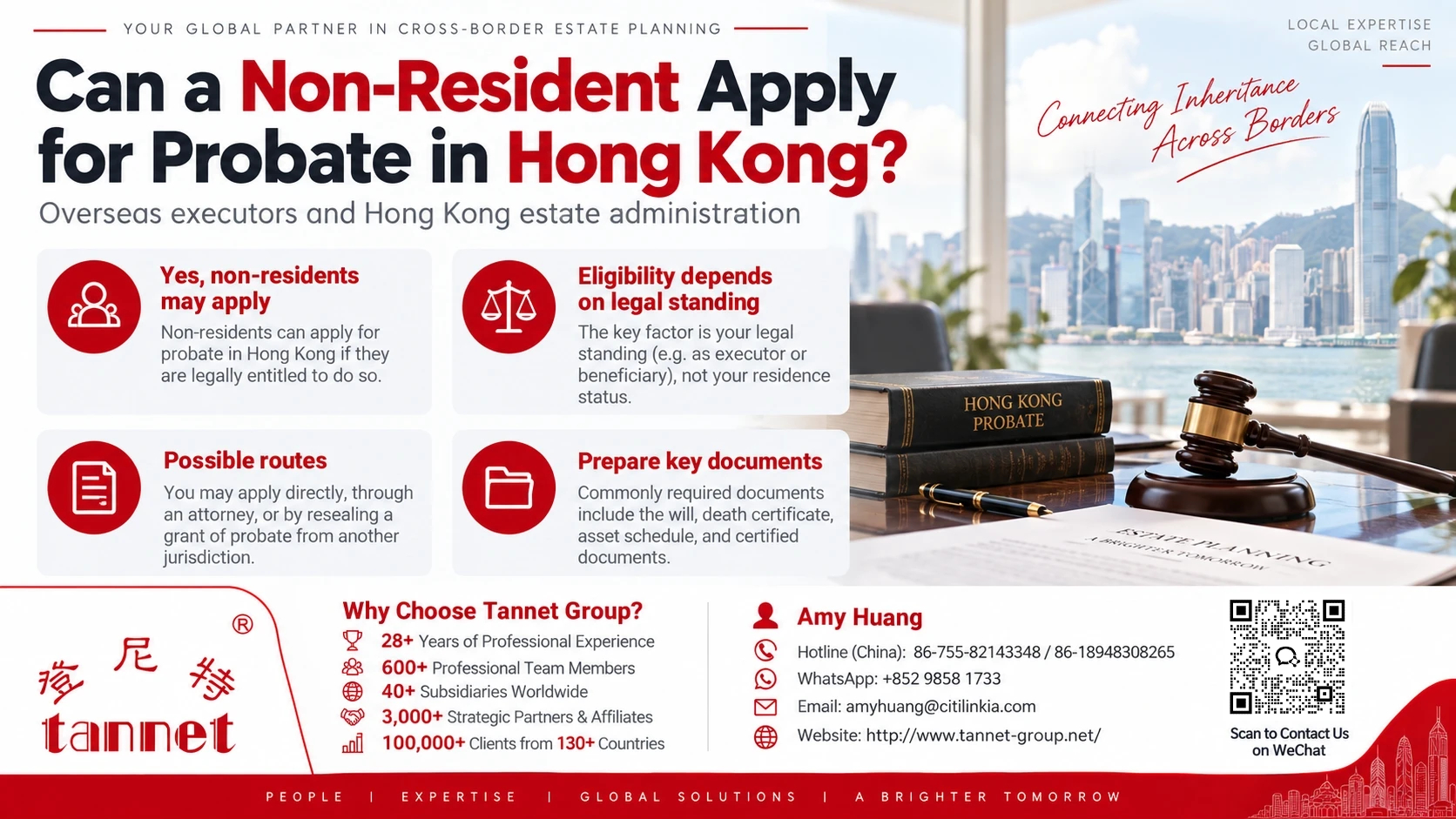
Yes. A person who lives outside Hong Kong may be able to apply for a Hong Kong grant of representation. Residence is not the only test. The applicant must be the named executor, a person entitled to administration, an attorney appointed by an overseas executor, or another person accepted by the court. This matters to overseas families handling Hong Kong bank accounts, shares, investments, or property. The main caution is procedural. Foreign domicile, an overseas grant, missing originals, notarization, translation, and possible security requirements can change the correct route and increase the evidence required.
The direct answer
A non-resident is not excluded from Hong Kong probate. The questions are whether the person has legal standing and which type of grant is required.
The Hong Kong Judiciary’s Guide to the use of the Specified Forms expressly addresses an executor who resides outside Hong Kong. It states that such an executor may use Form W1.2 to appoint another person to apply for a grant. The attorney then uses Form W1.2a or W1.2b.
That route is useful, but it does not mean every overseas applicant must appoint an attorney. The appropriate filing depends on the will, the applicant’s capacity, domicile, any foreign proceedings, and directions from the Probate Registry.
Who may apply from outside Hong Kong
An executor named in the will
An overseas executor remains the first person to consider for probate. The executor should confirm that the will appoints them clearly, that no later will exists, and that they have not renounced.
If remote administration is impractical, the Judiciary’s specified form W1.2 provides a power-of-attorney route. The resulting application is for administration with the will annexed by the executor’s attorney.
A person entitled where no executor acts
If the will names no executor, or all executors have died or renounced, another person may seek administration with the will annexed. Entitlement depends on the will and the probate rules, not on who is most convenient for the family.
Renunciations, death evidence, or an explanation of why the executor cannot act may be required. The court can also require notice or consent where another person has a prior right.
A relative in an intestate estate
Where there is no will, Rule 21 of the Non-Contentious Probate Rules sets the general priority. The Judiciary summarizes the order as spouse, child, parent, sibling, and then others.
A relative living abroad does not become entitled merely because the family agrees. The applicant must establish the correct relationship, address people with equal or prior priority, and satisfy any security requirement.
A holder of a foreign grant
If a court abroad has issued probate or administration, Hong Kong may allow resealing under the Probate and Administration Ordinance, Cap. 10, when the grant and issuing jurisdiction qualify.
Resealing is not available for every country or every instrument. If resealing is unavailable, the applicant may need leave and a fresh Hong Kong grant. The Judiciary identifies forms F2.1, F3.1, and F4.1 for different foreign-domicile situations.
Three routes to compare
Direct Hong Kong application
The non-resident executor or entitled administrator applies for a Hong Kong grant. This may suit an estate with no usable foreign grant or a will that directly supports a local application.
The filing can require sworn evidence signed abroad. The Probate Registry may raise requisitions about execution of the will, domicile, family relationships, names, asset ownership, or foreign law.
Application through an attorney
An executor outside Hong Kong may appoint another person under the specified probate power of attorney. This can reduce travel and allow a Hong Kong-based person to handle collection and administration.
The power must fit the probate purpose. A general commercial power of attorney may not supply the wording or authority required for an estate application.
Resealing a foreign grant
Resealing can be efficient when an eligible foreign grant already exists. The Hong Kong court places its seal on the grant so it can operate for Hong Kong administration.
The applicant still needs Hong Kong asset information, proper copies, supporting affidavits, and any required foreign-law evidence. Resealing should therefore be assessed, not assumed.
Documents commonly required
Start with the death certificate and the original will, including every codicil. If a foreign court holds the original will, determine what sealed or court-certified copy the Probate Registry will accept.
Provide the applicant’s passport, address, and evidence of the capacity in which the person applies. A power of attorney, renunciation, consent, or death certificate for a prior executor may also be relevant.
Prepare a schedule of Hong Kong assets and liabilities. The Judiciary publishes Form N2.1 for verifying the schedule used for a grant. Bank statements, securities records, share certificates, land searches, loan documents, and policy records support the figures.
For intestacy, obtain official records proving marriage, birth, adoption, death, or other family relationships. Name changes and inconsistent transliterations should be explained with supporting documents.
Foreign documents may require notarization, authentication, an apostille, legalization, or certified translation. The requirement depends on the document, place of issue, and intended use.
Evidence of the deceased’s domicile may include residence history, immigration status, homes, family connections, tax filings, business interests, and intentions. Domicile is a legal concept and is not decided only by citizenship.
Security and sureties
An executor proving a will and an administrator seeking letters of administration do not always face identical requirements. Administration cases can involve an administration bond, guarantee, or sureties, particularly where the court sees a risk to beneficiaries or estate assets.
Overseas residence can affect the court’s assessment because enforcement and supervision may be harder across borders. The exact requirement is discretionary and fact-sensitive.
Do not ask relatives to sign as sureties before the form, amount, and liability have been explained. A surety may assume real financial exposure if the administrator breaches duties.
Practical application process
First, identify every Hong Kong asset and how it is owned. Joint ownership, nominations, trusts, and insurance contracts may change whether probate is needed.
Second, confirm whether the deceased left a will and locate the original. Check the executor clause, later wills, codicils, alterations, and any separate will for Hong Kong assets.
Third, determine domicile at death and whether a foreign grant already exists. These facts guide the choice between a direct grant, an attorney application, and resealing.
Fourth, establish priority. Obtain renunciations, consents, relationship records, or court directions where a person with a better or equal right is not applying.
Fifth, prepare the Hong Kong asset schedule and sworn evidence. Resolve name differences, translations, certification, and authentication before filing.
Finally, answer Probate Registry requisitions precisely. Do not distribute estate assets until authority, liabilities, claims, and beneficiary entitlements have been checked.
Common mistakes
One mistake is treating residence as the only eligibility test. The applicant’s role and priority are more important.
Another is using a generic power of attorney. The Judiciary provides a probate-specific form for an overseas executor who appoints another person.
Families sometimes start a fresh Hong Kong application without checking whether an existing foreign grant can be resealed. Others make the opposite mistake and assume every foreign grant qualifies.
Applicants also underestimate domicile evidence. A passport or overseas address does not by itself establish the law governing movable succession.
A further mistake is submitting incomplete translations or uncertified copies. Each missing formality can produce a requisition and delay the grant.
Frequently asked questions
Q1 Must a probate applicant live in Hong Kong
No general answer turns only on residence. A non-resident may apply if legally entitled, but the court process, signing arrangements, security, and representation must be addressed.
Q2 Can an overseas executor appoint someone in Hong Kong
Yes. The Judiciary’s guide identifies Form W1.2 for an executor residing outside Hong Kong who wishes to appoint another person to apply.
Q3 Can a foreign lawyer file the Hong Kong application
A foreign lawyer’s role depends on professional and procedural rules. Court filing and Hong Kong legal representation should be handled through properly qualified Hong Kong practitioners where required.
Q4 Is a foreign grant automatically valid in Hong Kong
No. It must qualify for resealing or support the evidence for a fresh Hong Kong application. The issuing jurisdiction and type of grant matter.
Q5 Will a non-resident administrator need sureties
Possibly. Security requirements depend on the form of grant and the court’s assessment. They should be checked before filing.
Q6 Can all documents be signed overseas
Many documents can be executed abroad, but the oath, notarization, authentication, translation, and delivery requirements must be confirmed for each document.
Q7 What if several overseas relatives have equal priority
The court may require consents, renunciations, notice, or another procedural step. Family agreement should be documented in the form accepted by the Probate Registry.
How Tannet can assist
Tannet can assist non-resident families with a preliminary asset map, document checklist, coordination of certified translations and authentication, Hong Kong company share-record reviews, and communication planning with banks and professional advisers. Where an estate requires legal opinions, a contested application, court advocacy, or advice on fiduciary liability, Tannet can coordinate with qualified Hong Kong legal and tax professionals. The correct scope depends on the applicant’s status, the foreign documents, and the Hong Kong assets.
Sources
- Hong Kong Judiciary, Probate Registry, https://www.judiciary.hk/en/court_services_facilities/probate.html
- Hong Kong Judiciary, Guide to the use of the Specified Forms for Probate Registry, https://www.judiciary.hk/en/court_services_facilities/probatef.html
- Hong Kong Judiciary, Application with Will, https://www.judiciary.hk/en/court_services_facilities/probatef_formw.html
- Hong Kong Judiciary, Deceased Domiciled in Foreign Country, https://www.judiciary.hk/en/court_services_facilities/probatef_formf.html
- Hong Kong e-Legislation, Probate and Administration Ordinance, Cap. 10, https://www.elegislation.gov.hk/hk/cap10
- Hong Kong e-Legislation, Non-Contentious Probate Rules, Cap. 10A, https://www.elegislation.gov.hk/hk/cap10A
Written by: Tannet Business Services Team
Reviewed by: Consultant Amy Huang
First published: 18 Sep. 2026
Last reviewed: 18 Sep. 2026
————————————————Simplifying Business, Empowering Entrepreneurs————————————————