Key Takeaway
Yes.
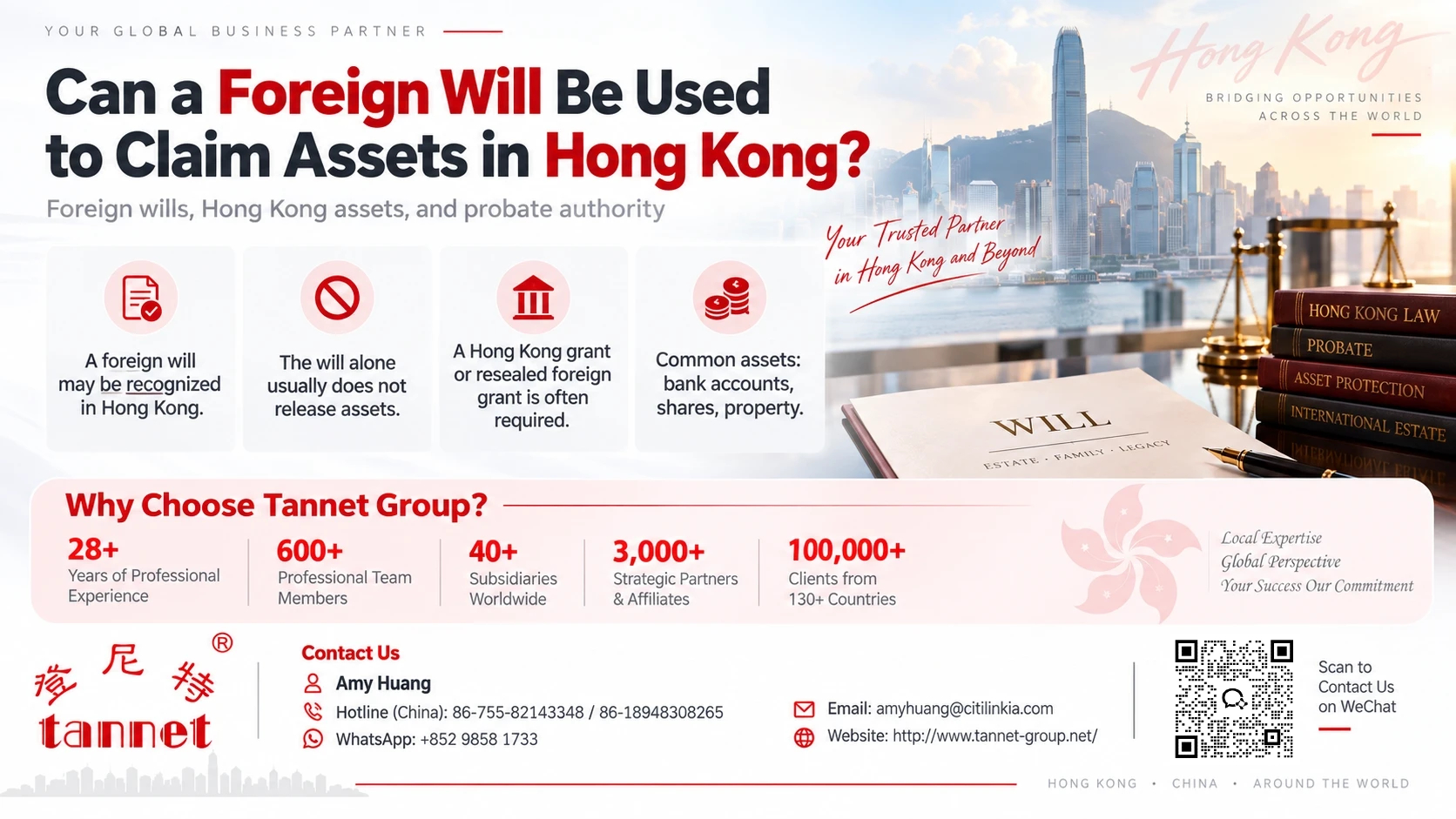
A will made outside Hong Kong can often support a claim to Hong Kong assets, but the will alone normally does not give an executor authority to collect a bank balance, transfer shares, or sell Hong Kong property. The estate usually needs a Hong Kong grant of representation, or the resealing of an eligible foreign grant. This matters to overseas executors, beneficiaries, expatriate families, and advisers handling cross-border estates.
The main caution is to separate three questions: whether the will is formally valid, which succession law governs each asset, and which Hong Kong court procedure gives the personal representative authority to act.
The short answer
Hong Kong does not reject a will merely because it was signed abroad. Section 24 of the Wills Ordinance, Cap. 30, provides several connecting tests under which a will may be treated as properly executed. These include compliance with the internal law of the place of execution and, in relevant cases, the law connected with the testator’s domicile, habitual residence, or nationality.
Formal validity is only the first step. A bank or share registrar must know who has legal authority to represent the estate. A foreign will identifies the deceased’s intentions and usually names an executor. A Hong Kong grant confirms the representative’s authority over assets administered in Hong Kong.
A foreign will is different from a foreign grant
A will is the deceased’s testamentary document. A grant of probate is a court order confirming the will and the executor’s authority. Letters of administration with the will annexed may be required when a valid will exists but the named executor cannot or will not act.
A foreign court may already have issued probate or another grant. That foreign grant does not automatically operate in Hong Kong. In qualifying cases, the Hong Kong High Court may reseal it under the Probate and Administration Ordinance, Cap. 10. Otherwise, a fresh Hong Kong grant may be needed.
Which Hong Kong assets usually require authority
Hong Kong banks commonly require a grant before releasing substantial balances held solely in the deceased’s name. The bank will set its own documentation process, but private bank accounts, term deposits, securities accounts, and safe custody assets often enter the estate administration.
Shares in a Hong Kong company may require the personal representative to prove authority before registration of a transmission. The company’s articles, register of members, share certificates, and beneficial ownership records should be checked early.
Hong Kong real property usually requires a grant before the personal representative can complete a sale or transmission. Land is an immovable asset, so local property and succession rules need specific analysis even when a foreign will covers worldwide assets.
Insurance, nominated benefits, jointly held property, and trust assets may pass outside the estate. Check the governing document and legal ownership.
Which law governs the succession question
Cross-border estates divide assets into movable and immovable property. CLIC, the Community Legal Information Centre of the University of Hong Kong, explains that the law of the deceased’s domicile at death generally governs succession to movable property such as bank money and shares.
Immovable property is generally governed by the law of the place where it is situated. A Hong Kong apartment therefore raises Hong Kong law issues even when the deceased lived abroad and signed a foreign will.
Domicile differs from nationality, residence, passport status, and tax residence. It concerns the legal system treated as the person’s permanent home and requires evidence of life and intention.
Two principal procedural routes
Fresh Hong Kong application
The executor may apply to the Probate Registry for a Hong Kong grant based on the foreign will. The court may request evidence showing that the will was properly executed and remains effective. Foreign law evidence may be needed if validity or the applicant’s entitlement depends on another legal system.
If no appointed executor can act, the court may issue letters of administration with the will annexed.
Resealing a foreign grant
Where a foreign court has already issued a grant and the statutory conditions are met, an applicant may seek resealing in Hong Kong. A resealed grant can provide authority for the Hong Kong estate without repeating every part of the original probate process.
Resealing is not available for every jurisdiction or every document. The grant must come within the class recognized under Hong Kong legislation, and the Hong Kong filing requirements still apply. Applicants should confirm eligibility before ordering expensive certified copies or legal opinions.
Documents commonly required
Start with the original foreign will, including every codicil. If the original is held by a foreign court, obtain the form of court-certified or sealed copy required for the Hong Kong application.
Obtain the death certificate and any foreign grant. Names, dates, identity numbers, and addresses should be consistent across the documents. Explain variations before filing instead of waiting for a requisition.
Prepare identification and evidence of the applicant’s right to act, including any renunciation or power of attorney.
Prepare a schedule of Hong Kong assets and liabilities. Use current statements, title searches, company registers, share certificates, policy records, and loan documents. Separate legal ownership from beneficial or nominee arrangements.
Foreign documents may require certification, authentication, legalization, or an apostille, depending on the issuing place and the document. A document in another language normally needs a certified translation suitable for court use.
The Probate Registry may request an affidavit or expert evidence on foreign law, validity, domicile, or the foreign grant’s effect.
A practical sequence for executors
First, secure the original will and search for later wills or codicils. Review whether separate wills were made for different jurisdictions. A later will may accidentally revoke an earlier Hong Kong will if the drafting was not coordinated.
Second, map every Hong Kong asset and ask each institution which grant it will accept.
Third, identify domicile and asset type. This determines which law may govern beneficial entitlement and which evidence the Hong Kong court may request.
Fourth, choose between resealing and a fresh Hong Kong grant. Compare statutory eligibility, document availability, time, cost, and the risk of conflicting grants.
Fifth, prepare consistent evidence. Resolve spelling differences, missing originals, unclear executor appointments, and translation issues before submission.
Finally, collect assets only after authority is established. Pay liabilities, keep accounts, and address claims before distribution.
Common mistakes
One mistake is sending only the foreign will to a Hong Kong bank. The will may be valid, but it is not normally the court authority that releases estate assets.
Another mistake is assuming every foreign grant can be resealed. Eligibility depends on Cap. 10 and the nature and origin of the grant.
Families also confuse domicile with citizenship. A passport is relevant evidence, but it does not decide domicile by itself.
Applicants sometimes translate only the signature page. The court may need a complete, certified translation of the will, codicils, death record, and supporting orders.
A further mistake is distributing money before debts, expenses, competing claims, or family provision issues have been considered. A personal representative has fiduciary duties and may face personal exposure for an improper distribution.
Frequently asked questions
Q1 Can a UK, US, Canadian, Australian, or Mainland will be recognized in Hong Kong
Potentially, yes. The relevant question is whether the will satisfies a formal-validity route under Cap. 30 and whether its substantive effect applies to the asset. The court may request evidence of the foreign law.
Q2 Must the deceased have lived in Hong Kong
No. A Hong Kong grant may be required because the deceased left assets in Hong Kong, even if the deceased lived and died elsewhere.
Q3 Can I use a photocopy if the original will is unavailable
Possibly, but a copy creates additional proof issues. The applicant may need evidence explaining loss, non-revocation, execution, and contents. Obtain advice before assuming a copy will be admitted.
Q4 Is resealing always faster than a fresh application
No. Resealing can be efficient when the foreign grant is eligible and the papers are complete. It can still attract requisitions about domicile, beneficiaries, estate value, authentication, or foreign law.
Q5 Does a foreign will cover a Hong Kong apartment
It may express a valid gift, but Hong Kong immovable property requires local-law analysis and Hong Kong authority for administration and transfer.
Q6 Can an overseas executor apply without travelling to Hong Kong
Often much of the work can be coordinated remotely. However, affidavits, identity checks, notarization, powers, and court directions depend on the facts and the country where documents are signed.
Q7 What if there are two wills for different countries
Both wills must be reviewed together. The key questions are scope, date, governing language, and whether either document revoked the other. CLIC notes that separate Hong Kong and overseas wills can create additional verification requirements.
How Tannet can assist
Tannet can assist where a family needs a preliminary Hong Kong asset map, a coordinated document checklist, certified translation and authentication support, company share-record review, or communication planning for banks and professional advisers. For validity disputes, domicile opinions, court advocacy, or contested probate, Tannet can coordinate with qualified Hong Kong legal and tax professionals. The correct route depends on the will, foreign grant, asset location, and family circumstances.
Sources
- Hong Kong Judiciary, Probate Registry, https://www.judiciary.hk/en/court_services_facilities/probate.html
- Hong Kong e-Legislation, Wills Ordinance, Cap. 30, https://www.elegislation.gov.hk/hk/cap30
- Hong Kong e-Legislation, Probate and Administration Ordinance, Cap. 10, https://www.elegislation.gov.hk/hk/cap10
- Community Legal Information Centre, Probate, https://www.clic.org.hk/en/topics/probate
Written by: Tannet Business Services Team
Reviewed by: Consultant Amy Huang
First published: 18 Sep. 2026
Last reviewed: 18 Sep. 2026
————————————————Simplifying Business, Empowering Entrepreneurs————————————————