Key Takeaway
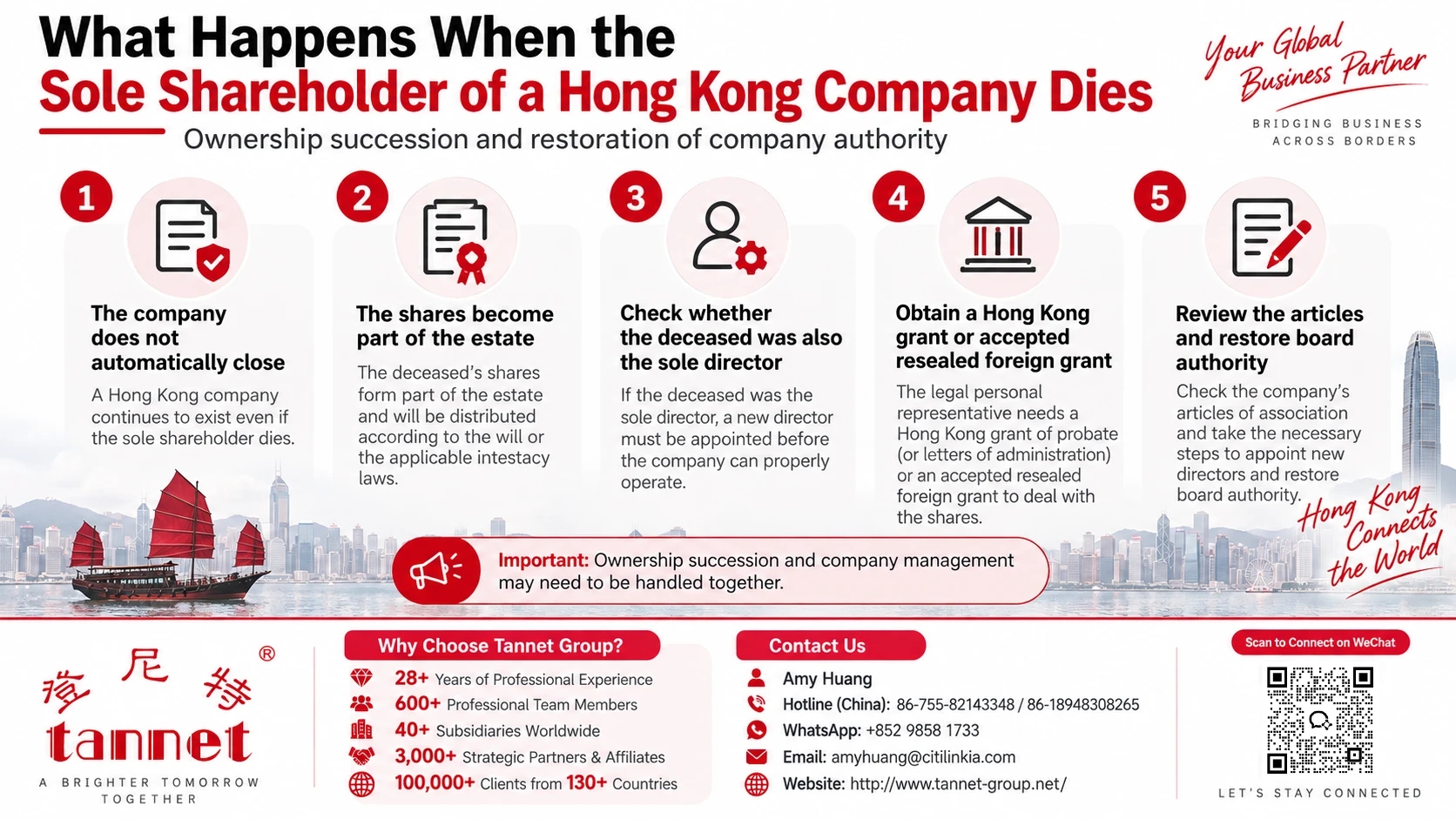
A Hong Kong company does not automatically close when its sole shareholder dies. The company remains a separate legal entity, while the deceased’s shares become part of the estate.
An executor or administrator normally needs a Hong Kong grant, or an accepted resealed foreign grant, before the company can register the person entitled to the shares.
This guide is for families, executors, directors, company secretaries, and overseas beneficiaries.
The most important point is to check whether the deceased was also the sole director. If so, ownership succession and restoration of board authority must be managed together, under the company’s articles and Hong Kong law.
The company continues to exist
Death ends the individual’s ownership role, but it does not end the company. The company keeps its assets, debts, contracts, employees, tax obligations, licences, and filing duties.
The deceased’s estate owns the economic interest in the shares. However, the company cannot simply replace the shareholder’s name with a beneficiary’s name based only on a family request or a copy of the will.
The register of members remains central. Until the company registers a person entitled by transmission or a later transferee, the deceased may remain shown as the registered member in the company’s internal records.
Separate ownership from management
A shareholder owns shares. A director manages the company. The same person may hold both positions, but the legal roles are different.
If other directors remain in office, they can usually continue managing ordinary company affairs, subject to the articles and any reserved matters. They should protect assets, preserve records, and avoid decisions that require a shareholder resolution until voting authority is clear.
If the deceased was also the only director, the practical risk is greater. Banking instructions, contracts, payroll, statutory approvals, and company filings may stall because no board member remains to act.
Review the articles immediately
The articles of association are the company’s internal rulebook. They govern director appointment, decision making, transmission of shares, evidence requirements, and registration of a person entitled after death.
Hong Kong’s Companies Model Articles Notice, Cap. 622H, provides default rules for companies using the relevant model articles. A company’s filed articles may modify or replace those rules.
Do not rely on a generic summary. Obtain the actual articles, all amendments, shareholders’ agreements, investment documents, and any succession or buy-sell arrangement.
Where no director remains, the articles may contain an emergency appointment route. The exact wording and the identity of the person entitled to use it must be checked before an appointment is attempted.
Identify the estate representative
If the deceased left a valid will, the named executor usually applies for a Grant of Probate. If there is no will, an entitled person applies for Letters of Administration.
The Hong Kong Judiciary describes a grant as a court order authorizing the grantee to administer the deceased’s Hong Kong estate. It also explains that the Probate Registry’s jurisdiction covers assets in Hong Kong.
A will names intentions and executors. It does not always provide enough authority for a bank, company, or counterparty to act before a grant is issued.
Where a foreign grant already exists, ask whether it qualifies for resealing in Hong Kong. If it does not, a fresh Hong Kong grant may be necessary.
Confirm the shares and their value
Obtain the latest register of members and the original share certificate. Confirm the deceased’s name, share class, number of shares, amount paid, certificate number, and date of registration.
Compare the register with allotment records, annual returns, beneficial ownership information, declarations of trust, shareholder loans, and prior transfers. Resolve discrepancies before asking the board to recognize a transmission.
Transmission comes before any later transfer
Transmission is the legal consequence of death. Transfer is a later disposition by instrument, such as a distribution to a beneficiary or sale to a buyer.
The person entitled by transmission may seek registration as shareholder or direct a transfer, depending on the articles and available evidence. Those routes should not be merged into one undocumented step.
Section 153 of the Companies Ordinance, Cap. 622, provides that a transfer by a deceased member’s personal representative is valid as if the representative had been the registered holder when executing it.
That provision supports the chain of title. It does not remove the need to prove representative authority, comply with the articles, consider contractual restrictions, and update the corporate records.
Documents commonly required
The exact list depends on the estate and the articles. A typical file includes the death certificate, sealed or certified grant, original share certificate, will where relevant, and identification of the personal representative.
The company may request address evidence, a written transmission request, certified translations, apostilles, notarization, or other authentication for overseas documents.
If the share certificate is missing, the board may require a statutory declaration, indemnity, advertisement, insurance, or other protection before issuing a replacement.
Restore board authority where necessary
First confirm whether any director remains validly appointed. Check the register of directors, recent board minutes, resignation records, and Companies Registry filings.
If a director remains, that director may be able to call meetings, protect company property, and process the transmission. However, shareholder approval may still be needed for reserved decisions.
If no director remains, review the articles for the appointment mechanism that applies after the last member’s death. Legal advice may be needed if the wording is unclear, custom articles conflict, or competing representatives claim authority.
After appointment, document the decision carefully. File the required notice of director appointment with the Companies Registry within the applicable statutory period and update the company’s registers.
Protect operations during the transition
Secure seals, digital certificates, accounting access, statutory records, passwords, contracts, insurance, and licence information. Preserve data rather than using the deceased’s credentials. Sequencing reduces delay and protects the evidentiary record for successors.
Update corporate and beneficial ownership records
Once the board accepts the evidence, the company secretary should update the register of members and issue or replace the relevant share certificate.
A member change is generally reflected in the next annual return rather than through a standalone share-transfer form. Director changes, by contrast, have their own filing requirements.
Banking and contracts need separate attention
A change in shareholder does not automatically change every bank mandate. Banks apply their own due diligence, mandate, beneficial ownership, sanctions, and source-of-wealth procedures.
Tax and stamp-duty points
Hong Kong estate duty was abolished for deaths occurring on or after 11 February 2006, according to the Inland Revenue Department. Older deaths require historical analysis.
Estate-duty abolition does not mean every succession step is tax free. A transmission, in-specie distribution, sale, gift, or restructuring can have different stamp-duty and overseas tax consequences.
Common mistakes
- Assuming the company is dissolved because its sole shareholder died.
- Treating the beneficiary named in a will as the immediate registered member.
- Ignoring the difference between sole shareholder and sole director.
- Signing a transfer before the personal representative proves authority.
- Using a generic model article without checking the company’s filed articles.
- Updating a certificate but not the register of members or control records.
- Forgetting bank mandates, licences, contracts, payroll, and tax deadlines.
- Assuming abolition of estate duty removes stamp duty or overseas tax issues.
Frequently asked questions
Q1. Does the company stop trading immediately? No. It continues as a legal entity. Its ability to act depends on whether authorized directors and banking signatories remain.
Q2. Do the shares pass straight to the beneficiary? Not automatically. The personal representative normally establishes authority first, and the company then follows its articles to register a transmittee or transferee.
Q3. What if the deceased was also the only director? Check the articles urgently for a valid director-appointment route. If the route is uncertain or disputed, obtain Hong Kong legal advice.
Q4. Is a will enough for the company secretary? Often not. A grant of representation or an accepted resealed grant is commonly required before the estate can deal with Hong Kong shares.
Q5. Can the company pay dividends during probate? Only after confirming who may lawfully receive them and whether the directors can validly declare or pay them under the articles and financial rules.
Q6. Must the personal representative become a shareholder? Not always. Depending on the articles, the representative may register or arrange a permitted transfer to the beneficiary or buyer.
Q7. Does the Companies Registry register the share transfer? The company maintains its register of members. Member information is generally reported in the annual return, while related director changes may require separate filings.
How Tannet can assist
Tannet can assist with company-record review, succession checklists, document coordination, certified translation arrangements, board and register updates, significant-controller review, annual-return information, and communication among families, company secretaries, banks, accountants, tax advisers, and Hong Kong lawyers without unnecessary duplication. Probate applications, disputed entitlement, court orders, and legal opinions should be handled by qualified Hong Kong legal professionals.
Sources
Hong Kong Companies Registry, Companies Ordinance and official guidance: https://www.cr.gov.hk/en/legislation/companies-ordinance/cap622/companies-ordinance.htm
Hong Kong e-Legislation, Companies Ordinance, Cap. 622, including section 153: https://www.elegislation.gov.hk/hk/cap622
Hong Kong e-Legislation, Companies Model Articles Notice, Cap. 622H: https://www.elegislation.gov.hk/hk/cap622H
Hong Kong Judiciary, Probate Registry: https://www.judiciary.hk/en/court_services_facilities/probate.html
Inland Revenue Department, Estate Duty: https://www.ird.gov.hk/eng/tax/edu.htm
Written by: Tannet Business Services Team
Reviewed by: Consultant Amy Huang
First published: 20 Sep. 2026
Last reviewed: 20 Sep. 2026
————————————————Simplifying Business, Empowering Entrepreneurs————————————————