Key Takeaway
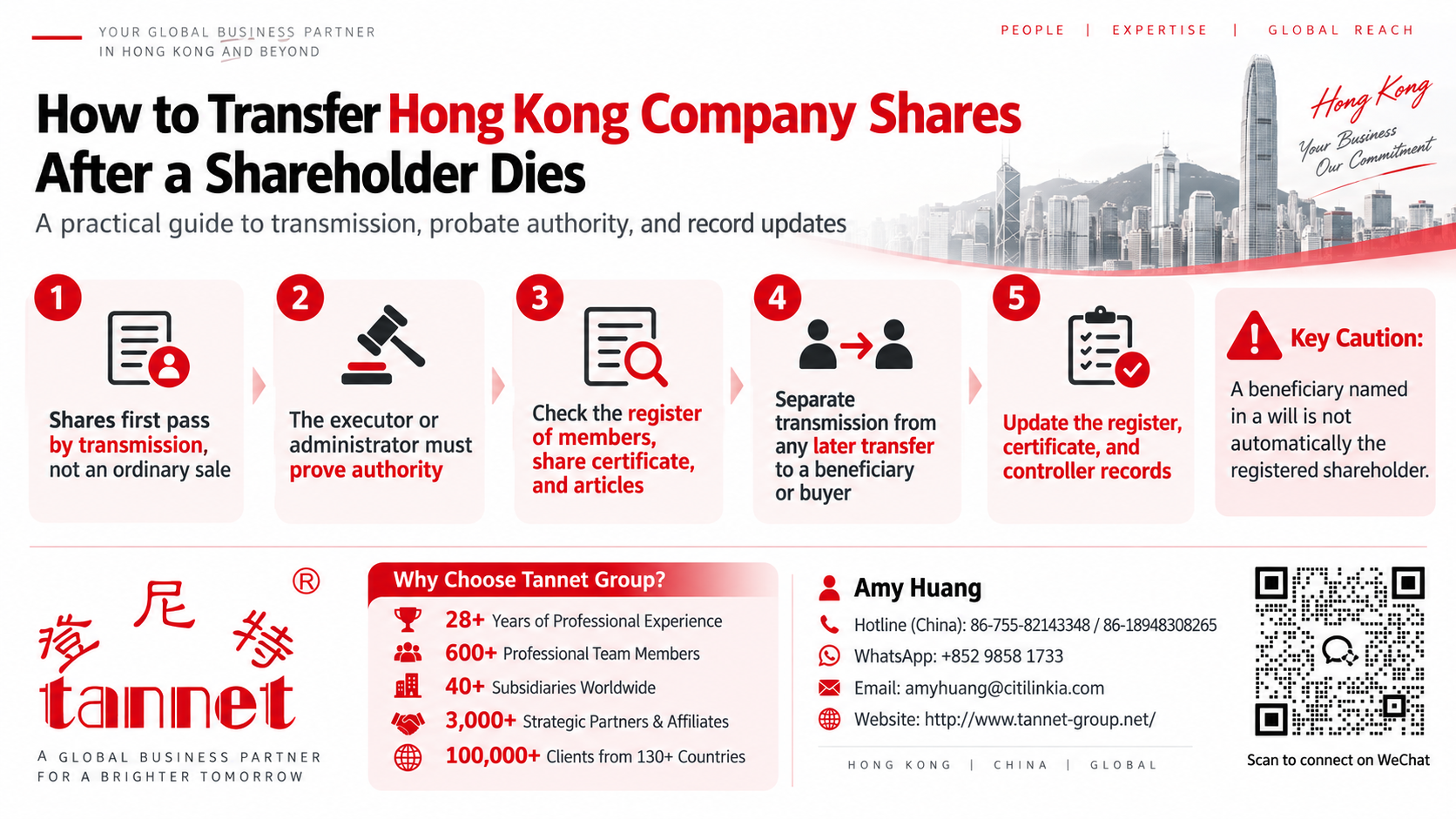
When a Hong Kong company shareholder dies, the shares do not pass by an ordinary sale. They first pass through a legal process called transmission.
The executor or administrator must prove authority, usually with a Hong Kong grant of representation or an accepted resealed foreign grant. The company then applies its articles, verifies the evidence, and updates its register of members.
This guide is for families, executors, directors, company secretaries, and overseas beneficiaries. The main caution is to separate transmission to the personal representative from any later transfer to a beneficiary or buyer.
Each stage can require different approvals, records, and stamp-duty analysis.
The legal position after death
A shareholder’s death does not automatically replace the name in the company’s register of members. The deceased normally remains the registered member until the company registers the person entitled by transmission or a later transferee.
The Companies Ordinance, Cap. 622, recognizes the role of the personal representative. Section 153 states that a transfer made by a deceased member’s personal representative is valid as if the representative had been the registered holder when signing the instrument.
That statutory rule does not remove the company’s verification duties. The board and company secretary must examine the grant, the articles of association, the share records, and any restrictions that govern registration.
Transmission is different from transfer
A transfer is a later transaction completed by an instrument of transfer. It may move the shares from the personal representative to a beneficiary, purchaser, family holding company, or another permitted person.
Keeping these stages separate prevents several errors. A beneficiary named in a will is not necessarily entitled to exercise shareholder rights immediately. The executor named in the will may also need a grant before the company accepts instructions.
First identify the shareholding
Obtain the latest register of members. Confirm the deceased’s full name, address, share class, certificate number, number of shares, amount paid, and date of entry.
Check whether the shares were held solely or jointly. If there are joint registered holders, the company’s articles may recognize the survivor differently from a sole holding that falls into the estate.
Review the share certificate, allotment documents, past transfers, annual returns, beneficial ownership records, and any declarations of trust. Differences between these records should be resolved before the board considers registration.
Review the articles and shareholder arrangements
The company’s articles govern how it handles a person entitled by transmission. The Companies Model Articles Notice, Cap. 622H, contains default transmission provisions for companies that adopted the relevant model articles without modification.
Custom articles may impose additional evidence requirements. They may also regulate whether the transmittee can be registered personally or direct a transfer to someone else.
A shareholders’ agreement may contain death-related buyout rights, valuation formulas, insurance arrangements, options, or pre-emption provisions. These contractual provisions do not replace probate authority, but they can affect the eventual destination and price of the shares.
Obtain authority to represent the estate
Where the deceased left a valid will, the named executor usually applies for a Grant of Probate. Where there is no will, an entitled person applies for Letters of Administration.
The Hong Kong Judiciary’s Probate Registry explains the application routes and specified forms. A grant confirms who has authority to collect and administer estate assets in Hong Kong.
If a foreign court has already issued a grant, determine whether it can be resealed in Hong Kong under the Probate and Administration Ordinance, Cap. 10. Not every foreign grant or issuing jurisdiction qualifies.
If resealing is unavailable, a fresh Hong Kong application may be required. Foreign domicile, competing executors, missing originals, and overseas signatures can increase the evidence needed.
Documents the company commonly requests
The precise list depends on the articles and circumstances. A typical file starts with the official death certificate and a sealed or certified copy of the grant of representation.
The company may request the original share certificate, the will, identification and address evidence for the personal representatives, and certified translations for non-English or non-Chinese documents.
The personal representatives should submit a written transmission request. It should identify the shares, explain the requested registration, and state whether they wish to be registered or transfer the shares onward.
If the certificate is lost, the company may require a statutory declaration, advertisement, indemnity, insurance, or other protection. Listed-company procedures and private-company procedures should not be mixed.
Registering the personal representative
Under model-style transmission provisions, a person entitled by death may choose to become the registered holder or transfer the shares to another person, subject to the articles.
The board should record why it accepts the evidence. The company secretary then updates the register of members, cancels the deceased’s certificate where appropriate, and prepares a replacement certificate.
The company should also review its significant controllers register. A change in ultimate control or a personal representative’s legal position may require notices, investigation, or an updated entry under the Companies Ordinance.
Transferring shares to a beneficiary
Registration of the personal representative may be only an intermediate step. The will, intestacy rules, estate accounts, and administration decisions determine whether the shares are distributed in specie, sold, or used to satisfy another entitlement.
The personal representative may execute an instrument of transfer under section 153 of the Companies Ordinance. The company must still apply its articles and consider any board discretion, pre-emption procedure, or contractual buyout.
Valuation deserves separate attention. Private-company shares may carry minority discounts, control premiums, restrictions, shareholder loans, unpaid capital, or uncertain dividend rights.
Stamp duty and estate duty
Do not assume every post-death step has the same stamp-duty treatment. A transmission by operation of law, a distribution to a beneficiary, a sale, and a gift are legally different events.
The Stamp Office may need to examine the relevant instrument and consideration. A sale of Hong Kong stock can require contract notes and an instrument of transfer to be stamped, while another estate step may require evidence or adjudication rather than the same treatment.
Hong Kong estate duty was abolished for deaths occurring on or after 11 February 2006, according to the Inland Revenue Department. Older deaths require separate historical analysis.
When the deceased was the sole shareholder and director
This situation creates a governance problem as well as an estate problem. The company may have no person able to approve banking, payroll, contracts, or corporate records.
Check the articles immediately. Some articles provide a route for the personal representative of the last member to appoint a director. Custom articles may use different wording or leave an issue that needs court or legal intervention.
Common mistakes
One mistake is signing an ordinary transfer before establishing probate authority. This can create a defective chain of title.
Another is treating the will as sufficient. A will identifies intentions and executors, but institutions commonly require a grant or resealed grant before acting.
Families often overlook the articles. Pre-emption rights, board discretion, and death-buyout clauses can change the route.
Some companies update only the share certificate. The register of members, board minutes, beneficial ownership records, and annual-return information must also be considered.
Another mistake is assuming no tax review is needed because Hong Kong abolished estate duty. Stamp duty and overseas tax can still be relevant.
Finally, parties distribute dividends or allow voting before confirming who may exercise the rights. The articles and registration status should be checked first.
Frequently asked questions
Q1. Can the beneficiary become a shareholder immediately after death? Usually not automatically. The personal representative must establish authority, and the company must register the appropriate person or transfer.
Q2. Is the original share certificate essential? It is important, but a lost certificate can sometimes be addressed through declarations, indemnities, and company procedures.
Q3. Can directors refuse the registration? The answer depends on the Companies Ordinance and the company’s articles. Any refusal should be based on a lawful power and properly recorded.
Q4. Must a foreign grant be resealed? It may need resealing if it is eligible. Otherwise, a fresh Hong Kong grant or another approved route may be required.
Q5. Is stamp duty always payable? No single answer covers every estate step. Transmission, distribution, sale, and gift should be analyzed separately.
Q6. What if the deceased was the only director? Check the articles urgently for an appointment mechanism and obtain legal advice if the company cannot restore its board.
Q7. When can the new holder vote? Voting normally follows registration in the register of members, subject to the articles and the exact transmission route.
How Tannet can assist
Tannet can assist with company-record review, shareholding verification, document checklists, certified translation coordination, board and register updates, significant-controller review, and communication among executors, beneficiaries, banks, company secretaries, tax advisers, and Hong Kong lawyers. Probate applications, contested entitlement, court representation, and legal opinions should be handled by qualified Hong Kong legal professionals.
Sources
Hong Kong Companies Registry, Companies Ordinance and official guidance: https://www.cr.gov.hk/en/legislation/companies-ordinance/cap622/companies-ordinance.htm
Hong Kong e-Legislation, Companies Ordinance, Cap. 622, including section 153: https://www.elegislation.gov.hk/hk/cap622
Hong Kong e-Legislation, Companies Model Articles Notice, Cap. 622H: https://www.elegislation.gov.hk/hk/cap622H
Hong Kong Judiciary, Probate Registry: https://www.judiciary.hk/en/court_services_facilities/probate.html
Inland Revenue Department, Estate Duty: https://www.ird.gov.hk/eng/tax/edu.htm
Written by: Tannet Business Services Team
Reviewed by: Consultant Amy Huang
First published: 20 Sep. 2026
Last reviewed: 20 Sep. 2026
————————————————Simplifying Business, Empowering Entrepreneurs————————————————