Obtaining Hong Kong residency can be an important step for entrepreneurs and professionals seeking a long-term base in Asia.
But after securing a Hong Kong visa or residency status, many people ask:
Am I now automatically a Hong Kong tax resident?
Not necessarily.
For tax purposes, what happens after obtaining immigration status can be just as important as the visa itself.
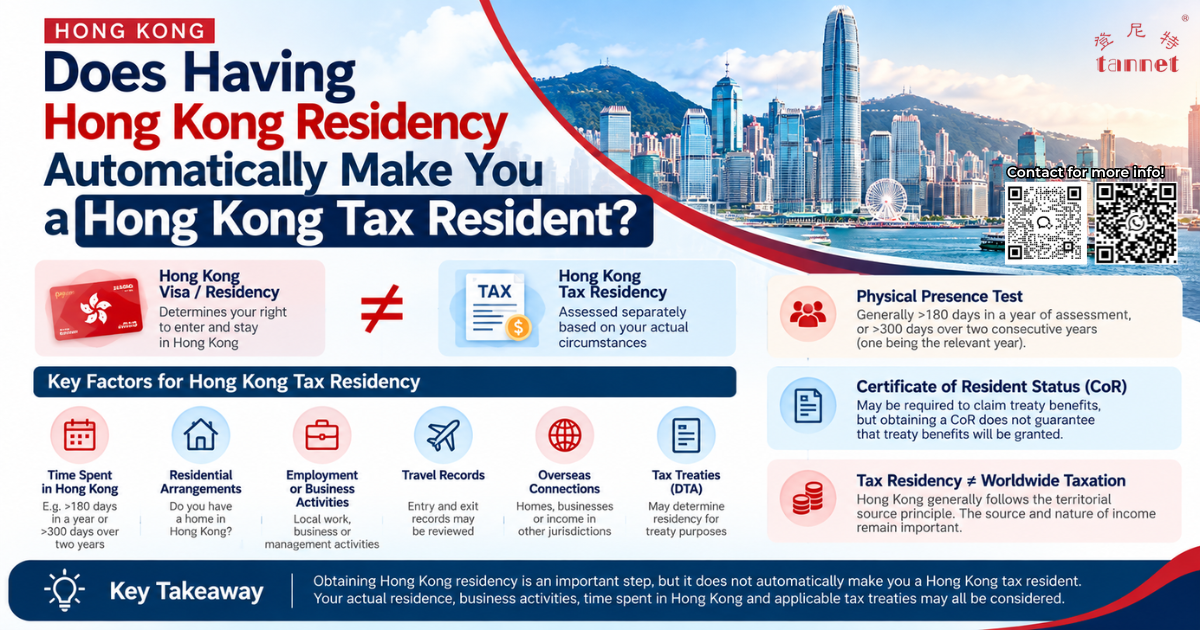
Hong Kong Residency Is Not Automatically Tax Residency
Hong Kong provides multiple immigration routes, including the Top Talent Pass Scheme, Quality Migrant Admission Scheme and employment-related visas.
These programmes determine whether someone can legally enter and stay in Hong Kong.
Tax residency is governed separately.
Therefore:
Hong Kong visa ≠ automatic Hong Kong tax residency.
An individual’s actual residence and circumstances may need to be examined.
What Does “Ordinarily Residing” Mean?
The Hong Kong Inland Revenue Department identifies ordinary residence as one basis for an individual to qualify as a Hong Kong tax resident.
Physical-presence tests can also apply where someone stays in Hong Kong for more than 180 days during a year of assessment, or more than 300 days across two consecutive years of assessment, one being the relevant year.
But internationally mobile individuals should not assume that counting days is the only consideration in every situation.
Where treaty benefits are involved, the relevant Double Taxation Agreement or Arrangement must also be reviewed.
Scenario 1: You Obtain a Visa but Remain Overseas
Suppose an entrepreneur obtains a Hong Kong Top Talent Pass but continues living primarily overseas.
The person visits Hong Kong occasionally but maintains their main home and daily activities elsewhere.
Although the individual has valid Hong Kong immigration permission, the visa alone does not automatically establish Hong Kong tax residency.
Scenario 2: You Relocate and Build a Hong Kong Presence
Consider another entrepreneur who obtains the same visa but actually relocates.
The entrepreneur establishes a home in Hong Kong, conducts business locally and spends substantial time there.
This creates a very different factual profile.
Actual presence therefore matters when considering tax residency.
Scenario 3: You Split Your Time Between Two Jurisdictions
The situation becomes more complex where an entrepreneur maintains substantial connections with both Hong Kong and another jurisdiction.
For example, someone may have homes, businesses or income in both places.
If both jurisdictions potentially consider the person resident, the applicable DTA may contain rules for determining how residence is treated for treaty purposes.
This is why internationally mobile individuals should review their position rather than relying on their Hong Kong visa alone.
What Evidence May Become Relevant?
Depending on the tax-residency question, relevant information may include:
- time spent in Hong Kong;
- residential arrangements;
- travel records;
- Hong Kong employment;
- business activities; and
- overseas connections.
Maintaining accurate documentation can therefore become important for internationally active entrepreneurs.
What About the Certificate of Resident Status?
Where an individual needs to claim benefits under an applicable DTA, a Certificate of Resident Status (CoR) may be required.
A CoR provides evidence that the applicant is a Hong Kong resident for the relevant treaty purpose.
However, the IRD states that issuance of the certificate does not guarantee that treaty benefits will ultimately be granted.
The treaty partner’s tax authority determines whether the relevant requirements are satisfied.
Residency Does Not Automatically Mean Worldwide Taxation
Becoming a Hong Kong tax resident should also not be confused with automatically becoming taxable on every source of worldwide income.
Hong Kong generally follows the territorial source principle.
The source and nature of income remain important when determining Hong Kong taxation.
Therefore, internationally mobile individuals should consider tax residency and income source separately.
What Should You Do After Obtaining Hong Kong Residency?
For entrepreneurs and professionals, receiving a visa should be viewed as the beginning of a broader process.
The next steps may include establishing an actual Hong Kong presence, arranging employment or business activities, maintaining appropriate records and assessing the individual’s tax-residence position.
Where cross-border income is involved, the applicable DTA should also be considered.
TANNET can assist international entrepreneurs and professionals with Hong Kong immigration, company incorporation, accounting and tax compliance, corporate services and Certificate of Resident Status application support, helping clients coordinate their Hong Kong immigration and business structure more effectively.
📞 Free 1-on-1 Consultation Now,
Official Service Hotline: +86-755-82148419
Cell: +86-13823131503;+60 19-309 2363
WeChat ID: 13823131503;
WhatsApp:+86-13823131503;+60 19-309 2363
Email: mytannet08@gmail.com; susiehu@citilinkia.com