Key Takeaway
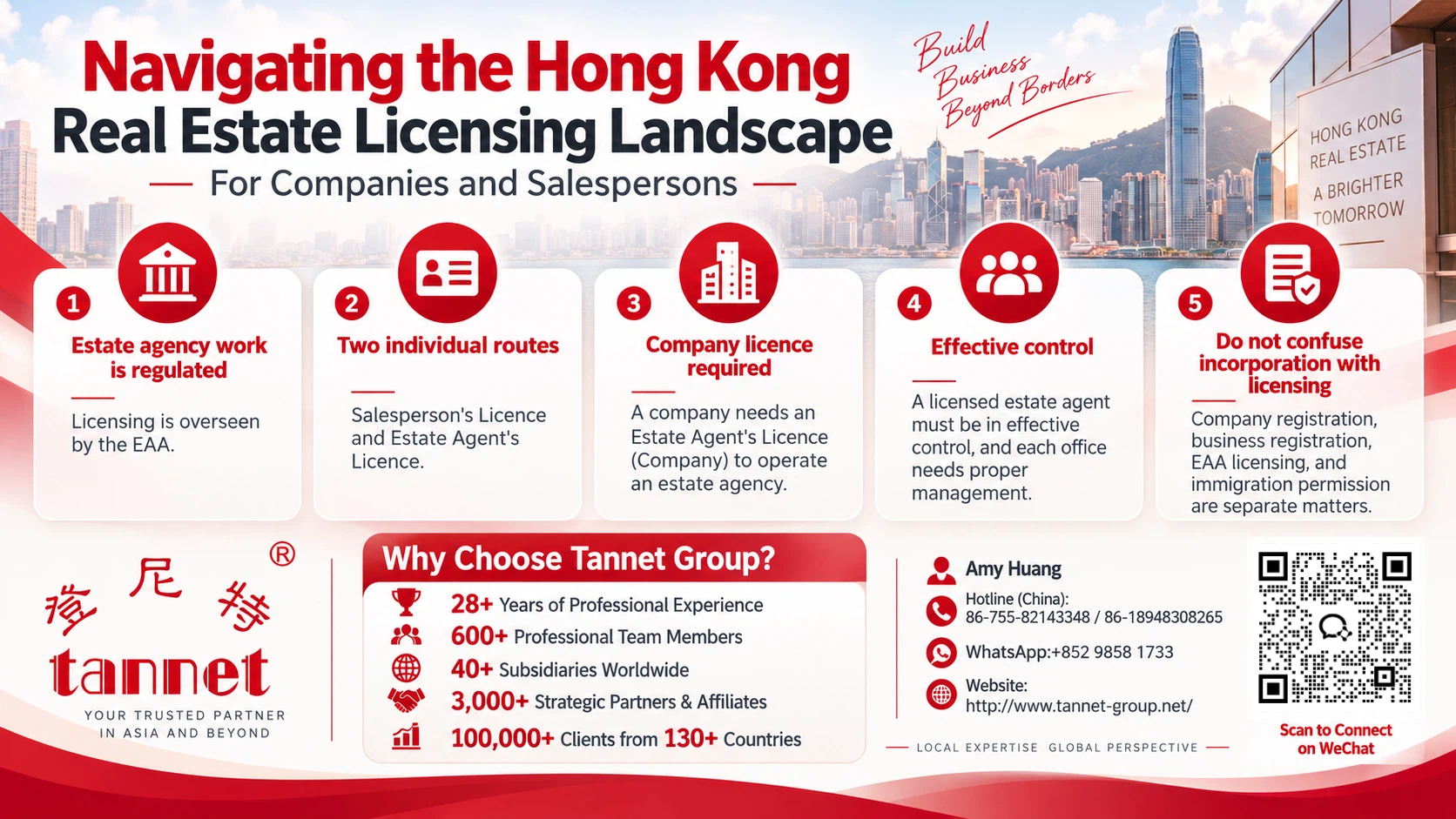
Hong Kong regulates estate agency work through the Estate Agents Authority, or EAA, under the Estate Agents Ordinance. An individual may need either a Salesperson’s Licence or an Estate Agent’s Licence.
A company operating an estate agency must hold an Estate Agent’s Licence (Company), place a licensed estate agent in effective control, and meet business-premises requirements. This framework suits founders, overseas property groups, licensed practitioners and new entrants planning to conduct estate agency work in Hong Kong.
The main caution is that company incorporation, business registration, an EAA licence and immigration permission are separate matters.
Passing an examination or registering a company does not by itself authorize the business to begin trading.
What activities require an EAA licence?
Subject to statutory exceptions, a person carrying on estate agency work in the course of business in Hong Kong must hold a valid licence. A person acting as a salesperson for an estate agent must also be licensed.
The EAA states that unlicensed practice is a criminal offence. The maximum penalty is two years’ imprisonment and a HK$500,000 fine.
The licensing question should be reviewed before marketing property, introducing parties, negotiating a transaction or handling agency instructions. The legal analysis depends on the actual activity, not the business description printed on a Companies Registry record.
The two individual licence routes
Hong Kong law recognizes two individual licence types. Their permitted roles are different.
Salesperson’s Licence
A licensed salesperson may perform estate agency work only as a salesperson of a licensed estate agent. The licence does not permit the holder to run an independent agency business.
A first-time applicant normally must:
- Be at least 18 years old on the application date.
- Have completed Form 5 secondary education or an accepted equivalent.
- Pass the Salespersons Qualifying Examination, or SQE, within the 12 months immediately before applying.
- Satisfy the EAA that the applicant is fit and proper.
The EAA currently lists the SQE fee as HK$650.
Estate Agent’s Licence (Individual)
This licence allows an individual to carry on estate agency work as an estate agent. It can also support roles such as sole proprietor, partner, company director, office manager or salesperson, subject to the applicable business structure.
A first-time applicant normally faces the same age, education and fit-and-proper standards. However, the relevant examination is the Estate Agents Qualifying Examination, or EAQE.
The current EAQE fee is HK$900. A pass can support either individual licence, subject to the other conditions.
What a company needs before operating an estate agency
Incorporating a Hong Kong limited company does not create an estate agency licence. A company intending to carry on estate agency business must make a separate application to the EAA.
For an Estate Agent’s Licence (Company), the applicant must:
- Be a company.
- Have at least one director who holds a valid Estate Agent’s Licence.
- Have a licensed estate agent in effective control of the company’s estate agency business.
- Have directors who are considered fit and proper.
- Be considered fit and proper as a company.
The EAA currently lists the company licence fee as HK$2,800 for 12 months or HK$5,460 for 24 months. These amounts should be checked again immediately before filing because fees and forms can change.
The effective-control requirement is operational
Effective control is more than placing a licence number on an organization chart. The responsible licensed estate agent should have genuine authority over the agency business.
Each estate agency office must also be under the effective and separate control of a manager who holds an Estate Agent’s Licence (Individual). A multi-branch operator therefore needs a branch-control plan before signing leases or hiring sales staff.
Statement of Particulars of Business
An estate agent must obtain a Statement of Particulars of Business, or SPOB, for each place of business under each business name. The SPOB must be displayed conspicuously at the relevant premises.
When the EAA grants a company licence, an initial SPOB is issued without an additional fee. An extra location or business name requires a further SPOB application and may create an additional fee.
Application documents and filing sequence
The company application uses Form 3 (CN). Section A must be signed by the company representative who is a licensed estate agent and has effective control of the business.
Directors without a valid estate agent’s licence must complete the relevant declarations. The EAA guide also asks for current corporate evidence, including:
- A valid Business Registration Certificate.
- A certificate of incorporation or another Companies Registry record showing the company name and number.
- NNC1, NAR1 or ND2A records showing the latest directors, as applicable.
- NAR1 or NR1 evidence showing the latest registered office.
These Companies Registry documents prove corporate particulars. They are supporting evidence for the EAA application. They are not substitutes for the EAA licence.
Online services: two systems, two legal purposes
EAA e-Services support eligible renewal, re-application and other licensing functions. The Companies Registry portal is separate. NAR1 and NR1 maintain company particulars; they do not authorize estate agency work.
Fit and proper review
The EAA reviews the individual applicant, relevant directors and company. Conviction, undischarged bankruptcy or liquidation may trigger special vetting, which the EAA says can take three to six months after all requested information is supplied.
Renewal and mandatory CPD in 2026
A licence expires on the date shown on it. The normal renewal window opens three months before expiry and closes one month before expiry.
An operator that misses the window may face a gap. Estate agency work must stop if the licence expires before a new licence is granted.
Phase I of the Mandatory CPD Scheme began on 1 January 2025. It covers specified new entrants and returning practitioners using post-implementation examination results, not every licensee. A target licensee normally needs four points for 12 months or eight for 24 months.
Foreign applicants: licensing and immigration are separate
The published requirements do not state that an applicant must be a permanent resident. The application guide accepts an HKID card or travel document. However, an EAA licence is not a work visa. Immigration permission remains a separate workstream.
A practical launch sequence
Use a gated sequence instead of parallel assumptions:
- Define the regulated activities, legal entity, business names and intended offices.
- Identify the licensed director, effective controller and manager for every office.
- Verify individual licences, examination dates, disclosures and immigration status.
- Prepare Form 3, corporate evidence and SPOB information.
- Wait for the required grants before starting estate agency work.
After launch, maintain one calendar for company filings, licences, SPOBs, CPD and work permissions. Review it before hiring, relocating, opening a branch or changing the controller.
Common mistakes
Mistake 1: Registering a company and assuming it can trade
A certificate of incorporation and Business Registration Certificate do not replace the EAA company licence or SPOB.
Mistake 2: Appointing a nominal licensed director
The licensed representative must exercise effective control. A name on paper without authority, information or supervision can create regulatory risk.
Mistake 3: Choosing the wrong individual examination
Passing the SQE supports a Salesperson’s Licence only. A founder who needs to act as the licensed estate agent or effective controller should assess the EAQE route.
Mistake 4: Opening a branch without a control plan
Each office requires separate effective control by a manager holding an individual Estate Agent’s Licence and an appropriate SPOB.
Mistake 5: Ignoring fit-and-proper disclosures
Incomplete or misleading answers can delay the application and create a separate compliance problem. Potential bankruptcy, conviction or liquidation issues should be documented early.
Mistake 6: Treating CPD as voluntary for everyone
Phase I mandatory CPD applies to target licensees. The licence conditions and EAA Licence List should be checked for the individual concerned.
Frequently Asked Questions
Q1. Can a Salesperson’s Licence holder open an independent agency?
No. A salesperson may work only for a licensed estate agent. Independent operation requires the appropriate estate agent licence and business documents.
Q2. Does every company director need an individual Estate Agent’s Licence?
The company needs at least one licensed director. All directors must be fit and proper, and unlicensed directors complete the relevant declarations.
Q3. Is one licensed person enough for several branches?
Do not assume so. Each office needs effective and separate control by a manager holding an individual Estate Agent’s Licence.
Q4. How long is an examination result valid for a new application?
The relevant qualifying examination must normally have been passed within the 12 months immediately before the licence application.
Q5. Can the first company licence application be completed entirely online?
First-time applicants follow the prescribed form and document process. Online functions mainly cover eligible renewal and re-application cases.
Q6. How long does the EAA take to process a normal application?
The EAA pledges 10 working days after receiving a complete normal grant application. Special vetting falls outside that target.
Q7. Does an EAA licence give a foreign applicant the right to work in Hong Kong?
No. Licensing and immigration permission are separate. A foreign applicant should confirm the applicable visa or conditions of stay before performing work.
Conclusion
A compliant Hong Kong estate agency needs more than a company and a qualified salesperson. The licence type, responsible director, effective controller, office manager, SPOB, renewal timetable and staff permissions must fit the actual operating model.
Tannet can assist when Hong Kong company formation, business registration, company secretarial records, EAA application coordination and immigration document preparation need to be organized together. Licensing and immigration decisions remain with the relevant authorities, and specialist advice may be needed for individual facts.
Sources:
EAA licensing requirements; EAA qualifying examinations;
EAA licence fees; EAA licence application guide;
EAA renewal guidance; EAA Mandatory CPD Scheme; Hong Kong Immigration Department GEP guidance.
Written by: Tannet Business Services Team
Reviewed by: Consultant Amy Huang
First published: 8 Sep. 2026
Last reviewed: 8 Sep. 2026
————————————————Simplifying Business, Empowering Entrepreneurs————————————————