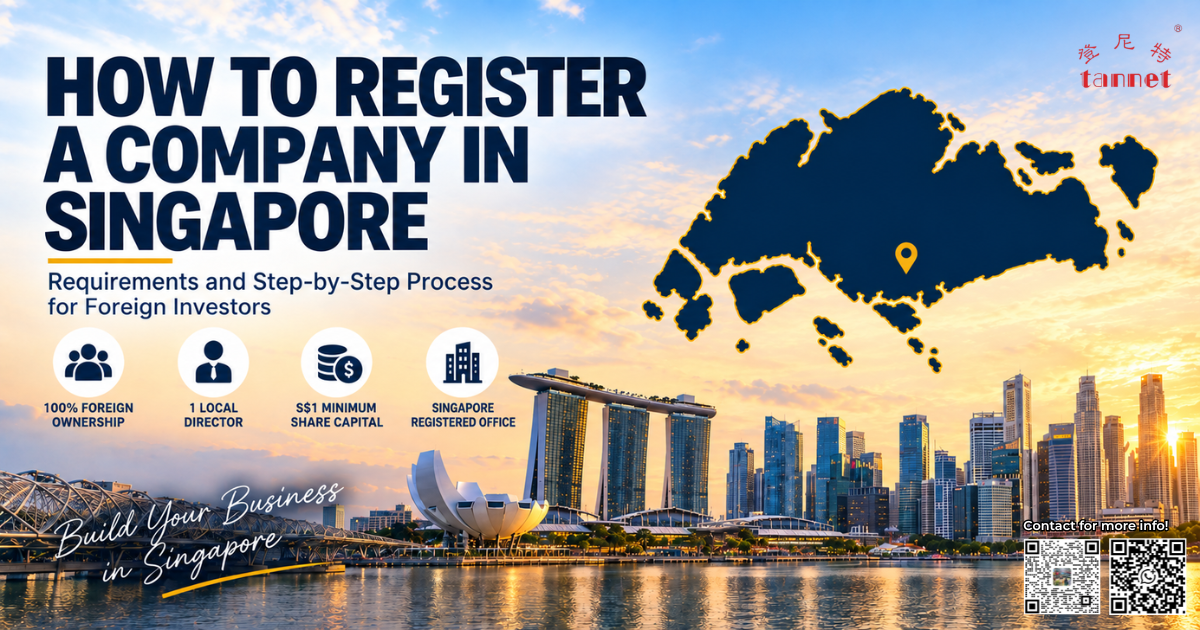
Singapore is a popular destination for foreign investors seeking a stable base for business operations in Asia. Its transparent regulatory system, established banking sector, skilled workforce and strategic location make it suitable for international trading, technology, professional services and regional headquarters.
Foreign investors can generally own 100% of a Singapore company. However, company registration does not automatically give a foreign shareholder or director the right to live or work in Singapore. Certain regulated business activities may also require additional licences.
1. Choose the Appropriate Company Structure
The most common structure for foreign investors is a private company limited by shares, normally registered with “Pte. Ltd.” in its name.
A Singapore private limited company is a separate legal entity from its shareholders. Shareholders’ liability is generally limited to the amount invested or payable on their shares.
Foreign companies may also establish a Singapore branch or representative office. However, a subsidiary is often preferred when investors want a locally incorporated entity with separate liability and greater operational flexibility.
2. Confirm the Registration Requirements
Before registering a company in Singapore, foreign investors should prepare the following:
- At least one shareholder
- At least one director ordinarily resident in Singapore
- A physical registered office address in Singapore
- A company secretary
- A company constitution
- At least S$1 in initial share capital
- A proposed company name
- Details of the principal business activities
- A financial year-end date
A private company may generally have up to 50 shareholders. Its shareholders can be foreign individuals or corporate entities, subject to restrictions that may apply to regulated industries.
Foreign directors can be appointed, but the company must maintain at least one director who satisfies Singapore’s local residency requirements.
3. Reserve the Company Name
The proposed name must be submitted to the Accounting and Corporate Regulatory Authority, or ACRA, through Bizfile.
The name must not be identical to an existing business name, undesirable or prohibited by law. Investors should also check whether the name could infringe an existing trademark.
Applications containing regulated words or suggesting activities such as banking, finance, education or healthcare may be referred to another government authority for review. This can extend the registration timeline.
4. Prepare the Required Documents
Foreign individual shareholders and directors will normally need to provide:
- A clear passport copy
- Proof of residential address
- Contact information
- Details of their occupation or business background
- Proposed shareholding information
- Source-of-funds or business information when required for due diligence
When a foreign company will become the shareholder, additional documents may include:
- Certificate of incorporation
- Constitution or equivalent document
- Registered office information
- Register of directors and shareholders
- Ownership structure identifying the ultimate beneficial owners
- Board resolution approving the Singapore investment
Overseas documents may need to be certified, notarised or translated into English, depending on their format and the compliance requirements of the appointed service provider.
Foreign applicants without the required Singapore digital credentials must engage a registered Corporate Service Provider to reserve the name and submit the incorporation application.
5. Appoint the Company Officers
Every Singapore company must have at least one qualified locally resident director. Additional foreign directors may be appointed.
A company secretary must be appointed within six months after incorporation. The secretary must be a natural person who satisfies the local residency requirements. If the company has only one director, that director cannot also act as the company secretary.
Directors must understand that their position carries legal responsibilities. They are responsible for acting in the company’s interests, maintaining proper records and ensuring that statutory obligations are fulfilled.
6. Provide a Registered Office
The company must maintain a registered office in Singapore from the date of incorporation. This is the official address used for government correspondence and statutory records.
The registered office must be a physical Singapore address and cannot be only a post-office box. It does not necessarily have to be the company’s operating location, but it must meet ACRA’s accessibility requirements and be capable of receiving official notices.
7. Submit the Incorporation Application
Once the company details are ready, the application can be submitted through Bizfile. The filing normally includes:
- Approved company name
- Registered office and office hours
- Financial year-end
- Director and secretary information
- Shareholder and share-allocation details
- Share-capital information
- Controller and nominee information, where applicable
- Company constitution
Straightforward applications may be approved quickly. Cases involving regulated activities, complex ownership structures or referrals to other authorities may require additional review.
After approval, the company receives a Unique Entity Number and electronic confirmation of incorporation.
8. Complete the Post-Registration Requirements
After incorporation, the company may still need to:
- Open a corporate bank account
- Register for applicable taxes
- Apply for business or industry-specific licences
- Maintain accounting records and statutory registers
- Issue share certificates
- Maintain beneficial ownership information
- File annual returns and corporate tax submissions
- Appoint an auditor if it does not qualify for an exemption
- Activate a Customs Account for import or export activities
Foreign investors planning to work in Singapore must separately obtain an appropriate work pass. Share ownership or appointment as a director does not automatically provide employment or immigration rights.
Conclusion
Registering a company in Singapore is relatively straightforward when the ownership structure, local director, registered office and supporting documents are properly prepared. Investors should also review licensing, tax, banking and work-pass requirements before incorporation. Completing these checks early can prevent a company from being registered successfully but unable to begin its intended operations.
Official and High-Credibility Sources
Sources:
ACRA requirements and eligibility for business registration;
ACRA guide to registering a local company;
ACRA requirements for company directors and key officers;
ACRA share capital and share type requirements;
ACRA company registration process through Bizfile;
ACRA post-registration guide for local companies;
IRAS corporate income tax guide for companies;
Ministry of Manpower requirements for Singapore work passes;
Singapore Customs registration requirements for importers and exporters.
📞 Free 1-on-1 Consultation Now,
Official Service Hotline: +86-755-82148419
Cell: +86-13823131503;+60 19-309 2363
WeChat ID: 13823131503;
WhatsApp:+86-13823131503;+60 19-309 2363
Email: mytannet08@gmail.com; susiehu@citilinkia.com