Key Takeaway
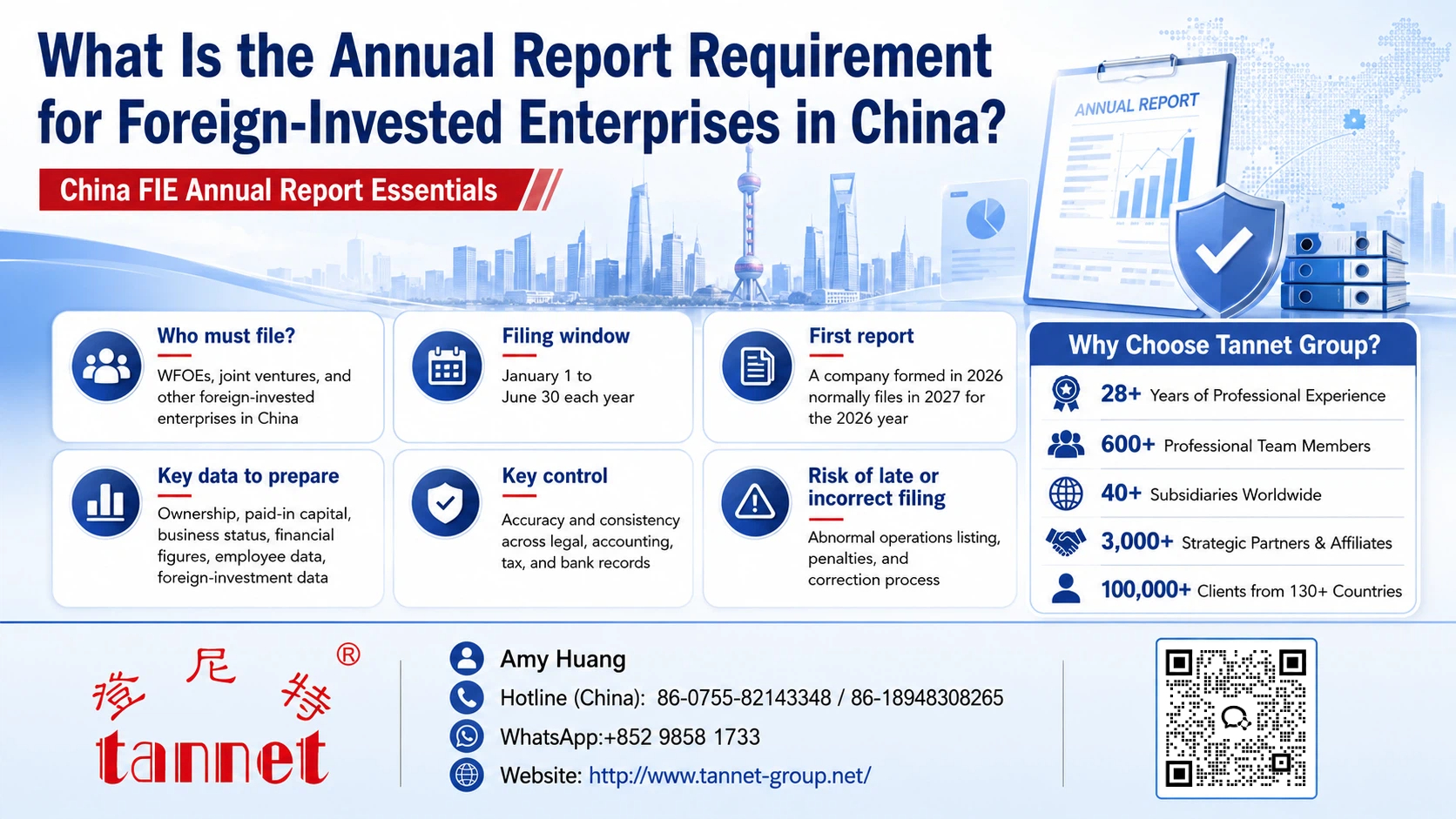
China’s annual report is a mandatory corporate disclosure filed through the National Enterprise Credit Information Publicity System. It applies to foreign-invested enterprises, including wholly foreign-owned enterprises, joint ventures, and many companies with foreign investment.
The normal filing window is January 1 to June 30 for the previous calendar year.
A company formed during 2026 starts reporting in 2027.
The most important point is accuracy, not speed.
Ownership, paid-in capital, business status, financial figures, and foreign-investment data should agree with corporate, accounting, tax, and banking records.
A dormant or pre-revenue company is not automatically exempt.
The Annual Report in One Sentence
An enterprise registered in China must report specified information for the previous year and disclose the required portion through the official public-credit system.
The obligation is based on the Interim Regulation on Enterprise Information Disclosure. Article 8 sets the January 1 to June 30 window. It also states that an enterprise formed during a year begins annual reporting in the following year.
For a foreign-invested enterprise, the same submission channel also carries foreign-investment information to the commerce authorities. The Foreign Investment Information Reporting Measures therefore add a foreign-investment layer to the ordinary enterprise annual report.
Who Must File
The rule applies to companies registered in mainland China, regardless of whether their shareholders are domestic or foreign. A WFOE is not outside the regime because its shareholder, legal representative, or management team is overseas.
An FIE with no revenue, no employees, or no active transactions should still check and complete its annual report. The regulation ties the duty to registered enterprise status, not to revenue volume.
A company registered during 2026 does not report 2025 information. It normally files its first annual report between January 1 and June 30, 2027, covering its 2026 position and activity.
Companies in liquidation, business suspension, or another special status should not assume the obligation disappears. The annual report itself asks for operating-status information. Local authorities should be consulted where deregistration or status changes overlap the reporting window.
When the Report Is Due
The statutory window runs from January 1 through June 30 each year. The report covers the immediately preceding calendar year.
As of September 3, 2026, the Ministry of Commerce annual-report application states that the period for 2025 foreign-investment annual information reports ended on June 30, 2026. Late, missing, or incorrect reports now require a remediation process rather than ordinary in-window editing.
Do not use a tax-return deadline, audit timetable, or group reporting calendar as the annual-report deadline. These are separate compliance tracks.
Where the Report Is Filed
The normal filing channel is the National Enterprise Credit Information Publicity System, commonly called GSXT. The enterprise enters the provincial interface connected to its place of registration.
Foreign-investment information is transmitted to the commerce authorities through government data sharing. In most ordinary cases, an FIE should not treat the enterprise annual report and the foreign-investment annual information report as two disconnected filings.
After filing, retain the submission record and review the public display. The 2019 joint announcement by MOFCOM, SAMR, and SAFE says an FIE may check the commerce authority’s receipt status on the foreign-investment information platform seven days after submission.
What Information Must Be Prepared
The enterprise-disclosure regulation identifies the main annual-report fields. These include the company’s contact details, operating status, external investments, shareholder contributions, equity transfers, and websites or online stores.
It also covers employee numbers and financial information. Examples include total assets, total liabilities, owners’ equity, revenue, profit, tax paid, and external guarantees.
The first six categories in Article 9 are publicly disclosed. The enterprise may choose whether to disclose the seventh category, which includes staffing and financial data. Internal approval should guide that choice.
An FIE must also prepare foreign-investment information. The reporting measures identify enterprise basics, investors and actual controllers, operations, and balance-sheet information. If the business falls under foreign-investment access restrictions, relevant industry-licence information may also be required.
The filing interface and local prompts determine the precise fields. The legal categories should be treated as the minimum framework, not as a substitute for reviewing the current screen.
A Practical Filing Process
Step 1: Confirm the Reporting Entity
Match the unified social credit code, registered name, registration authority, and reporting year. A group with several China entities must review each legal entity separately.
Step 2: Freeze a Reliable Data Date
Use the year-end position for balance-sheet and ownership data where the form requires it. Identify later changes separately so they are not mixed into the previous year’s report.
Step 3: Reconcile Corporate Records
Check the business licence, articles of association, shareholder register, capital-contribution records, board or shareholder resolutions, and completed registration changes.
Registered capital, subscribed capital, paid-in capital, contribution dates, and methods should not be guessed. Confirm them against both legal records and accounting evidence.
Step 4: Reconcile Accounting and Tax Records
Map annual-report figures to the final ledger, statutory financial statements where available, tax filings, payroll records, and bank statements. Document any permitted difference in definitions.
Step 5: Validate Foreign-Investment Data
Confirm the foreign investors, their jurisdiction, the actual controller, investment chain, business sector, and any licence connected with restricted access.
Do not copy last year’s data without checking changes. A restructuring outside China can alter the actual-controller answer even when the China shareholder name remains unchanged.
Step 6: Complete the GSXT Submission
Enter the official system through a trusted government address. Follow the identity-verification method used in the relevant province. Save drafts and review every section before submission.
Step 7: Approve Disclosure Choices
Determine which optional financial and staffing items should be public. The responsible company officer should understand that mandatory corporate information will be visible to third parties.
Step 8: Submit and Preserve Evidence
Save the receipt, submission time, final report, screenshots, preparer name, reviewer name, and source files. This creates an audit trail for future corrections and regulator questions.
Step 9: Verify the Result
Check the GSXT public record. For foreign-investment reporting, review the commerce platform status after the processing interval and raise discrepancies with the local commerce authority.
Common Mistakes
- Treating a tax return, audit, or statistical filing as a substitute for the corporate annual report.
- Assuming a dormant or pre-revenue company does not need to report.
- Reporting group totals instead of the individual China legal entity’s figures.
- Confusing subscribed capital with paid-in capital or using an uncompleted contribution date.
- Leaving an outdated shareholder, actual controller, address, email, website, or operating status.
- Submitting before finance, legal, HR, and management have reconciled their data.
- Missing June 30 and expecting the ordinary editing route to remain open.
- Saving no evidence of submission, review, correction, or public-display checks.
What Happens If the Report Is Late or Wrong
Under the revised enterprise-disclosure regulation, failure to publish an annual report on time can lead to inclusion in the list of abnormal business operations and an administrative penalty.
If an enterprise has remained uncorrected after being listed for two consecutive years of non-reporting and cannot be contacted at its registered address or business premises, the authority may revoke its business licence.
False public information can also trigger correction orders and fines. The regulation states a range of RMB 10,000 to RMB 50,000 where no other law applies, and RMB 50,000 to RMB 200,000 for serious cases, with additional credit consequences.
The foreign-investment reporting measures create a separate enforcement route. If an FIE fails to report or correct after official notice, fines can range from RMB 100,000 to RMB 300,000, or RMB 300,000 to RMB 500,000 in specified serious cases.
Frequently Asked Questions
Q1. Is the filing deadline always June 30?
The national rule sets January 1 to June 30 for the previous year’s report. Monitor local notices for system arrangements, but do not assume a local notice extends the statutory deadline.
Q2. Does a new WFOE file in its incorporation year?
No annual report is due for a period before registration. A WFOE formed in 2026 normally starts filing in 2027 for the 2026 year.
Q3. Must a dormant WFOE file?
Normally, yes. Registered status creates the annual-report duty. The company should report its actual operating and financial position, including zero activity where accurate.
Q4. Is an audit report required for every filing?
The national annual-report rules do not make a standalone audit report the universal filing document. Other laws, licences, local rules, or company circumstances may create separate audit duties.
Q5. Will all financial data become public?
Article 9 allows the enterprise to choose whether staffing and listed financial information is disclosed publicly. Other corporate fields are mandatory public information.
Q6. Can the company correct a submitted report?
In-window corrections should be made by June 30, with both the original and corrected information displayed. After July 1, an FIE may need to apply to the commerce authority and use the designated application.
Q7. What if the company already missed the deadline?
Check its GSXT status, contact the local market-regulation and commerce authorities, submit or correct the report through the directed route, and address any abnormal-list or credit-repair steps separately.
When Tannet Can Assist
Tannet may assist when an overseas shareholder needs a bilingual reporting checklist, multi-department data reconciliation, filing coordination, post-deadline correction support, or review across corporate, accounting, tax, and foreign-investment records. The company and its responsible officers should still confirm source data and approve the final submission.
Sources
Written by: Tannet Business Services Team
Reviewed by: Consultant Amy Huang
First published: 3 Sep. 2026
Last reviewed: 3 Sep. 2026
————————————————Simplifying Business, Empowering Entrepreneurs————————————————