Key Takeaway
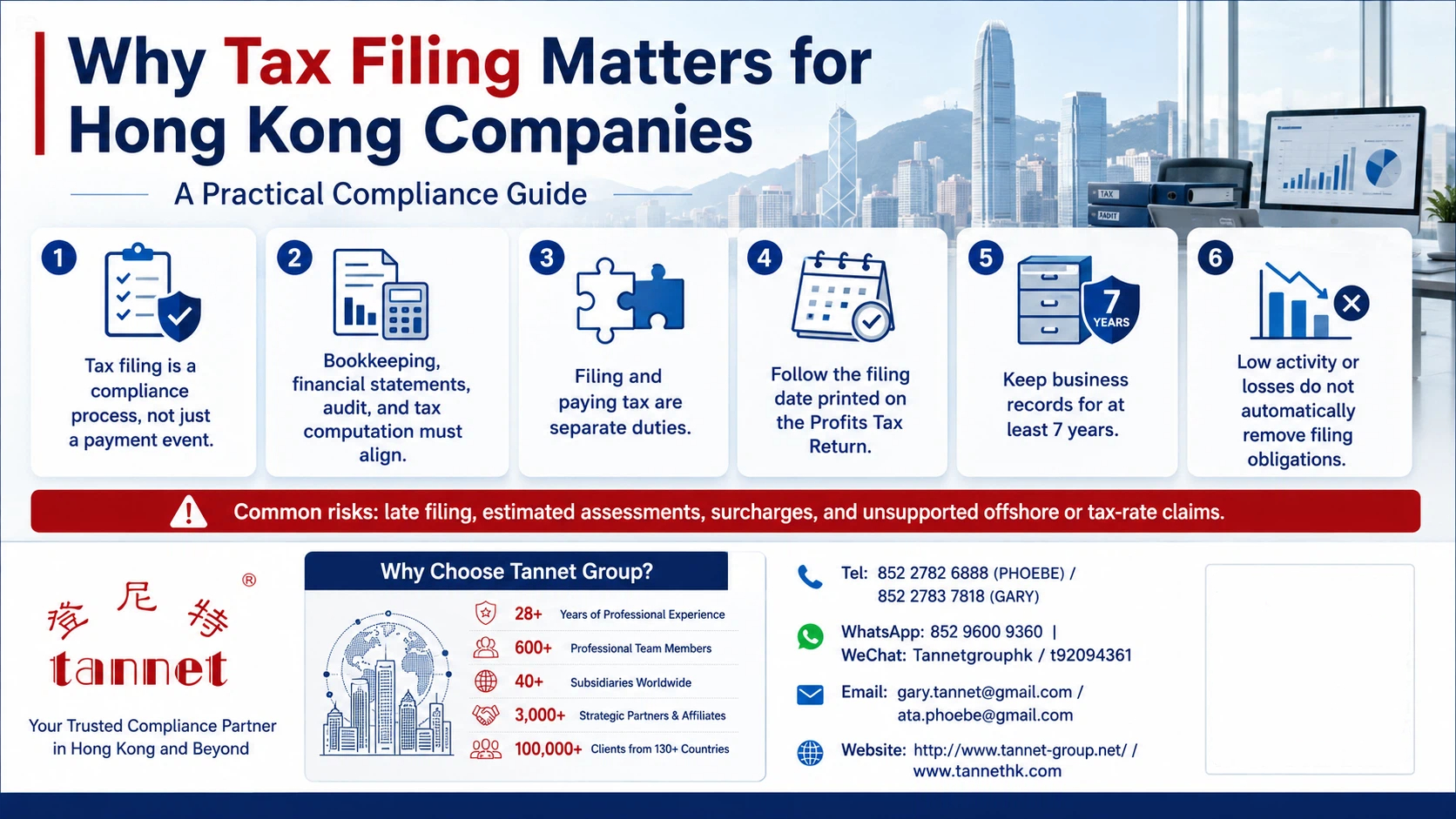
Hong Kong company tax filing is a documented compliance process, not simply a payment event. It connects bookkeeping, financial statements, audit work, tax computation, supplementary disclosures, and Inland Revenue Department deadlines.
It matters to active companies, loss-making businesses, newly incorporated entities, and companies that receive a return after a period without annual filing.
The main caution is that filing and paying are separate duties.
A company should follow the date printed on its return and assessment, keep supporting records for at least seven years, test any tax-rate or offshore claim against its own facts, and never assume that low activity removes the need to respond.
Why a Profits Tax Return matters
A Hong Kong Profits Tax Return is the company’s formal report of information needed to determine its tax position. For a corporation, the usual form is BIR51. Applicable supplementary forms and supporting documents form part of the filing process.
The return should be based on completed accounting records. It should reconcile with the company’s financial statements and tax computation. Material positions should be traceable to contracts, invoices, bank records, and working papers.
This process gives management control over the facts presented to the Inland Revenue Department, or IRD. It also exposes gaps before they become deadline problems. Missing invoices, unreconciled balances, and unclear related-party payments are easier to resolve early.
Filing and paying tax are separate duties
Filing reports the company’s position. Payment settles tax demanded under an assessment. Completing one step does not automatically complete the other.
The GovHK filing guide states that a Profits Tax Return and required supplementary forms should generally be filed within one month from issue. The actual compliance date is printed on page one of the return. An approved or applicable extension may change that date.
Tax is paid by the date on the notice of assessment. Management should therefore maintain two controls: a return-filing calendar and an assessment-payment calendar. These dates may fall months apart.
Who may need to file
The IRD generally issues a newly registered business its first Profits Tax Return about eighteen months after commencement or incorporation. Continuing businesses may receive returns through the annual bulk issue, usually beginning on the first working day of April.
Some businesses are not called upon to file annually when they have no assessable profits, have not commenced, or have ceased without recommencing. This is an administrative practice, not permission to ignore a later return.
When the IRD issues a return, the company must comply with the filing requirement. A loss, low turnover, dormant label, or empty bank account does not by itself cancel the notice.
What Hong Kong profits tax is calculated on
Profits tax is not charged on turnover alone. The computation starts from accounting results and applies tax adjustments to determine assessable profits under Hong Kong law.
For corporations, the standard profits tax rate is 16.5%. Under the two-tiered regime, the first HK$2 million of assessable profits may be taxed at 8.25%, with the excess taxed at 16.5%, subject to the statutory conditions.
The IRD explains that restrictions apply to connected entities. A group cannot assume that every connected company receives the lower tier. The election and eligibility should be checked for the relevant year.
Hong Kong also applies a territorial source principle. The place of incorporation, customer location, payment currency, or overseas bank account is not decisive by itself. The operations that produced the profit and the specific income facts matter.
Records are the foundation of filing
Section 51C of the Inland Revenue Ordinance requires persons carrying on a trade, profession, or business in Hong Kong to keep sufficient records in English or Chinese. The records must enable assessable profits to be readily ascertained.
The IRD states that business records should generally be retained for at least seven years after the transaction date. This applies even when storage is digital.
Useful records include sales invoices, purchase invoices, receipts, payment vouchers, contracts, bank statements, ledgers, inventory records, payroll information, and schedules of assets and liabilities. Cross-border transactions may require evidence showing functions, decision-making, and services performed.
Digital files should be organised, searchable, and backed up. A folder containing unnamed scans is not a reliable audit trail. Each material balance should connect to source evidence and an accounting entry.
How filing connects bookkeeping, audit, and governance
Tax preparation should not begin when the return arrives. Regular bookkeeping supports accurate year-end closing. It also reduces the volume of questions that must be resolved during audit and tax computation.
For many Hong Kong corporations, audited financial statements are part of the broader annual reporting process. The tax return, accounts, auditor’s report where applicable, tax computation, and supporting schedules must tell a consistent story.
Directors remain responsible for company oversight. They should understand material estimates, unusual transactions, related-party balances, and significant tax claims. Delegating preparation does not remove the need for informed review.
A practical timetable should assign ownership. Finance closes the ledger. Management explains business transactions. The auditor tests the accounts. The tax preparer converts accounting results into the tax computation. An authorised signer reviews the final return.
Supplementary forms require an early review
Supplementary forms are part of the Profits Tax Return when applicable. They cover topics such as the two-tiered rate election, transfer pricing, research and development, specified foreign-sourced income, and selected concessionary regimes.
GovHK states that applicable supplementary forms for years of assessment 2020/21 to 2026/27 must be submitted electronically through the Business Tax Portal or Tax Representative Portal, regardless of how the main return is filed.
The company should identify applicable forms before finalising the return. Waiting until signature day may expose missing data, portal access problems, or inconsistent answers.
Special rules can also affect large multinational groups, cross-border financing, intellectual property, equity disposals, and foreign-sourced income. These issues require a fact-specific review rather than a generic tax-rate assumption.
A step-by-step filing workflow
- Confirm the accounting period, return form, issue date, filing date, and any valid extension. Save the original notice and assign an owner.
- Close the ledger. Reconcile all bank accounts, receivables, payables, payroll, inventory, fixed assets, loans, and shareholder or director balances.
- Collect evidence. Match material income and expenses to invoices, contracts, receipts, payment records, and business explanations.
- Prepare financial statements and complete the audit process where applicable. Resolve audit adjustments before freezing the tax computation.
- Convert accounting profit or loss into assessable profit or loss. Document non-deductible items, allowances, claims, losses, and other tax adjustments.
- Review supplementary-form triggers. Consider connected entities, related-party dealings, foreign-sourced income, incentives, and specialised activities.
- Perform a final consistency check. Names, business registration details, dates, figures, accounts, schedules, and electronic files should agree.
- Submit through the correct channel. Retain the signed return, upload files, acknowledgement, computation, accounts, and evidence of submission.
- Monitor the assessment. Compare it with the filed position, note objection deadlines if an issue arises, and arrange payment by the stated date.
Common Mistakes
- Treating zero tax as zero filing. A return received from the IRD still requires action even when the company expects a loss or no tax payable.
- Reconstructing a year from bank statements. Bank movements do not explain accruals, cash expenses, loans, capital items, or the commercial purpose of transactions.
- Claiming offshore treatment from customer location alone. Source analysis depends on the operations that produced the profit and supporting facts.
- Assuming every group company gets the 8.25% tier. Connected-entity restrictions can limit the benefit.
- Mixing personal and company spending. This weakens the audit trail and creates classification, deduction, and governance questions.
- Filing before accounts and schedules agree. A quick submission can create discrepancies that later require explanation or correction.
- Assuming an extension is automatic. The company should rely on the date printed on its return or a confirmed extension, not informal expectations.
What happens after late filing or late payment
Failure to submit a return on time can lead to an estimated assessment, penalties, or prosecution, depending on the facts. An estimated assessment may not reflect the company’s deductions, losses, or explanations.
Late payment is a separate risk. Government guidance states that a 5% surcharge is generally imposed on tax in default. A further 10% surcharge may apply to the unpaid total after six months, and recovery action can include notices to third parties.
The right response to a missed date is prompt, documented action. The company should confirm what is outstanding, complete the records, communicate through the appropriate channel, and obtain advice where an assessment or penalty requires a formal response.
Management should forecast provisional tax and payment timing. A profitable year can create a demand covering final tax and provisional tax, so the cash requirement may exceed the amount expected by an owner. Compare the assessment with the filed computation as soon as it arrives. If figures differ, identify whether the issue concerns arithmetic, omitted information, an estimated amount, or a disputed treatment. Objection and holdover procedures have statutory conditions and deadlines. They should be reviewed promptly rather than treated as an extension of payment.
Frequently Asked Questions
Q1. Must a company file if it made a loss?
If the IRD issues a return, the company must file by the applicable date even when it reports a loss. The loss position should be supported by accounts, a tax computation, and records.
Q2. Does a dormant company always avoid filing?
No. The label “dormant” does not override an issued return. The company should check its legal status, actual transactions, and the specific IRD notice before deciding what to submit.
Q3. Is tax charged on revenue received into Hong Kong?
Not simply. Profits tax is based on assessable profits. Source, deductions, and adjustments depend on the operations and evidence, not only the bank location.
Q4. Can every corporation use the 8.25% rate?
No. The two-tiered regime has conditions, including restrictions for connected entities. Eligibility and the required election should be reviewed annually.
Q5. How long must records be kept?
The IRD states that business records should generally be retained for at least seven years after the transaction date. Certain disputes or other laws may justify longer retention.
Q6. Are supplementary forms optional?
They are required when the relevant circumstances apply. For specified years, applicable supplementary forms must be filed electronically even if the main return uses another filing mode.
Q7. Can an accountant file without management review?
Preparation can be delegated, but management should confirm completeness and material facts. Directors should understand significant judgments and ensure the authorised submission is accurate.
When Tannet may assist
Tannet may assist when a Hong Kong company needs to organise bookkeeping records, coordinate accounts and audit schedules, review filing readiness, track notices, or assemble information for a tax professional. Complex source-of-profit, transfer-pricing, foreign-sourced-income, objection, or multinational issues should also receive appropriate specialist advice.
This content is general information. It is not legal, tax, or accounting advice. Requirements can change, and each company should check its own facts and the latest official guidance.
Sources
Consult:
📍 HK Office:Unit B, 26/F, EGL Tower, 83 Hung To Road, Kwun Tong, Kln., Hong Kong
📞 Tel:852 2782 6888(PHOEBE)/ 852 2783 7818 (GARY)
📞 WhatsApp:852 9600 9360 | WeChat:Tannetgrouphk/ t92094361
Email:gary.tannet@gmail.com / ata.phoebe@gmail.com
🌐 Website:www.tannet-group.com / www.tannethk.com
Written by: Tannet Business Services Team
Reviewed by: Consultant Amy Huang
First published: 2 Sep. 2026
Last reviewed: 2 Sep. 2026
————————————————Simplifying Business, Empowering Entrepreneurs————————————————