Key Takeaway
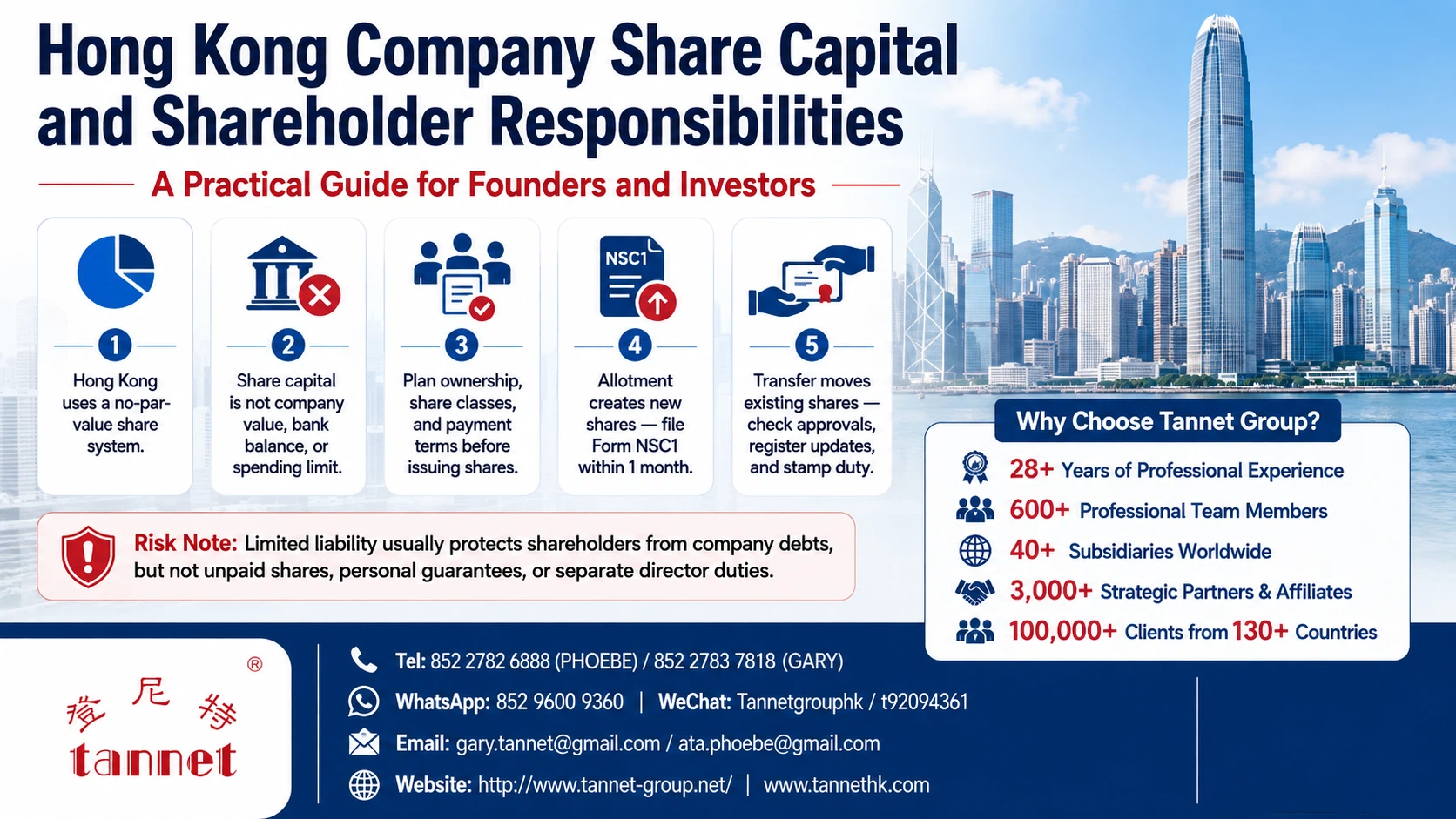
Hong Kong companies limited by shares use a mandatory no-par-value system. Share capital records the consideration paid or agreed for issued shares. It is not the company’s valuation, bank balance or spending limit. The framework suits sole founders, international owners, family businesses and investor-backed ventures that need a clear ownership structure.
The main caution is to design ownership before issuing shares. Founders should distinguish allotments from transfers, record paid and unpaid amounts, follow approval and filing rules, and understand that limited liability normally covers company debts but not unpaid share amounts, personal guarantees or separate director duties.
Why “Registered Capital” Can Mislead
Founders often ask how much “registered capital” a Hong Kong company needs. Hong Kong law uses more precise concepts: issued shares, share classes, subscribed capital, paid-up capital and unpaid consideration.
These figures describe the ownership and contribution structure. They do not prove commercial value. A company with HK$10,000 of share capital may hold a valuable business, while a company with higher stated capital may have little cash or trading activity.
The Companies Registry states that Hong Kong adopted a mandatory no-par regime for local companies with share capital on 3 March 2014. Par value, authorised share capital and share premium are no longer current capital concepts.
How the No-Par System Works
A no-par share has no fixed nominal or face value. It still represents a unit of ownership. The shareholder’s percentage depends on the shares held relative to the company’s total issued shares and any class rights.
The company and subscriber agree the consideration for an issue. The full proceeds are credited to share capital. The law no longer links the minimum issue price to an artificial nominal amount.
No-par does not mean no value. It removes a legal label that could be mistaken for market value. The economic value of a share depends on the business, assets, liabilities, rights, prospects and transaction terms.
Issued capital relates to shares already created and allotted. Paid-up capital is the consideration actually paid. A partly paid share carries an outstanding amount that may be called or remain payable under the issue terms.
Choosing the Initial Share Structure
A simple fully paid structure often works for a sole founder. Complexity becomes more important when there are co-founders, family members, investors, nominee arrangements or future employee incentives.
Before incorporation or an allotment, answer five questions:
- Who should own the company, and in what percentages?
- Which voting, dividend and return-of-capital rights should each class carry?
- How much consideration will each subscriber pay, and when?
- Could new shares dilute an existing owner or change control?
- What approvals and restrictions appear in the articles or shareholders’ agreement?
The number of shares is a denominator, not a quality score. One hundred shares can express a 60:40 relationship as clearly as one million shares. A larger number may provide finer allocation units, but it does not make the company stronger.
An unusually low or high capital amount should have a reason. Consider working-capital needs, bank or counterparty expectations, future fundraising, accounting treatment, licensing requirements and the owner’s willingness to fund the commitment.
Share Rights Need Written Rules
Ownership percentage is only one part of a shareholding. Different classes may carry different voting, dividend, conversion, redemption or capital rights, subject to the Companies Ordinance and the company’s constitutional documents.
The articles govern the company and its members. A shareholders’ agreement may add transfer restrictions, reserved matters, funding obligations, deadlock procedures, information rights and exit arrangements.
These documents should work together. A commercial promise in an email may be difficult to reconcile with registered articles or board records later. Important rights should be documented before money or shares change hands.
The Issue Price Is a Governance Decision
The no-par regime removed the former minimum issue price tied to nominal value. It did not remove directors’ duties.
The Companies Registry explains that an issue price is a commercial bargain between the company and investor. Directors retain an overriding fiduciary duty to set the price in good faith.
This matters when shares go to a founder, connected party or new investor. A low-priced issue can dilute another shareholder. A high-priced issue can create funding, valuation, tax or accounting questions.
Before approval, document the commercial purpose, proposed price, payment terms, ownership effect and relevant conflicts. Check whether board approval, shareholder approval, class consent or contractual consent is required.
Allotment Creates New Shares
An allotment occurs when the company creates and issues new shares. It can increase issued capital and change ownership percentages.
Section 142 of the Companies Ordinance requires a limited company to deliver a return of allotment within one month after an allotment. Form NSC1 includes a Statement of Capital.
A practical allotment sequence is:
- Review the articles, shareholders’ agreement and existing class rights.
- Confirm authority, approvals, issue price and payment terms.
- Sign subscription and supporting documents.
- Pass and retain the required resolutions.
- Receive or clearly record the agreed consideration.
- Update the register of members and issue the share certificate.
- File Form NSC1 within the statutory period.
- Reconcile the public filing with the accounts and internal records.
Non-cash consideration needs additional attention. Property, services, debt conversion or another asset should be described and supported consistently in the transaction documents and filing.
Founder shares issued to the members who signed the articles at incorporation generally do not require a separate NSC1. Later allotments should be assessed separately.
A Transfer Moves Existing Shares
A transfer does not create new shares. It moves existing shares from one holder to another. Issued capital normally remains unchanged, although ownership and control may change.
The Companies Registry does not require an immediate specified form merely because a transfer occurs. The transfer is reported in the first annual return made after the transfer.
That rule does not complete the transaction. The company should check transfer restrictions, obtain required approvals, prepare contract notes and an instrument of transfer where applicable, address stamp duty, update the register of members and issue the appropriate certificate.
The Inland Revenue Department provides e-Stamping services for share-transfer instruments. Consideration, market value, timing and exemptions can affect the assessment. Current Stamp Office guidance should be checked for each transaction.
If an annual return was filed before the change, the company should not submit a revised annual return merely to report the new shareholder. The next annual return reports the position as at its made-up date.
What the Statement of Capital Shows
The Companies Registry describes a Statement of Capital as a snapshot of the company’s total subscribed capital at a particular time. It appears in forms delivered when share capital changes.
The statement should align with the number and class of shares, total subscribed amount, paid and unpaid amounts, resolutions, subscription records, accounts and register of members.
The Registry’s 2026 filing tips identify common errors. Paid-up capital is sometimes reported as greater than issued capital, or annual-return figures do not match the Registry’s existing record.
Reconcile figures before filing. Correcting an ownership history during investment, banking, audit or due diligence is usually harder than maintaining it correctly after each event.
What Limited Liability Actually Covers
Section 84 of the Companies Ordinance states that the articles of a company limited by shares must limit members’ liability to any amount unpaid on their shares.
A shareholder holding fully paid shares is generally not personally liable merely because the company cannot pay an ordinary company debt. The company is a separate legal person.
Partly paid shares are different. The member may remain responsible for the unpaid consideration. The issue terms, articles and circumstances determine how that amount can become payable.
Limited liability is not complete immunity. A shareholder can assume a separate personal obligation by signing a guarantee, borrowing personally, entering a separate contract or making a personal representation.
A shareholder who is also a director has another legal role. Director duties and conduct-related liabilities arise independently from share ownership. Fraud, wrongful conduct, insolvency issues and regulatory breaches require specific legal analysis.
Shareholders and Directors Have Different Roles
A shareholder owns shares and exercises rights attached to them. A director manages or supervises the company’s affairs and must comply with director duties.
The same person can hold both roles in a private company. Corporate records should still identify which capacity is being used for each decision.
An allotment may require a board decision, member authority or both. A related-party transaction may require conflict disclosure. A transfer may need board registration under the articles.
Clear resolutions reduce later arguments about whether a person acted as owner, director, creditor, guarantor or contracting party.
Ownership Changes Affect More Than Certificates
Every Hong Kong company must keep a register of members in English or Chinese. The register is the core internal record of legal membership.
An ownership change may also affect the Significant Controllers Register. The Companies Registry states that Hong Kong incorporated and re-domiciled companies must obtain and maintain up-to-date beneficial ownership information, subject to applicable exemptions.
A person can meet a significant-control condition through direct or indirect ownership, voting rights or other control. The official FAQ uses more than 25% of issued shares as one ownership threshold.
After an allotment or transfer, review the register of members, Significant Controllers Register, share certificates, annual-return data, banking records, licences, tax files and contractual notices.
Build a Pre-Transaction Evidence File
Before approval, create one capital schedule showing every holder, class, number of shares, ownership percentage, subscribed amount, paid amount, unpaid amount and currency. Recalculate the position before and after the proposed event.
Add the articles, shareholders’ agreement, resolutions, register of members and latest filed Statement of Capital. This baseline helps the board identify pre-emption rights, class consents, transfer restrictions and existing discrepancies before they affect the transaction.
Prepare a transaction memorandum. State whether the event is an allotment or transfer, its commercial purpose, consideration, payment method, valuation basis, approval route, conflict position, filing deadline and person responsible for each action.
After completion, collect signed resolutions, agreements, banking or non-cash evidence, stamping records, certificates, updated registers and filing receipts.
For cross-border owners, names and addresses should match identity and corporate documents. Explain transliteration, legal-name, currency or date differences. A consistent evidence chain supports banking, audit, fundraising, succession planning and future due diligence.
The process should have one accountable coordinator. Directors make the decisions, while the company secretary or service team can maintain the checklist, deadlines and document index.
Common Mistakes
- Treating share capital as the company’s market valuation.
- Copying a generic share number without modelling ownership percentages.
- Assuming no-par shares can be issued without good-faith pricing decisions.
- Confusing an allotment with a transfer and using the wrong documents.
- Missing the one-month deadline for Form NSC1 after an allotment.
- Reporting paid-up capital above issued capital or using inconsistent currencies.
- Believing fully paid shares cancel personal guarantees or director duties.
- Updating a share certificate but not the statutory and beneficial-ownership records.
Frequently Asked Questions
Q1. Is there a statutory minimum share capital for a normal Hong Kong private company?
The no-par framework does not use a general authorised-capital ceiling or nominal-value minimum. The company still needs at least one issued share, and sector-specific licensing or commercial requirements may affect an appropriate amount.
Q2. Does HK$10,000 of share capital mean HK$10,000 must stay in the bank?
Not automatically. Share capital records the contribution position. Use of company funds depends on proper corporate purposes, accounting, solvency, contractual restrictions and applicable law.
Q3. Can a company issue shares for services instead of cash?
Potentially. Non-cash consideration needs clear valuation, approval, documentation and filing support. Form NSC1 may need accompanying documents.
Q4. Does adding a shareholder require Form NSC1?
It depends on the transaction. Creating new shares is an allotment and normally requires NSC1. Moving existing shares is a transfer and follows a different process.
Q5. Are shareholders responsible for company debts?
Ordinary company debts generally remain with the company. A member’s statutory exposure is normally the unpaid amount on held shares, but guarantees, contracts, directorships and misconduct can create separate liability.
Q6. Can directors issue shares at any price?
No-par removes a nominal-value floor, not governance duties. Directors should set the price in good faith, follow approvals and document the commercial basis and dilution effect.
Q7. When is a share transfer shown at the Companies Registry?
The transfer is generally reported in the first annual return made after it occurs. Internal registration and stamp-duty steps should be completed without waiting for that return.
Q8. Should a sole shareholder maintain a Significant Controllers Register?
Most Hong Kong incorporated private companies must keep the register even when ownership is simple, unless an exemption applies. The required particulars and designated representative should be reviewed.
When Tannet Can Assist
Tannet can assist when founders need an initial ownership map, incorporation documents, allotment or transfer coordination, Companies Registry filings, statutory-register updates, Significant Controllers Register support or a compliance calendar. Transactions involving disputes, valuation, tax, securities regulation, insolvency or personal liability may also require advice from the relevant qualified professional.
Sources
Consult:
📍 HK Office:Unit B, 26/F, EGL Tower, 83 Hung To Road, Kwun Tong, Kln., Hong Kong
📞 Tel:852 2782 6888(PHOEBE)/ 852 2783 7818 (GARY)
📞 WhatsApp:852 9600 9360 | WeChat:Tannetgrouphk/ t92094361
Email:gary.tannet@gmail.com / ata.phoebe@gmail.com
🌐 Website:www.tannet-group.com / www.tannethk.com
You are also welcome to visit our service outlets in Beijing, Shanghai, Guangzhou, Shenzhen, and other cities at any time.
Written by: Tannet Business Services Team
Reviewed by: Consultant Amy Huang
First published: 2 Sep. 2026
Last reviewed: 2 Sep. 2026
————————————————Simplifying Business, Empowering Entrepreneurs————————————————