Key Takeaway
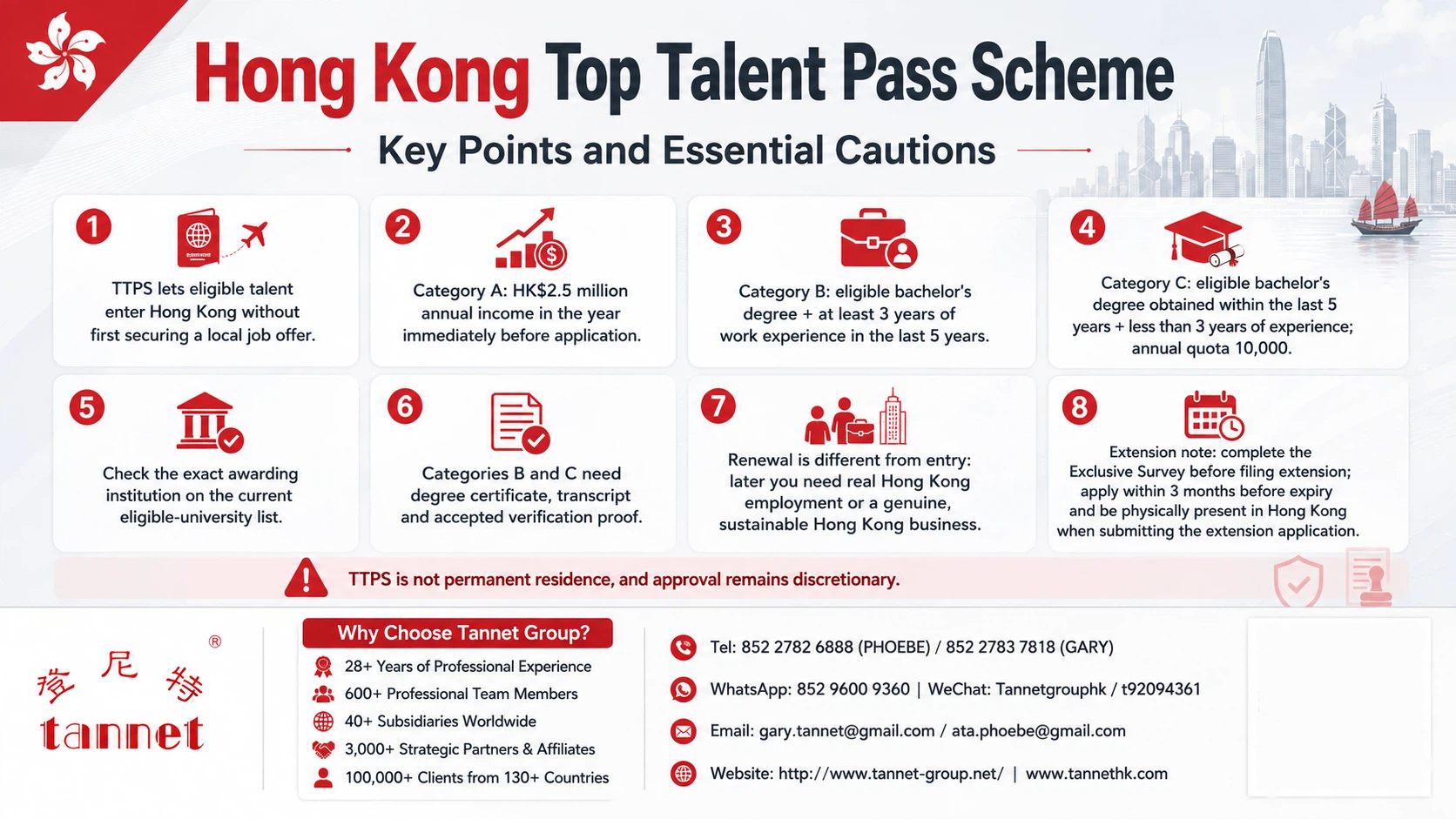
Hong Kong’s Top Talent Pass Scheme, or TTPS, lets eligible high earners and graduates of listed universities enter Hong Kong without first securing a local job offer.
Category A is income based. Categories B and C depend on an eligible bachelor’s degree, graduation timing and work experience.
The scheme suits executives, entrepreneurs and recent graduates who want flexibility to explore employment or business.
The main caution is that entry eligibility and renewal eligibility are different.
Applicants must select the correct category, verify current university and evidence rules, and plan genuine Hong Kong employment or business activity before the initial stay expires.
What the Top Talent Pass Scheme Is
TTPS is a Hong Kong entry arrangement for high-income talent and graduates of eligible universities. It started on 28 December 2022.
An initial Hong Kong job offer is not required. This distinguishes TTPS from employer-sponsored routes that depend on a confirmed position at filing.
Approval remains discretionary. Meeting a published threshold does not remove normal immigration, security, criminal-record and document requirements.
The Hong Kong Immigration Department recorded 14,847 TTPS approvals in the first half of 2026. Of these, 5,937 were Category A approvals.
These figures show that TTPS is established. They do not predict the outcome of a case.
The same official data shows that commerce and trade, innovation and technology, and financial services were major declared sectors among approved applicants with work experience. TTPS is therefore not limited to one profession.
The scheme also should not be confused with permanent residence. Every approval carries a time limit. Continued residence depends on a later extension or another lawful immigration status.
The Three TTPS Categories
An applicant should use one category. The correct route depends on income, degree-awarding institution, graduation date and post-graduation work history.
Category A – The High-Income Route
Category A requires annual income of at least HK$2.5 million, or the foreign-currency equivalent, in the year immediately preceding the application.
The official definition focuses on taxable employment or business income. Salary, allowances, stock options and profits from self-owned companies may fall within it.
Personal investment income is excluded. Savings, asset values, portfolio gains and property appreciation do not become qualifying income merely because they show wealth.
Business owners face an additional evidence issue. Immigration generally expects continuous ownership of the relevant company throughout the preceding tax assessment year used for the profit calculation.
Approved Category A applicants normally receive an initial stay of 36 months.
Category B – Eligible Degree Plus Experience
Category B requires a bachelor’s degree from an institution on the current aggregate list of eligible universities.
The applicant must also have accumulated at least three years of work experience during the five years immediately preceding the application.
Official guidance treats relevant experience as full-time employment or self-employment after graduation. Dates should therefore be calculated rather than estimated from a résumé.
Approved Category B applicants normally receive an initial stay of 24 months.
Category C – Recent Graduate Route
Category C requires an eligible bachelor’s degree obtained within the five years immediately preceding the application. The applicant has less than three years of work experience.
The five-year test is counted by year of graduation. Applicants close to the boundary should check the official FAQ before choosing a filing date.
Category C has an annual quota of 10,000. Allocation is first come, first served.
It is not available to non-local students who obtained the relevant undergraduate qualification through a full-time, locally accredited programme in Hong Kong. The Immigration Arrangements for Non-local Graduates may be more relevant in that situation.
Approved Category C applicants normally receive an initial stay of 24 months.
University Name Alone Does Not Establish Eligibility
Categories B and C use the current Aggregate List of Eligible Universities. The list is compiled under specified ranking and specialist-institution criteria.
Applicants should check the exact awarding institution. General reputation, historic ranking or an online claim is not a substitute for the official list in force at filing.
The 2026 list illustrates why a fresh check matters. It added several institutions and removed Ecole Polytechnique, Université Grenoble Alpes, Universite Sorbonne Paris Cite-USPC and the University of Freiburg from 1 January 2026.
The qualification must be equivalent to a recognised Hong Kong bachelor’s degree. An honorary bachelor’s degree is not accepted.
Qualifications issued by continuing-education arms, branch schools, extension schools or subsidiary schools of eligible universities are also excluded.
For a joint programme, every relevant awarding institution must be on the eligible list. A logo or teaching arrangement with one listed university is not enough.
Academic Verification Is a Core Filing Requirement
Category B and C applicants must provide the degree certificate and transcript. They must also provide verification proof for the bachelor’s qualification.
The verification may be issued by an accepted third-party credential-verification organisation or by the awarding institution. The applicant must provide information needed for online authentication.
A certificate alone may therefore be insufficient. Start verification before filing, especially where the awarding institution, campus or programme has changed its name.
Certified translations may be needed where records are not in Chinese or English. Names, dates and programme titles should remain consistent across the source record, translation and online form.
Category A Requires an Income Reconciliation
Category A evidence should explain what produced each amount, when it arose and why it fits the official income definition.
For an employee, useful records can include a tax assessment, employer confirmation, employment contract, payroll statements, payment records and stock-option valuation documents.
For an owner, useful records can include registry records, audited financial statements, profit-and-loss accounts, profits tax returns and evidence connecting company profit to the applicant.
Bank statements prove that money moved. They do not, by themselves, establish the character, tax treatment or correct period of every receipt.
Prepare one reconciliation. Show the income source, gross amount, currency, conversion method, Hong Kong dollar amount, period and supporting document.
The online system can convert income stated in Hong Kong dollars or 17 listed foreign currencies. For another currency, the applicant should convert the amount and upload supporting evidence.
Work Experience Must Be Mapped to the Correct Period
Category B requires at least three years of experience in the preceding five years. Category C requires less than three years.
This means the same applicant may move from Category C to Category B as time passes. The filing date can change the available category.
Prepare a month-by-month employment chronology. Include employer, role, location, start date, end date, full-time status and whether the experience arose after graduation.
Self-employment should be supported with business registration, contracts, invoices, tax records and evidence of actual activity. A company certificate alone does not prove full-time experience.
Overlapping roles, career breaks and part-time periods should be explained. Do not leave Immigration to reconstruct the chronology from disconnected letters.
A Practical Initial Application Workflow
The initial application is submitted online. A complete preparation process has six stages.
- Confirm Category A, B or C against the applicant’s current facts.
- Check nationality, residence history and normal immigration requirements.
- Verify the current eligible-university list, awarding institution, qualification and programme where Categories B or C are used.
- Build an income or work-experience reconciliation and collect third-party records.
- Review the online declarations, upload readable files and pay the application fee.
- Preserve the submitted form, uploads, receipt, correspondence and approval documents for renewal.
The applicant and any dependant must confirm that information is correct, complete and true. A parent or legal guardian signs for a dependant child under 16.
The official service standard is normally about four weeks after all required documents and the fee are received. Verification or supplementary requests can extend the timeline.
Fees Should Be Budgeted Per Person
TTPS is a specified scheme under the current fee structure. Each principal or dependant application carries a HK$600 application fee.
The application fee is non-refundable regardless of the result. Payment does not constitute an assurance of approval.
After approval, a separate visa or entry-permit issuance fee applies. A relevant period exceeding 180 days currently carries a HK$1,300 issuance fee.
Applicants should also budget for degree verification, certified translations, corporate or tax records and dependant evidence where applicable.
Normal Immigration Rules Still Apply
TTPS does not apply to nationals of Afghanistan, Cuba or the Democratic People’s Republic of Korea under the current official rules.
Overseas Chinese nationals holding People’s Republic of China passports must satisfy additional overseas residence and application-location conditions.
Other applicants must meet the normal requirements. They should hold a valid travel document, have no known serious criminal record, raise no security objection and be able to support themselves.
Complex nationality, immigration-history or criminal-record issues should be reviewed before fees are paid. A simplified category checklist cannot resolve them.
Dependants Need Their Own Evidence
A TTPS applicant or entrant may sponsor an eligible spouse or legally recognised partner and unmarried dependent children under 18.
The relationship must be genuine. The dependant must have no known adverse record.
The sponsor must show adequate financial support and suitable accommodation in Hong Kong. Principal eligibility does not automatically establish the dependant case.
Under current policy, admitted TTPS dependants may work or study in Hong Kong. Their permitted stay normally remains linked to the sponsor’s status.
Family files should be timed with the principal case. Marriage, birth, custody and accommodation records may need translation or further authentication depending on where they were issued.
What Approval Allows
TTPS entrants are normally admitted on time limitation only without other conditions of stay.
During the permitted stay, they may take up employment, change employment, establish a business or join a business without prior Immigration Department approval.
That flexibility is useful for executives comparing opportunities and founders testing a Hong Kong operation. It also creates responsibility to build a verifiable local record.
The initial stay under TTPS is available only once. A person whose TTPS stay expires cannot simply submit a second initial TTPS application.
Re-entry during the permitted stay normally does not require a separate re-entry visa, provided the limit of stay remains valid and the circumstances supporting residence have not changed. Entrants should still check travel-document validity before travel.
Renewal Uses a Different Test
Entry eligibility looks at historic income, education and experience. General renewal looks at the entrant’s current Hong Kong employment or business.
An employment-based extension requires stable Hong Kong income. The position should be appropriate for a degree holder or a person with strong professional or technical qualifications, abilities, experience or achievements.
The remuneration package should be at market level. Useful evidence includes the contract, employer letter, payroll, MPF and Hong Kong tax records.
A business-based extension requires evidence of a genuine, healthy and sustainable Hong Kong operation. Incorporation without operations is insufficient.
Immigration may consider turnover, financial resources, investment, local jobs, economic benefit, business development and the applicant’s duration of stay.
A general extension is normally granted for not more than three years, or until the employment contract expires if that date is earlier.
The 2026 Survey Is Part of the Extension Process
From 30 January 2026, every TTPS entrant must complete the Exclusive Survey for Top Talent Pass Holders before commencing an online extension application.
The acknowledgement of completion must be uploaded with the extension file. This is a procedural requirement, not optional market research.
The applicant must be physically present in Hong Kong when submitting the online extension and when collecting the e-Visa.
An application can be filed within three months before expiry. Immigration advises filing at least six weeks before the existing limit ends.
The Top-Tier Stream Has a Separate Income Test
A six-year extension may be available under the top-tier employment stream.
The applicant must have remained under TTPS for at least two years. The applicant must also have at least HK$2 million in assessable income for Hong Kong Salaries Tax in the previous year of assessment.
This is not the original Category A test. It is a separate Hong Kong Salaries Tax test applied at extension.
Applicants considering this route should retain Hong Kong employment and tax evidence from the beginning. Original overseas income does not replace the later local requirement.
Common Mistakes
- Selecting a category from a summary without testing the exact dates.
- Counting personal investment returns as Category A income.
- Using company turnover instead of qualifying income attributable to the owner.
- Assuming a famous university, branch campus or extension programme qualifies.
- Filing without accepted degree verification for Category B or C.
- Submitting inconsistent job titles, dates, income figures or translations.
- Treating a Hong Kong company certificate as sufficient renewal evidence.
- Waiting until the extension window opens to build local records.
Frequently Asked Questions
Q1. Do I need a Hong Kong job offer before applying?
No. TTPS does not require an initial job offer. Renewal later requires credible Hong Kong employment or a genuine operating business.
Q2. Is HK$2.5 million in savings enough for Category A?
No. Category A focuses on qualifying annual employment or business income, not savings, net worth or personal investment returns.
Q3. Can I apply under Category B with a master’s degree from a listed university?
The core qualification is an eligible bachelor’s degree. A master’s degree alone does not replace the bachelor’s-degree requirement.
Q4. Does an overseas branch of an eligible university count?
Do not assume so. Branch, extension, continuing-education and subsidiary schools are excluded under the official guidance.
Q5. Can self-employment count as Category B work experience?
Potentially. It should be full-time, post-graduation experience within the relevant five-year period and supported by credible business, contract and tax records.
Q6. Can my spouse work in Hong Kong?
An eligible dependant admitted under current TTPS dependant policy may work or study. The dependant application still requires relationship and support evidence.
Q7. Is renewal automatic if I register a Hong Kong company?
No. The business should demonstrate genuine and sustainable operations through financial, commercial, tax, staffing and management evidence.
Q8. Can I apply for TTPS again after my initial stay expires?
No. The official FAQ states that the TTPS initial stay can be granted only once. Another immigration route would be needed.
When Tannet Can Assist
Tannet can assist where an applicant needs preliminary category mapping, an income or work-history checklist, document coordination, dependant preparation, Hong Kong company formation or a renewal evidence calendar. Complex immigration, tax, credential or criminal-record questions may require review by the relevant qualified specialist. The final filing should follow the official rules and eligible-university list in force on the application date.
Sources
Consult:
HK Office:Unit B, 26/F, EGL Tower, 83 Hung To Road, Kwun Tong, Kln., Hong Kong
Tel:852 2782 6888(PHOEBE)/ 852 2783 7818 (GARY)
WhatsApp:852 9600 9360 | WeChat:Tannetgrouphk/ t92094361
Email:gary.tannet@gmail.com / ata.phoebe@gmail.com
Website:www.tannet-group.com / www.tannethk.com
Written by: Tannet Business Services Team
Reviewed by: Consultant Amy Huang
First published: 1 Sep. 2026
Last reviewed: 1 Sep. 2026
————————————————Simplifying Business, Empowering Entrepreneurs————————————————