Key Takeaway
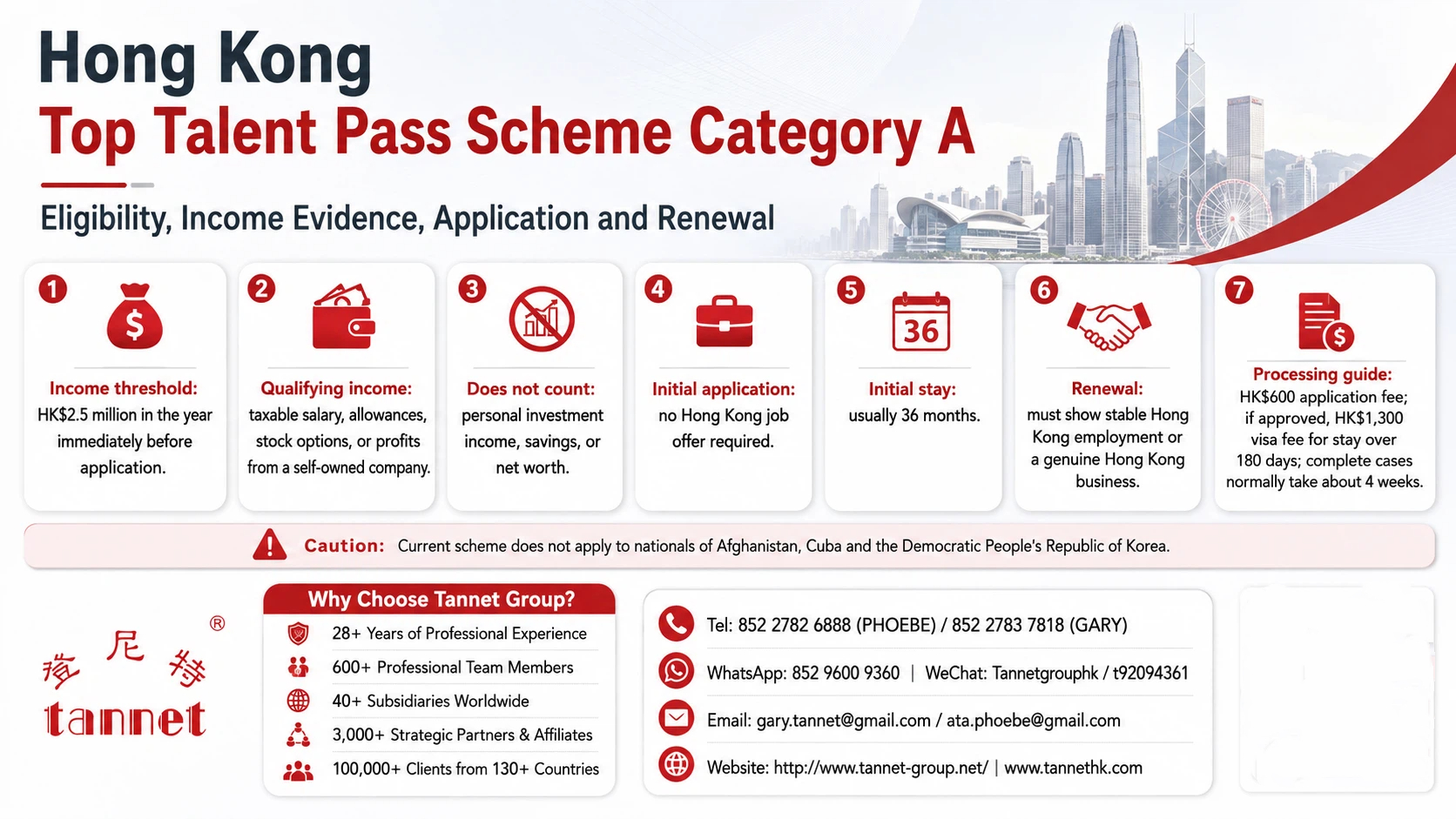
Hong Kong’s Top Talent Pass Scheme Category A is an income-based immigration route for people who earned at least HK$2.5 million, or the foreign-currency equivalent, in the year immediately before applying. It suits senior executives, entrepreneurs and business owners who want flexibility to work, change employment, or establish or join a Hong Kong business without first securing a local job offer.
The critical issue is evidence.
The Immigration Department looks at taxable employment or business income, the correct reference period and consistent documents. Personal investment income does not count. Approval is discretionary, and applicants should plan for renewal from the start.
What TTPS Category A Is
The Top Talent Pass Scheme, or TTPS, allows eligible talent to explore professional opportunities in Hong Kong. Category A is the route for applicants meeting the scheme’s high-income test.
A local employment offer is not required for the initial application. Successful Category A entrants normally receive 36 months on time limitation only, without other conditions of stay.
The HK$2.5 Million Eligibility Test
The applicant must show annual income of at least HK$2.5 million, or its equivalent in foreign currency, in the year immediately preceding the application date.
The application date therefore affects the reference period. Applicants should identify the applicable tax year or twelve-month period before assembling evidence.
The threshold is not a net-worth test. Owning valuable property, securities or other assets does not replace qualifying income.
Which Income Can Count
The Immigration Department defines annual income as taxable employment or business income. It gives salary, allowances, stock options and profits from self-owned companies as examples.
Employment income should be connected to the relevant period and supported by documents from the employer and competent tax authority. The claimed amount, remuneration components and payment record should align.
Business owners may rely on profits from self-owned companies. In general, the applicant should have continuously held the relevant shares throughout the preceding tax assessment year used for the calculation.
Which Income Does Not Count
Income generated from personal investment is not considered under the official Category A definition. A portfolio return or capital gain should not be presented as employment or business income merely because it is taxable elsewhere.
Applicants should not combine unrelated figures to reach the threshold without a defensible basis. Ambiguous items should be reviewed before the online form is signed.
Evidence for Employment Income
A credible employment-income file normally starts with an official tax assessment or equivalent record from the competent authority for the relevant year.
Useful supporting records may include tax-payment certificates, employment agreements, employer confirmation letters, payroll statements, bank records and documents specifying the value of stock options granted.
The evidence should identify the employer, position, income period, currency, gross amount and major remuneration components. Any difference between tax documents and employer records should be explained.
Evidence for Self-Owned Company Income
Business owners should separate the company’s performance from the income personally attributed to them. Ownership, profit and tax evidence must connect clearly.
The official examples include a profits tax assessment, tax-payment certificates, audited financial statements, a trading profit-and-loss account and a profits tax return.
Add corporate registry records showing shareholding continuity. Where several group entities are involved, explain which company generated the profit and how the applicant acquired qualifying income.
Normal Immigration Requirements
Meeting the income threshold does not compel approval. Each application is assessed on its individual merits, and approval remains discretionary.
Applicants should hold a valid travel document with adequate returnability, have no known serious criminal record or security concern, and not be likely to become a burden on Hong Kong.
The TTPS currently does not apply to nationals of Afghanistan, Cuba and the Democratic People’s Republic of Korea. Nationality and residence facts should be checked against the latest official guidance.
How the Online Application Works
Initial TTPS applications are submitted online. The applicant uploads a recent photograph, travel document and the evidence applicable to Category A.
GovHK accepts common image and PDF formats and imposes file-number and size limits. Scans should be legible, logically named and matched to a simple document index.
Documents not in Chinese or English should have a certified Chinese or English translation that meets the Immigration Department’s requirements.
Fees and Processing Time
TTPS is a specified scheme. The principal applicant and each dependant pay a non-refundable application fee. The official fee table lists HK$600 per specified-scheme application.
If approved, a separate visa or entry-permit issuance fee applies. For a period exceeding 180 days, the current fee table lists HK$1,300.
The Immigration Department states that complete TTPS entry applications normally take about four weeks. Processing does not start until required documents and the application fee are received.
Dependants
An eligible principal applicant may sponsor a spouse or legally recognised partner and unmarried dependent children under 18 under the prevailing dependant policy.
The sponsor must show a genuine relationship, suitable accommodation and the ability to support dependants above the subsistence level.
Dependant status is a separate evidence exercise. Relationship certificates, travel documents, financial support and accommodation information should be consistent with the principal application.
The dependant’s stay is normally linked to the sponsor’s stay. Eligible dependants are not prohibited from employment or study under the current policy.
Renewal Must Be Planned from Day One
The initial 36-month stay is normally granted only once. Extension is not based solely on the original HK$2.5 million income test.
At renewal, the holder must prove stable employment in Hong Kong or show that a Hong Kong business has genuinely been established or joined.
For employment, the role should normally be at a suitable professional level and remuneration should be at market level. Immigration may consider pay, economic benefit and time spent in Hong Kong.
For business, evidence may include registration records, ownership, licences, audited accounts, tax filings, office arrangements, contracts, invoices, investment and local jobs.
Extension Timing and the 2026 Survey
An extension application may be submitted within three months before the current stay expires. The Immigration Department advises filing as early as possible and at least six weeks before expiry.
Since 30 January 2026, TTPS entrants must complete the Exclusive Survey for Top Talent Pass Holders before starting the online extension application and upload the acknowledgement.
Applicants must be physically present in Hong Kong when submitting the online extension application. The stated routine processing time is two to three weeks after all documents and the fee are received.
A pending application does not automatically authorise an overstay. Unless exceptional approval is given, the person must leave before the existing limit expires.
The Six-Year Top-Tier Extension
A TTPS holder may seek assessment under the top-tier employment stream at the extension stage if two separate conditions are met.
The person must have been permitted to remain under TTPS for at least two years. The person must also have assessable income for Hong Kong Salaries Tax of at least HK$2 million in the previous year of assessment.
This is not the same as the initial Category A test. The initial test concerns qualifying annual income before application, while the top-tier test concerns Hong Kong assessable employment income at extension.
Official Statistics Provide Context, Not Eligibility
Immigration Department statistics show 14,847 TTPS approvals in the first half of 2026. Of these, 5,937 were Category A approvals reported by preceding-year income band.
The volume shows that Category A is an established route. It does not mean a threshold-only file will be accepted.
Each applicant still needs a complete, truthful and internally consistent record. Published approval totals cannot predict an individual result.
Common Mistakes
- Using net worth or personal investment gains as qualifying income.
- Selecting the wrong immediately preceding income period.
- Treating company turnover as the owner’s personal income.
- Ignoring shareholding continuity for self-owned company profits.
- Submitting tax, payroll and corporate records with inconsistent figures.
- Assuming the HK$2.5 million threshold makes approval automatic.
- Applying without a practical Hong Kong employment or business plan.
- Waiting until the final weeks to prepare for extension.
Frequently Asked Questions
Q1. Do I need a Hong Kong job offer for Category A?
No. An employment offer is not required for the initial application. A successful entrant may work, change employment, establish a business or join a business during the permitted stay.
Q2. Can investment income be used to reach HK$2.5 million?
The Immigration Department states that income generated from personal investment is not taken into consideration. Classify every income item before relying on it.
Q3. Can I use profits from my own company?
Potentially. The profits must support the applicant’s qualifying business income, and official guidance generally expects continuous shareholding throughout the relevant preceding tax assessment year.
Q4. Is a university degree required for Category A?
No. Category A is income-based. Categories B and C have separate eligible-university requirements.
Q5. How long is the first stay?
Successful Category A applicants normally receive 36 months, subject to travel-document validity and the individual decision.
Q6. Can my spouse work in Hong Kong?
Eligible dependants admitted under the prevailing policy are not prohibited from working or studying. The relationship and sponsorship requirements still apply.
Q7. Does renewal require another HK$2.5 million income year?
Not under the general extension test. The applicant must establish stable Hong Kong employment or a genuine Hong Kong business. The separate top-tier stream uses a HK$2 million Hong Kong Salaries Tax test.
Q8. When should I start preparing?
Before applying. Build the income file first, then preserve Hong Kong employment, tax, business and residence evidence throughout the initial stay.
When Tannet Can Assist
Tannet can assist when an applicant needs an initial Category A eligibility review, an income-document checklist, certified-document coordination, online application support, dependant preparation, Hong Kong company setup or an extension evidence plan. Complex immigration, tax, employment or cross-border income conclusions may require input from the relevant specialist. The service scope should be confirmed in writing and matched to the applicant’s facts.
Sources
Consult:
📍 HK Office:Unit B, 26/F, EGL Tower, 83 Hung To Road, Kwun Tong, Kln., Hong Kong
📞 Tel:852 2782 6888(PHOEBE)/ 852 2783 7818 (GARY)
📞 WhatsApp:852 9600 9360 | WeChat:Tannetgrouphk/ t92094361
Email:gary.tannet@gmail.com / ata.phoebe@gmail.com
Website:www.tannet-group.com / www.tannethk.com
You are also welcome to visit our service outlets in Beijing, Shanghai, Guangzhou, Shenzhen, and other cities at any time.
Written by: Tannet Business Services Team
Reviewed by: Consultant Amy Huang
First published: 1 Sep. 2026
Last reviewed: 1 Sep. 2026
————————————————Simplifying Business, Empowering Entrepreneurs————————————————