Key Takeaway
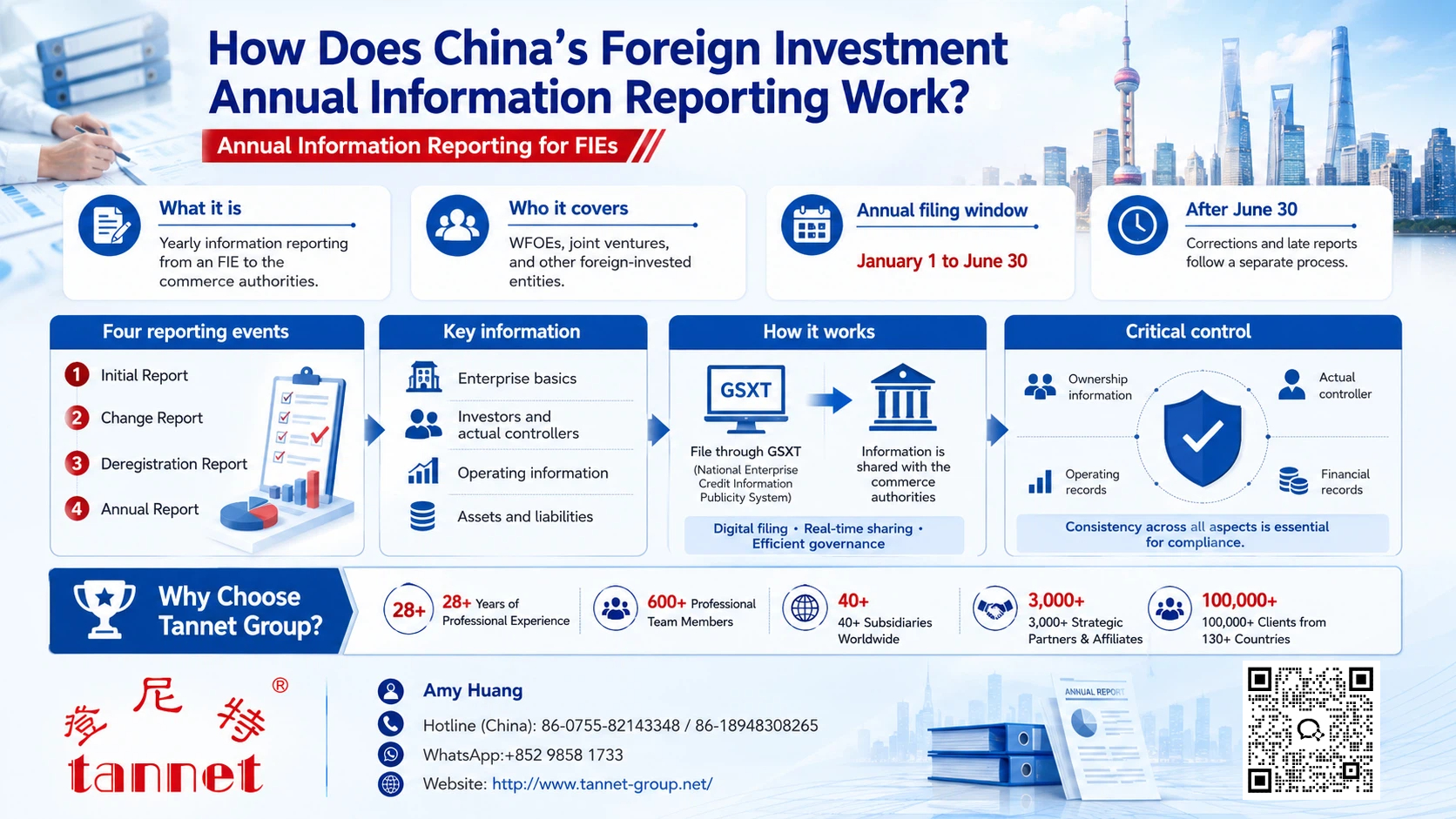
China’s foreign investment annual information reporting is the yearly data flow from a foreign-invested enterprise to the commerce authorities.
The FIE normally submits the information through the National Enterprise Credit Information Publicity System between January 1 and June 30, together with its enterprise annual report. It is relevant to WFOEs, joint ventures, and other registered entities with foreign investment.
The critical control is consistency. Investor, actual-controller, operating, asset, liability, and sector-licence data must reflect the reporting year and agree with corporate and financial records.
After June 30, corrections or late reports follow a separate commerce-authority process.
Why This Reporting System Exists
The Foreign Investment Law created an information-reporting system for foreign investors and FIEs. It replaced much of the former case-by-case establishment and change filing model with information submitted through registration and public-credit systems.
The Foreign Investment Information Reporting Measures implement that framework. They require information to be timely, true, accurate, and complete, without misleading statements or material omissions.
Annual reporting is only one part of the system. The measures also recognize initial, change, and deregistration reports. Each responds to a different event in the investment lifecycle.
The Four Reporting Events
Initial Report
A foreign investor establishing an FIE submits initial information through the enterprise-registration system when the entity is registered. A foreign investor acquiring equity in a domestic enterprise also reports through the change-registration process.
The initial report covers enterprise basics, investors and actual controllers, and investment-transaction information. It creates the regulatory starting point for later comparisons.
Change Report
Where a change requires enterprise registration or record filing, the FIE reports it during that registration process. This may include changes to shareholders, registered items, or other recorded matters.
If a reportable change does not require registration or record filing, the measures generally require a change report within 20 working days after the event. The event date depends on the corporate decision and any legal conditions for effectiveness.
Deregistration Report
When an FIE completes deregistration or converts into a domestic-invested enterprise, the completed registration is treated as the deregistration report. The market-regulation authority shares the information with the commerce authority.
Annual Report
The annual report provides the recurring year-by-year dataset. It is filed between January 1 and June 30 for the preceding year. An FIE established during the year begins annual reporting in the following year.
How the Data Moves Between Authorities
The enterprise submits through GSXT, which is administered within the market-regulation system. The relevant information is then shared with the commerce authorities.
This design matters operationally. A company may see one filing interface, but the data supports more than one regulatory function. Errors can therefore affect both enterprise disclosure and foreign-investment supervision.
The 2019 joint announcement states that information is shared among commerce, market-regulation, and foreign-exchange authorities. It also provides a method for an FIE to review whether the commerce authority received the annual report.
What the Foreign-Investment Section Covers
The reporting measures identify four broad data groups: enterprise basics; investors and actual controllers; operating information; and assets and liabilities.
The detailed annual-report form was published in MOFCOM Announcement No. 62 of 2019. The live filing interface should be treated as the current operational checklist because prompts can reflect system and local implementation updates.
Investor information should follow the legal ownership chain. The reporting team should identify the registered shareholder, investor jurisdiction, ownership percentage, and any relevant investment changes.
Actual-controller information is not always identical to the direct shareholder. A holding company, fund, trust, listed parent, state-owned investor, or individual controller may require additional analysis.
Operating information should describe the China entity, not the global group. Use entity-level revenue, profit, employment, sector, and activity data where requested.
Assets and liabilities should align with the relevant year-end accounting records. Definitions in the form should be mapped to ledger accounts before figures are entered.
An FIE subject to foreign-investment access restrictions must also report relevant industry-licence information. A valid business licence alone may not answer this field.
A Controlled Reporting Walkthrough
Step 1: Build a Responsibility Map
Assign one filing owner and named contributors from legal, finance, tax, HR, and operations. Identify who approves ownership, actual-controller, financial, and public-disclosure answers.
Step 2: Start From Last Year’s Filed Version
Use the prior report as a comparison document, not as an answer key. Mark every field that changed and every field requiring fresh year-end data.
Step 3: Confirm the Legal Chain
Reconcile the business licence, articles, shareholder register, capital records, overseas corporate documents, and completed China registration changes.
Document direct and indirect ownership separately. Determine whether an offshore restructuring changed the actual controller during the year.
Step 4: Confirm the Economic Data
Lock the annual ledger and map the required lines to financial statements. Reconcile assets, liabilities, equity, revenue, profit, tax, payroll, and guarantees where the interface requests them.
Use the reporting entity’s figures. Intercompany balances, consolidation adjustments, and different accounting frameworks can create mismatches if group data is copied directly.
Step 5: Check Sector and Licence Questions
Compare the actual activity with the registered business scope, current foreign-investment access rules, and sector approvals. Escalate any inconsistency before filing.
Step 6: Enter the GSXT Report
Access the official provincial GSXT interface. Complete the enterprise-disclosure and foreign-investment fields. Keep screenshots of material selections and disclosure settings.
Step 7: Run a Four-Way Review
Compare the draft against corporate registration, accounting records, tax filings, and the prior annual report. Resolve differences rather than forcing numbers to match without explanation.
Step 8: Submit Before the Deadline
Allow time for identity verification, password recovery, platform congestion, internal approvals, and corrections. June 30 should be the legal backstop, not the project start date.
Step 9: Verify Receipt and Public Display
Save the final report and receipt. Review the GSXT public record. The joint announcement allows an FIE to check the commerce platform seven days after submission and contact the local commerce authority if receipt is not shown.
Evidence to Retain
Keep the submitted PDF or screen export, receipt number, submission timestamp, public-display screenshot, and commerce-receipt check.
The data pack should identify the source for every material answer. Include ownership charts, registration extracts, capital evidence, ledger mappings, tax references, payroll support, licence copies, and written approvals.
Record who prepared, reviewed, and approved the report. If a later correction is required, note the original answer, corrected answer, reason, evidence, authority contact, and completion date.
Retention creates continuity when personnel or service providers change. It also helps the enterprise respond to regulator questions without rebuilding the reporting history under deadline pressure.
Before and After June 30
Before June 30, wrong or missing annual-report information can generally be corrected through GSXT. For public fields, the enterprise-disclosure regulation requires the pre-correction and post-correction information to remain visible.
From July 1, the ordinary window has closed. The current MOFCOM application states that an FIE with a missing, wrong, or incomplete 2025 report must apply to the commerce authority and use the foreign-investment annual-report application for supplementation or correction.
The company may also need a separate market-regulation remedy if it was placed on the abnormal business operations list. Completing one platform action does not necessarily close every credit consequence.
Common Mistakes
- Calling the foreign-investment annual report a second independent filing and duplicating inconsistent data.
- Assuming direct ownership automatically answers the actual-controller question.
- Copying global consolidated figures into an entity-level report.
- Ignoring an offshore restructuring because the China business licence did not change.
- Using registered capital where the form asks for paid-in contribution information.
- Treating the registered business scope as proof that every sector licence is current.
- Waiting until June 30 to resolve access credentials or internal sign-off.
- Correcting the data but failing to check abnormal-list or receipt status.
Frequently Asked Questions
Q1. Is this report separate from the ordinary company annual report?
The duties have different legal purposes, but the FIE normally submits through the same GSXT annual-report workflow. Government data sharing sends the foreign-investment information to the commerce authorities.
Q2. What is the deadline?
The report for the previous year is due between January 1 and June 30. A company established during a year starts annual reporting in the next year.
Q3. Who counts as the actual controller?
The answer depends on the ownership and control chain. It may be an individual, company, state body, fund structure, or another controlling person. Do not assume it is always the direct shareholder.
Q4. Does an offshore shareholder change need attention?
Yes. Even if the China registered shareholder remains unchanged, an offshore change can affect investor-chain or actual-controller information and may create a separate change-report question.
Q5. Are all submitted details public?
No. Public disclosure follows the enterprise-disclosure regulation and the enterprise’s permitted choices. Commerce authorities may receive additional foreign-investment information that is not automatically public.
Q6. Can an agent prepare and submit the report?
An authorized service provider may support preparation and platform work, subject to local access rules. The FIE remains responsible for truthful, accurate, complete, and timely information.
Q7. What happens after the deadline?
Contact the competent commerce and market-regulation authorities. Follow the designated correction or supplementary-report route and address any abnormal-list, penalty, or credit-repair process.
When Tannet Can Assist
Tannet may assist when a foreign-invested group needs to map its ownership chain, reconcile annual figures, coordinate GSXT submission, review foreign-investment fields, or manage a post-deadline correction. Support can also cover bilingual communication among overseas investors, China management, finance teams, and local authorities.
Sources
Written by: Tannet Business Services Team
Reviewed by: Consultant Amy Huang
First published: 3 Sep. 2026
Last reviewed: 3 Sep. 2026