Key Takeaway
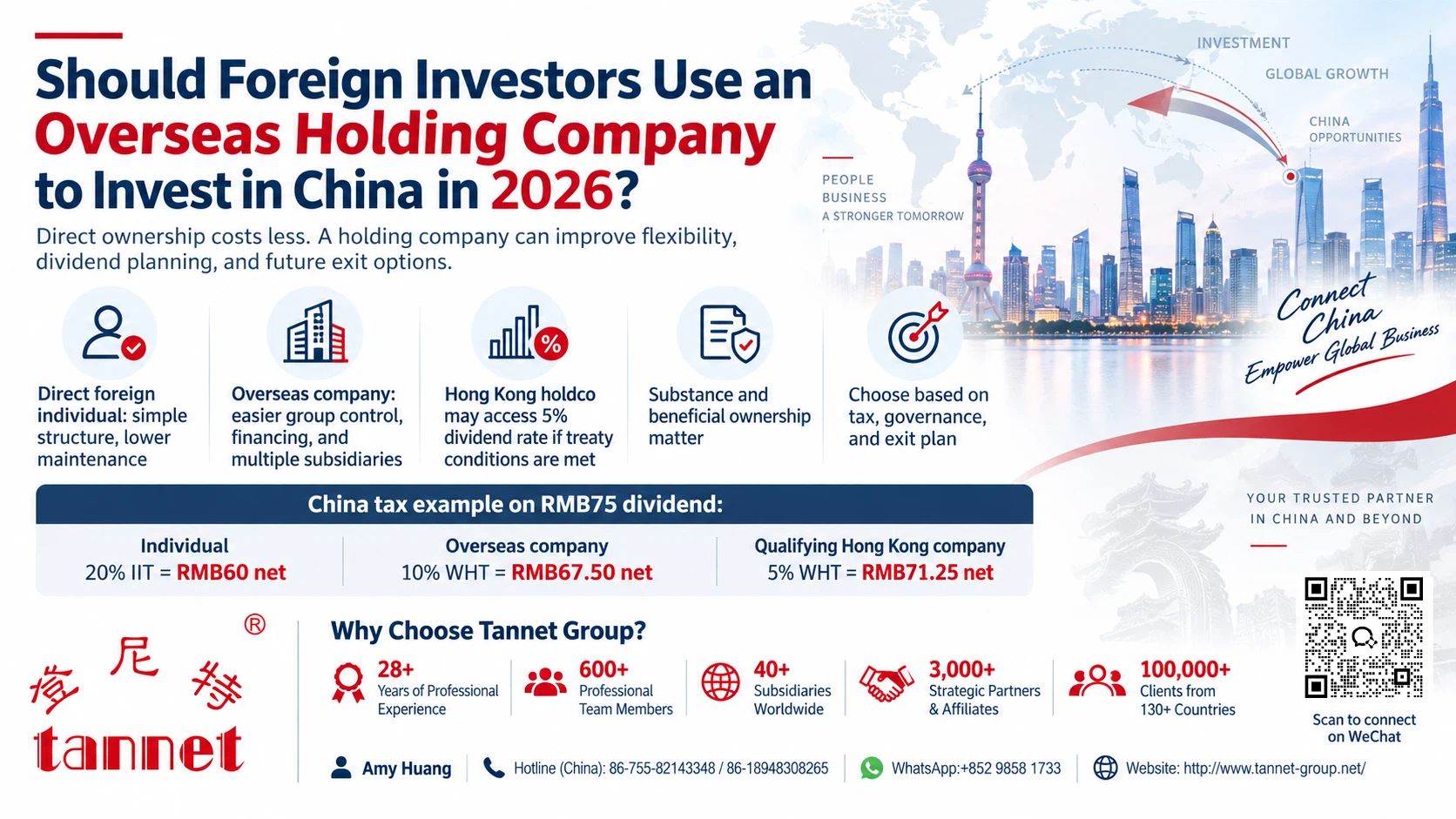
An overseas holding company is often useful when a foreign investor plans to operate in China for several years, receive regular dividends, add investors, establish several subsidiaries, or sell the business later. A common structure is a Hong Kong company holding a China foreign-invested limited liability company, often called a WFOE.
However, the structure is not automatically tax-efficient. The holding company must have a commercial purpose, treaty eligibility, and appropriate substance.
A foreign individual running a small, single-owner pilot may still prefer direct ownership because it costs less to maintain.
The correct decision requires a total-tax and exit analysis, not a comparison of headline dividend rates alone.
Why this question became more important in 2026
China changed the tax treatment of dividends paid to foreign individuals on 1 September 2026. Ministry of Finance and State Taxation Administration Announcement No. 27 states that dividends and profit distributions received by a foreign individual from a foreign-invested enterprise are subject to individual income tax at 20%.
The Chinese company normally withholds and files the tax. The change makes shareholder identity more important, but it does not mean every foreign founder needs an offshore company.
Option 1: the foreign individual holds the China company directly
Direct ownership has the fewest entities. The foreign individual becomes the shareholder of the Chinese operating company. The operating company remains a Chinese resident enterprise and is generally subject to the standard 25% enterprise income tax rate, unless a specific incentive applies.
After 1 September 2026, a dividend paid to the foreign individual is subject to a 20% domestic individual income tax rate. A tax treaty or arrangement may provide a lower rate if the individual is a qualifying resident and satisfies the applicable conditions.
Direct ownership can reduce compliance costs for a single-founder pilot. It is less flexible for new investors, multiple subsidiaries, succession, or a future transfer.
Option 2: an existing overseas business holds the China company
An established foreign company can invest directly in a Chinese subsidiary. This is often more defensible than creating a new shell because the overseas parent may already have employees, management, accounts, customers, and commercial operations.
Dividends paid by a Chinese company to a non-resident enterprise are generally subject to 10% Chinese withholding enterprise income tax under domestic rules. A tax treaty may reduce the rate if the overseas recipient qualifies for treaty benefits.
This structure can align the Chinese subsidiary with the group’s existing financial reporting, intellectual property, funding, and regional management. The investor must also examine tax in the parent company’s jurisdiction, including foreign tax credits, controlled foreign company rules, and global minimum tax exposure where relevant.
Option 3: a Hong Kong holding company holds the China company
Hong Kong is frequently considered because of its proximity to mainland China, established corporate system, banking infrastructure, and tax arrangement with the mainland. The holding company can sit between the ultimate foreign shareholder and the Chinese operating company.
Under the Mainland-Hong Kong tax arrangement, the Chinese dividend withholding rate may be limited to 5% when the Hong Kong recipient is the beneficial owner and directly owns at least 25% of the company paying the dividend. Other qualifying cases are generally capped at 10%.
The 5% rate is not automatic. The Hong Kong company must be a qualifying Hong Kong resident. It must support its beneficial-owner position and satisfy anti-abuse requirements. A company that immediately passes income to another person, has no real decision-making capacity, or exists mainly to obtain a treaty rate may face questions.
Hong Kong itself does not impose withholding tax on dividends paid by a Hong Kong company. However, foreign-sourced dividends received in Hong Kong by an in-scope multinational enterprise entity must be reviewed under Hong Kong’s Foreign-sourced Income Exemption regime. Exemption may depend on economic substance or the participation exemption.
A simple China tax illustration
Assume the Chinese operating company earns RMB100 before enterprise income tax. Assume the standard 25% enterprise income tax rate applies. Ignore incentives, home-country tax, Hong Kong tax, and transaction costs.
- Direct foreign individual: the company pays RMB25 enterprise income tax. The remaining RMB75 dividend attracts RMB15 individual income tax at 20%. The shareholder receives RMB60 after these Chinese taxes.
- Overseas corporate shareholder at 10%: the company pays RMB25 enterprise income tax. The RMB75 dividend attracts RMB7.50 withholding tax. The overseas company receives RMB67.50.
- Qualifying Hong Kong corporate shareholder at 5%: the company pays RMB25 enterprise income tax. The RMB75 dividend attracts RMB3.75 withholding tax. The Hong Kong company receives RMB71.25.
These figures are not the investor’s final global tax burden. A second tax charge may arise when the holding company distributes money to the ultimate owner. Compliance costs also reduce the economic benefit.
When an overseas holding company is usually more suitable
Consider a corporate holding structure when several of the following conditions apply:
- The China business is expected to generate regular distributable profits.
- More shareholders or external investors may join later.
- The group expects to establish more than one Chinese subsidiary.
- The investor wants a clearer route for group financing or a future sale.
- Brand, technology, or regional contracts are managed outside mainland China.
- The investor already owns a substantive overseas operating company.
- Succession or family ownership needs to be separated from the China company.
The holding jurisdiction should follow commercial facts. Hong Kong may be appropriate for an Asia-focused group. The investor’s home-country company may be better when it already performs real management functions. Creating an additional jurisdiction without a business reason often adds more risk than value.
When direct individual ownership may still be reasonable
Direct ownership can remain practical for a small, single-founder project with limited capital. It may also suit a short market test where there is no near-term dividend, financing, acquisition, or exit plan.
The founder should still model the 20% dividend tax and check whether a treaty rate is available. Changing the shareholder later can require a Chinese equity transfer, tax review, corporate filings, banking updates, and foreign investment reporting. It is therefore better to consider the likely three-to-five-year plan before incorporation.
Common mistakes
Choosing a holding jurisdiction only because of a 5% rate
A treaty rate is conditional. Tax residence, beneficial ownership, substance, holding percentage, documentation, and anti-abuse provisions all matter.
Using a dormant shell with no decision-making record
Basic incorporation documents do not prove commercial substance. Board decisions, qualified personnel, premises, expenditure, banking activity, and actual control should match the company’s stated function.
Ignoring tax in the ultimate owner’s country
The China withholding rate is only one layer. The shareholder’s residence country may tax dividends, apply controlled foreign company rules, or restrict foreign tax credits.
Planning profit repatriation only after the profit is earned
Dividends require after-tax profits, loss recovery, corporate approval, tax filings, and banking evidence. Service fees, royalties, and shareholder loans are not interchangeable substitutes and must satisfy commercial and transfer-pricing rules.
Assuming an offshore share sale has no China tax exposure
An indirect transfer of a China investment can still require analysis under Chinese anti-avoidance rules. The exit route should be reviewed when the structure is designed.
Frequently Asked Questions
Q1. Is a Hong Kong company always the recommended shareholder for a China WFOE?
No. It is often useful for long-term Asia operations, financing, multiple investors, and planned exits. An existing substantive parent company may be simpler. Direct individual ownership may cost less for a small pilot.
Q2. Does a Hong Kong company automatically obtain the 5% dividend rate?
No. It normally needs to be the beneficial owner, qualify as a Hong Kong resident, directly hold at least 25% of the Chinese payer, and satisfy the relevant treaty and anti-abuse conditions.
Q3. Can a foreign individual still claim a treaty rate after the 2026 change?
Potentially. Announcement No. 27 establishes a 20% domestic rate. An eligible non-resident may claim applicable treaty treatment through China’s self-assessment, filing, and record-retention procedure.
Q4. Will a holding company remove all dividend tax?
Usually not. China may impose 10% withholding tax or an applicable treaty rate. The holding jurisdiction and the ultimate shareholder’s jurisdiction may create additional tax.
Q5. Is it better to use an existing overseas company or create a new one?
An existing operating company often has stronger commercial substance and lower incremental cost. A new company can improve ownership flexibility, but its purpose, management, funding, and compliance must be credible.
Q6. Can profits remain in the China company instead of being distributed?
Yes, subject to company needs and corporate approvals. Retained earnings may fund Chinese operations. Separate rules and conditions apply when a foreign corporate investor reinvests distributed profits and seeks available tax treatment.
Q7. Can the shareholder structure be changed after the WFOE is established?
Yes, but the transfer can trigger valuation, tax, registration, foreign investment reporting, banking, and beneficial-owner updates. Early planning is usually more efficient.
Conclusion
An overseas holding company is generally worth considering for a foreign investor building a scalable China business. It can improve ownership flexibility and may reduce Chinese dividend withholding when treaty conditions are met. It should not be created only to obtain a headline tax rate.
Tannet is suitable for situations requiring coordinated Hong Kong company formation, China WFOE registration, shareholder-structure review, banking preparation, accounting, tax filing, and cross-border compliance support. Legal and tax conclusions should be confirmed for the investor’s jurisdictions and facts before implementation.
Official and High-Credibility Sources
Written by: Tannet Business Services Team
Reviewed by: Consultant Amy Huang
First published: 7 Sep. 2026
Last reviewed: 7 Sep. 2026
————————————————Simplifying Business, Empowering Entrepreneurs————————————————