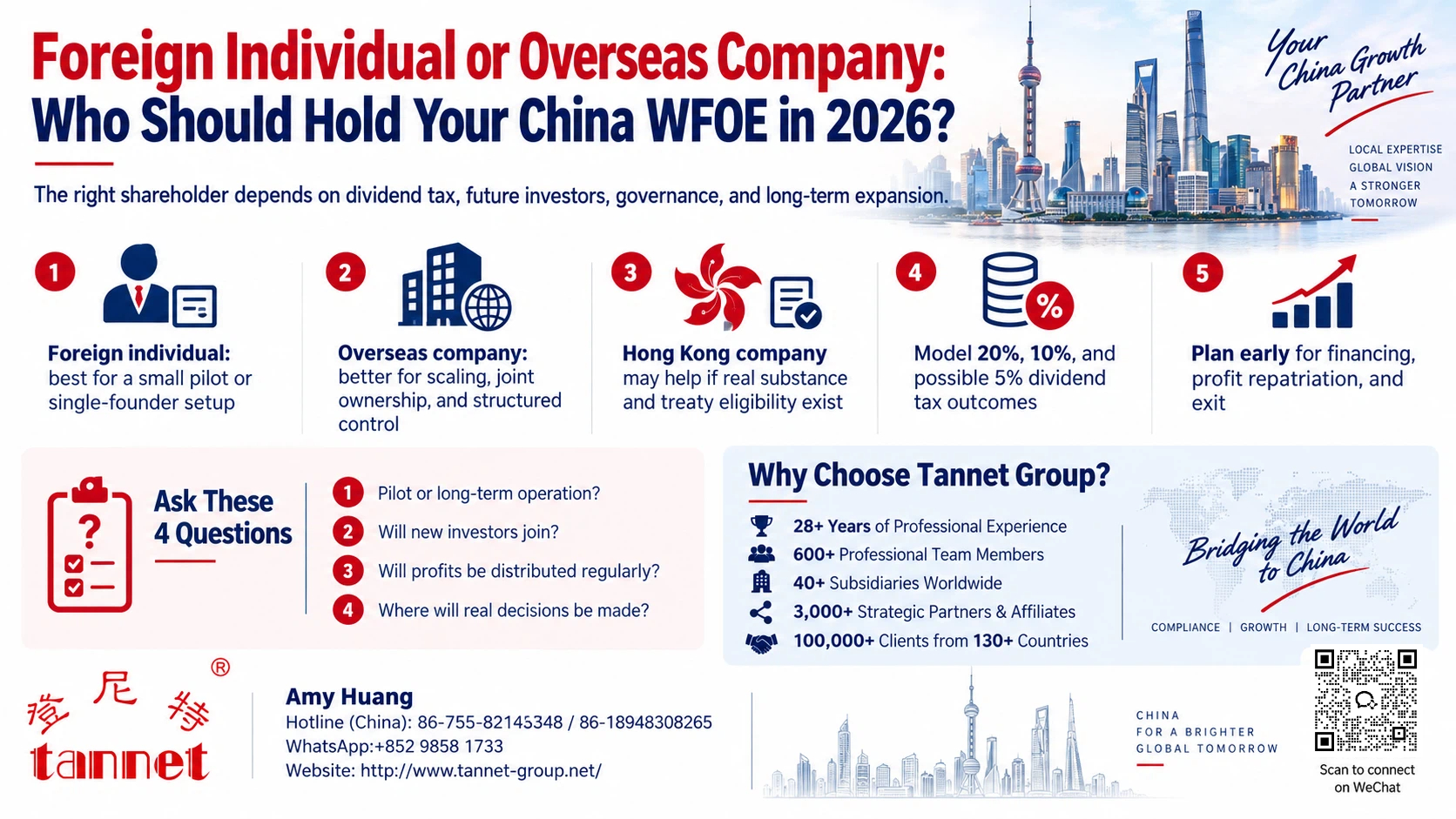
Key Takeaway
For most foreign investors building a long-term, scalable China business, an overseas company is usually the more adaptable shareholder of a China WFOE. It can simplify investor entry, group governance, succession, regional financing, and a future sale. It may also reduce China dividend withholding when a valid tax treaty applies. Direct individual ownership still suits a small, single-founder market test with limited capital and no near-term fundraising or exit plan. The most important caution is tax: from 1 September 2026, dividends paid by a foreign-invested enterprise to a foreign individual are subject to 20% Chinese individual income tax. A corporate structure is not automatically efficient. Substance, treaty eligibility, home-country tax, and recurring costs must be tested first.
The legal starting point: both shareholders are permitted
China’s Foreign Investment Law recognizes foreign natural persons and foreign enterprises as foreign investors. Either can establish or acquire a foreign-invested enterprise, subject to sector rules. “WFOE” is a market term; the entity is usually a foreign-invested limited liability company.
The shareholder choice does not override market access restrictions. The National Development and Reform Commission and Ministry of Commerce 2024 Foreign Investment Negative List contains 29 restricted or prohibited measures. Outside the list, national treatment generally applies.
Why the shareholder decision changed in September 2026
The Ministry of Finance and State Taxation Administration issued Announcement No. 27 on 1 September 2026. It applies 20% tax to dividends received by a foreign individual from a foreign-invested enterprise. The Chinese company normally withholds the tax.
A dividend paid to a non-resident corporate shareholder follows a different regime. Under China’s Enterprise Income Tax Law and its Implementing Regulation, the domestic withholding rate is generally 10% for relevant China-source income, including dividends, unless treaty relief applies.
Option 1: a foreign individual holds the WFOE directly
Direct ownership creates the shortest legal chain. The founder is registered as the shareholder. There is no separate overseas parent to incorporate, maintain, audit, or administer.
The main 2026 disadvantage is dividend tax. A post-1 September dividend to the foreign individual carries a 20% Chinese domestic individual income tax rate. A relevant tax treaty may limit the rate for an eligible non-resident, but treaty residence and procedural requirements must be checked.
Direct ownership can become awkward when the business expands. Adding a co-founder or investor normally requires a change in the Chinese company’s equity. That can involve valuation, tax analysis, corporate approvals, registration, foreign investment reporting, and banking updates.
Option 2: an overseas company holds the WFOE
This is often more suitable for a group entering China. The parent can centralize investor rights, board control, regional financing, intellectual property ownership, and consolidated reporting.
China-source dividends paid to a non-resident enterprise are generally subject to 10% withholding enterprise income tax under domestic rules. A tax treaty or arrangement may reduce the rate when the recipient meets residence, beneficial ownership, holding, and anti-abuse conditions.
An existing operating company may be more defensible than a newly formed shell. A new special-purpose company can still work, but its management, bank control, funding, records, and risks should match its stated role.
When a Hong Kong company may be used
Under Article 10 of the Mainland-Hong Kong tax arrangement, a dividend rate capped at 5% may apply when the Hong Kong beneficial owner is a company that directly owns at least 25% of the capital of the mainland payer. Other qualifying dividends are generally capped at 10%.
The 5% rate is not automatic. State Taxation Administration Announcement No. 9 of 2018 requires a facts-based beneficial ownership analysis. Relevant factors include substantive business activity, functions and risks, control of the income, and whether the recipient must pass the income to another person.
Hong Kong also has its own tax analysis. The Inland Revenue Department’s Foreign-sourced Income Exemption rules can apply when an in-scope multinational enterprise entity receives foreign-sourced dividends in Hong Kong. Economic substance or the participation requirement may be relevant.
A simple China tax illustration
Assume a WFOE earns RMB100 before enterprise income tax. Assume the standard 25% enterprise income tax rate applies. Ignore incentives, foreign tax credits, parent-jurisdiction tax, and compliance costs.
- The WFOE pays RMB25 enterprise income tax, leaving RMB75 available for distribution.
- If RMB75 is paid directly to a foreign individual at 20%, China tax on the dividend is RMB15. The individual receives RMB60 after these two China tax layers.
- If RMB75 is paid to an overseas company at the 10% domestic rate, withholding is RMB7.50. The parent receives RMB67.50.
- If a qualifying Hong Kong corporate shareholder obtains the 5% arrangement rate, withholding is RMB3.75. The Hong Kong company receives RMB71.25.
The illustration stops at the first recipient. Onward tax and annual holding-company costs must still be included.
Six questions that determine the better shareholder
1. Is this a pilot or a durable China operation?
Use direct ownership for a small trial. Assess a holding company for a multi-year regional plan.
2. Will new investors join?
An overseas parent can provide a familiar cap table, subject to investor and China reporting needs.
3. Will profits be distributed regularly?
Compare expected profit, dividend frequency, treaty relief, and tax on onward distribution.
4. Where will real decisions be made?
Board decisions, records, expenditure, and bank control should support the holding entity’s functions.
5. What is the expected exit route?
Model a WFOE sale, parent sale, and asset sale separately. China may review an indirect transfer.
6. What rules apply in the ultimate owner’s country?
Include foreign tax credits, controlled foreign company rules, and personal dividend tax.
A practical decision rule
Use a corporate shareholder for multiple owners, funding, several China entities, regular dividends, regional management, succession, or exit. Use direct ownership for one founder, limited capital, low distributions, and minimal administration. The jurisdiction should follow real management and business functions.
Common mistakes
Choosing the shareholder only from headline tax rates
The 20%, 10%, and possible 5% rates describe only one payment layer. Parent-country tax and ultimate-owner tax may reverse the apparent saving.
Assuming incorporation proves treaty eligibility
A certificate of incorporation is not enough. Tax residence, beneficial ownership, substantive functions, holding thresholds, documentation, and anti-abuse rules must be considered.
Using a nominee or dormant shell without control records
The legal shareholder should be able to approve investments, control its bank account, bear risk, and decide whether to retain or distribute income.
Ignoring the five-year capital contribution rule
China’s current Company Law generally requires shareholders of a newly established limited liability company to pay subscribed capital within five years. The amount and schedule should reflect operating needs and funding capacity.
Restructuring only when a dividend or sale is imminent
A late shareholder change can trigger valuation, tax, reporting, approval, and banking work. It may also weaken the commercial explanation for treaty planning.
Treating service fees, royalties, and loans as interchangeable with dividends
Each payment requires a real transaction, documentation, transfer-pricing support, tax treatment, and foreign-exchange evidence. They should not be used as artificial substitutes.
Frequently Asked Questions
Q1. Can a foreign individual legally own 100% of a China WFOE?
Yes, in sectors open to wholly foreign ownership. The Foreign Investment Law recognizes foreign natural persons as foreign investors. The Negative List and sector licensing rules must still be checked.
Q2. Is an overseas company automatically more tax-efficient after 1 September 2026?
No. China generally taxes a corporate dividend at 10%, compared with 20% for a foreign individual, but parent-jurisdiction tax, onward dividend tax, administration, and substance costs may reduce or eliminate the difference.
Q3. Does a Hong Kong shareholder automatically receive the 5% rate?
No. The Hong Kong company must be the qualifying beneficial owner, directly own at least 25% of the mainland payer, and satisfy residence, documentation, and anti-abuse conditions.
Q4. Can an individual obtain treaty relief from the 20% rate?
Potentially. An eligible non-resident individual may claim the applicable treaty treatment. Residence, beneficial ownership where relevant, filing information, and supporting records must be reviewed.
Q5. Should I use my existing overseas operating company?
Often yes, if it already has genuine management, accounts, personnel, and a commercial reason to own the China business. Its home-country tax and liability profile must also be acceptable.
Q6. Can I change from individual ownership to company ownership later?
Yes. The change is normally an equity transfer rather than a simple name update. It may require tax analysis, valuation, contracts, registration, reporting, and bank updates.
Q7. Does the shareholder choice change the WFOE’s operating tax rate?
Usually no. The Chinese company’s enterprise income tax, VAT, payroll, and local compliance depend mainly on its activities and eligibility for incentives. The shareholder choice most directly affects dividends, governance, financing, and exit planning.
Conclusion
For a foreign investor building a scalable China business, an overseas company is often the stronger default shareholder in 2026. The conclusion is conditional. The entity must serve a real commercial purpose, and the total cross-border tax burden must be modeled through to the ultimate owner.
Tannet can assist where Hong Kong company formation, China WFOE registration, ownership planning, banking preparation, capital contribution coordination, accounting, tax filing, and ongoing cross-border compliance need to be organized as one project. Legal and tax positions should be confirmed for the investor’s specific jurisdictions and facts before implementation.
Official and High-Credibility Sources
Sources:
Foreign Investment Law of the People’s Republic of China;
NDRC and MOFCOM Foreign Investment Negative List, 2024 Edition;
MOF and STA Announcement No. 27 of 2026;
Enterprise Income Tax Law Implementing Regulation;
Mainland-Hong Kong tax arrangement;
STA beneficial ownership rules; Hong Kong IRD FSIE guidance.
Written by: Tannet Business Services Team
Reviewed by: Consultant Amy Huang
First published: 7 Sep. 2026
Last reviewed: 7 Sep. 2026
————————————————Simplifying Business, Empowering Entrepreneurs————————————————