Key Takeaway
A China WFOE may distribute genuine after-tax profits to its foreign shareholder and remit the dividend overseas. This suits profitable foreign-invested companies with completed accounts, available cash, resolved prior losses, and corporate approvals.
The critical point is that accounting profit, distributable profit, and cash are not the same.
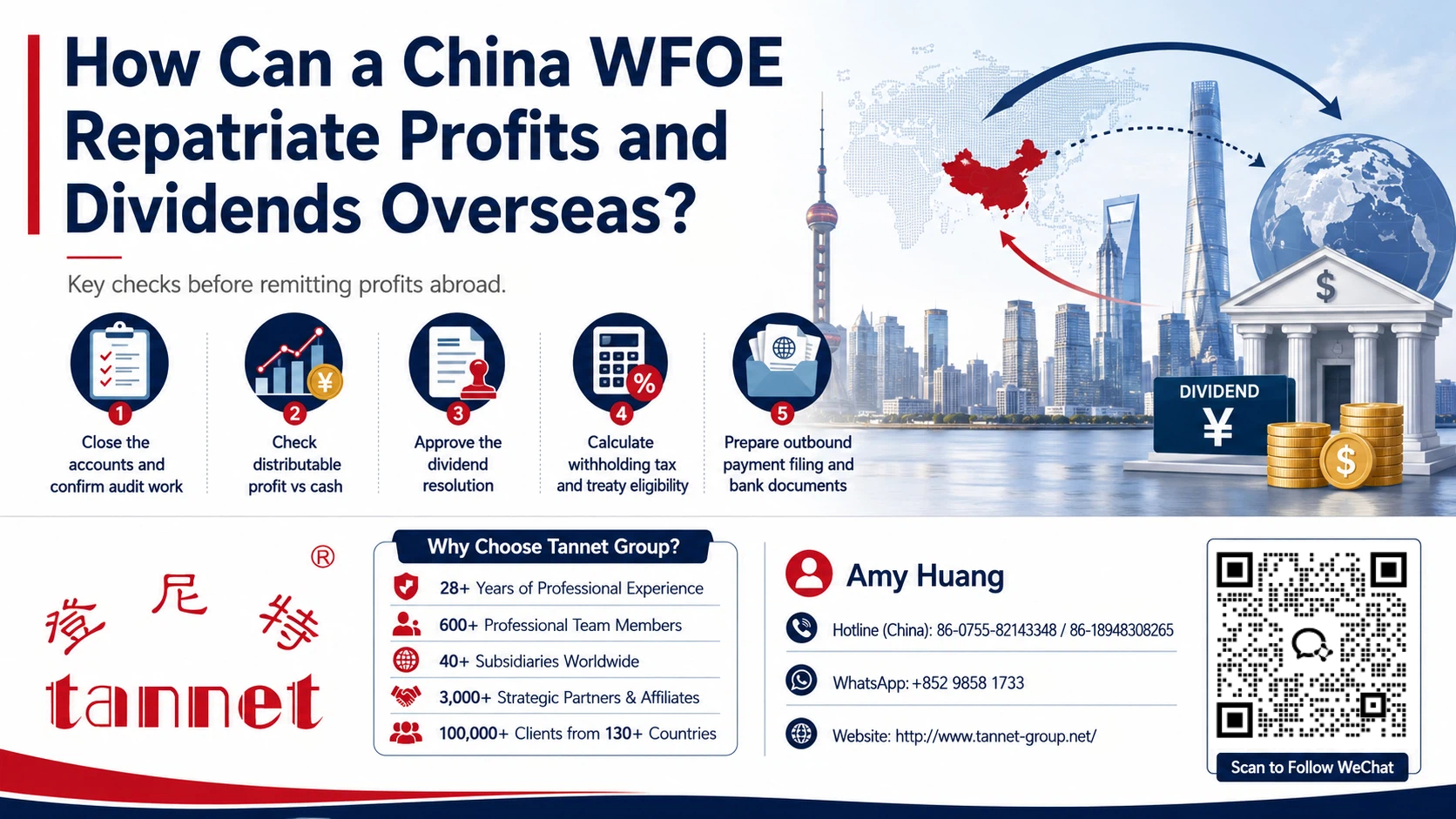
Before payment, the company should complete financial statements and required audit work, settle corporate income tax, calculate statutory reserves, approve the distribution, determine withholding tax and treaty eligibility, complete any required outbound-payment tax filing, and pre-check the bank’s foreign-exchange documents.
Unsupported or premature dividends can be rejected or recovered.
Profit Repatriation Is a Distribution, Not a Transfer
A WFOE cannot send cash to its shareholder merely because its bank balance is high. The payment must have a valid legal character, such as a dividend, service payment, royalty, loan repayment, capital reduction, or liquidation distribution.
Each category has different company-law, tax, foreign-exchange, and documentary rules. Calling a transfer “dividend” does not make it distributable profit.
A dividend comes from profits determined under Chinese accounting and tax rules. Management accounts prepared only for the overseas group may not establish the amount available under the WFOE’s statutory books.
Test Whether Profit Is Legally Distributable
Start with the WFOE’s annual financial statements and Chinese accounting records. Confirm that revenue, costs, taxes, related-party entries, foreign-exchange differences, and prior-year adjustments are complete.
The amended Company Law requires a company to prepare annual financial reports and have them audited according to law. Banks and tax authorities may also request financial evidence appropriate to the remittance.
Previous losses must be covered before profits are distributed. A company with current-year earnings may still have no distributable balance because accumulated losses remain.
Article 210 requires the company to allocate 10% of after-tax profit to the statutory common reserve. Further allocation is unnecessary once that reserve reaches at least 50% of registered capital.
After losses and reserves, a limited liability company generally distributes the balance according to shareholders’ paid-in contribution proportions, unless all shareholders have agreed on another allocation permitted by law.
Cash availability is a separate test. The WFOE should preserve enough liquidity for payroll, VAT, corporate income tax, suppliers, rent, debt, and foreseeable operating commitments.
Approve the Dividend Correctly
The board or executive body normally prepares the profit-distribution proposal according to the articles. The shareholder meeting, or the sole shareholder in writing, then approves the distribution.
The resolution should identify the profit period, distributable amount, reserve allocation, shareholder, gross dividend, withholding tax, net remittance, currency, and authorised signatory.
Under Article 212 of the Company Law, after the shareholder meeting adopts a distribution resolution, the board must make the distribution within six months. The documents and payment schedule should therefore be planned together.
For a single-shareholder WFOE, written resolutions remain important. They demonstrate that the company distinguished its own property from the shareholder’s property and followed corporate governance.
Calculate Corporate and Withholding Taxes
The WFOE first accounts for corporate income tax on its taxable income. The general corporate income tax rate is 25%, although incentives may change the company’s effective burden.
The dividend paid to a nonresident enterprise is generally China-sourced equity investment income. Domestic rules commonly produce a 10% withholding enterprise income tax rate, subject to a treaty or tax arrangement.
A lower treaty rate is not automatic. The recipient must satisfy residence, beneficial-owner, ownership-percentage, holding-period, documentation, and anti-abuse requirements applicable to the relevant agreement.
The WFOE is usually the withholding agent. It should calculate, report, withhold, and pay the tax at the correct time, using the prescribed exchange rate where the dividend is denominated in foreign currency.
Do not apply a treaty percentage simply because the shareholder is incorporated in a treaty jurisdiction. Substance, control over income, back-to-back arrangements, and the recipient’s functions can affect eligibility.
Complete Outbound-Payment Tax Filing Where Required
China’s tax guidance states that a domestic entity making a qualifying single outbound payment above USD50,000 equivalent must generally complete the service-trade and related outbound-payment tax filing.
Covered payments include dividends, profit distributions, interest, royalties, and certain other China-source income. For repeated payments under the same contract or arrangement, tax guidance may allow filing before the first payment only.
The filing is not the same as tax exemption or tax clearance. The company remains responsible for withholding, reporting, and paying tax correctly.
Prepare the filing form and the distribution resolution or other transaction evidence. Foreign-language materials may require a Chinese translation.
Pre-Clear the Bank’s Foreign-Exchange Review
Contact the account bank before finalising the payment date. The bank will apply authenticity, compliance, know-your-customer, sanctions, and payment-message checks.
SAFE rules state that for profit remittances above USD50,000 equivalent, banks review the distribution resolution, tax filing information, and financial statements supporting the profit. Smaller payments can receive simplified documentary treatment, but the bank may still request evidence based on risk.
The bank may request the business licence, articles, ownership chart, latest financial statements, audit report where relevant, shareholder resolution, tax filing record, withholding-tax evidence, and payment instruction.
Names, amounts, currencies, dates, and ownership percentages should reconcile across all documents. Explain any difference between accounting currency, resolution currency, remittance currency, and the net amount after withholding.
Bank review does not replace the company’s legal and tax assessment. A processed payment can still be questioned later if the underlying profit or tax treatment was incorrect.
A Practical Profit-Repatriation Workflow
- Close the statutory accounts. Reconcile revenue, expenses, taxes, related parties, and retained earnings under Chinese accounting rules.
- Confirm audit requirements. Obtain the annual audit or other financial verification required by law, the articles, the bank, or the group’s controls.
- Calculate distributable profit. Deduct prior losses, corporate income tax, statutory reserve, and any approved discretionary reserve.
- Model liquidity. Keep sufficient cash for liabilities and the next operating cycle.
- Review shareholder eligibility. Confirm the recipient, paid-in contribution ratio, treaty jurisdiction, beneficial ownership, and holding conditions.
- Approve the distribution. Prepare a compliant proposal and written shareholder resolution with gross and net amounts.
- Complete tax work. File withholding returns, pay tax, claim treaty treatment only with support, and complete outbound-payment filing if required.
- Assemble the bank pack. Reconcile the resolution, financial statements, tax records, remittance application, and beneficiary account.
- Execute and record. Remit from the WFOE’s account, retain bank evidence, and post both the gross dividend and withholding tax correctly.
- Preserve the file. Keep corporate approvals, tax submissions, financial reports, bank correspondence, and exchange-rate calculations together.
Alternatives to an Overseas Dividend
The group may leave profit in the WFOE as retained earnings, use it for lawful expansion, or consider qualifying reinvestment in China.
For qualifying direct reinvestments made from 1 January 2025 through 31 December 2028, current policy provides a tax credit calculated at 10% of the investment amount, or a lower treaty dividend rate where applicable. Conditions and recovery rules require specific advice.
Capital reduction can return investment but follows creditor-protection, registration, tax, and foreign-exchange procedures. It should not be used to disguise a profit distribution.
Common Mistakes
- Using group management accounts instead of reconciled Chinese statutory accounts.
- Declaring dividends before covering prior losses and statutory reserves.
- Applying a treaty rate without testing beneficial ownership and other conditions.
- Treating the USD50,000 threshold as an exemption from tax.
- Letting the resolution, tax filing, financial statements, and bank instruction show different amounts.
- Distributing most cash without protecting payroll, tax, and supplier liquidity.
- Replacing dividends with unsupported service fees or shareholder payments.
Frequently Asked Questions
Q1. Can a newly profitable WFOE remit dividends immediately?
Only if it has legally distributable after-tax profit, no unresolved prior losses, the required reserve allocation, valid approvals, completed tax work, and sufficient bank documentation.
Q2. Is an audit always needed for dividend remittance?
The Company Law requires annual financial reports to be audited according to law. The exact report requested for a remittance can also depend on the bank, location, period, and company circumstances.
Q3. Is withholding tax always 10%?
Ten percent is a common domestic rate for dividends paid to nonresident enterprises. A treaty may reduce it if the recipient satisfies the agreement and supporting requirements.
Q4. Does the USD50,000 threshold remove tax below that amount?
No. The threshold concerns outbound-payment filing and bank documentation procedures. Withholding and other tax obligations can still apply to a smaller dividend.
Q5. Can dividends be paid in renminbi?
Potentially yes. The parties should confirm the shareholder’s receiving route, cross-border renminbi arrangements, tax calculation, and bank payment instructions.
Q6. Can a WFOE distribute only part of its profit?
Yes. The shareholder may approve a partial distribution and retain the balance, provided the allocation follows the articles, law, and liquidity needs.
Q7. Can profit be reinvested instead of remitted?
Yes. Qualifying reinvestment may use a more direct foreign-exchange route and may access current tax incentives, but the investment must meet detailed conditions.
When Tannet May Assist
Tannet may assist when a WFOE needs to reconcile distributable profit, organise corporate resolutions, coordinate accounting and tax records, prepare a bank document pack, or compare remittance with reinvestment. The final treatment should be confirmed against the shareholder’s jurisdiction, treaty position, company location, bank requirements, and current tax and foreign-exchange rules.
Sources
Written by: Tannet Business Services Team
Reviewed by: Consultant Amy Huang
First published: 4 Sep. 2026
Last reviewed: 4 Sep. 2026
————————————————Simplifying Business, Empowering Entrepreneurs————————————————