Key Takeaway
A statutory audit is an independent examination of a Hong Kong company’s annual financial statements and supporting accounting evidence.
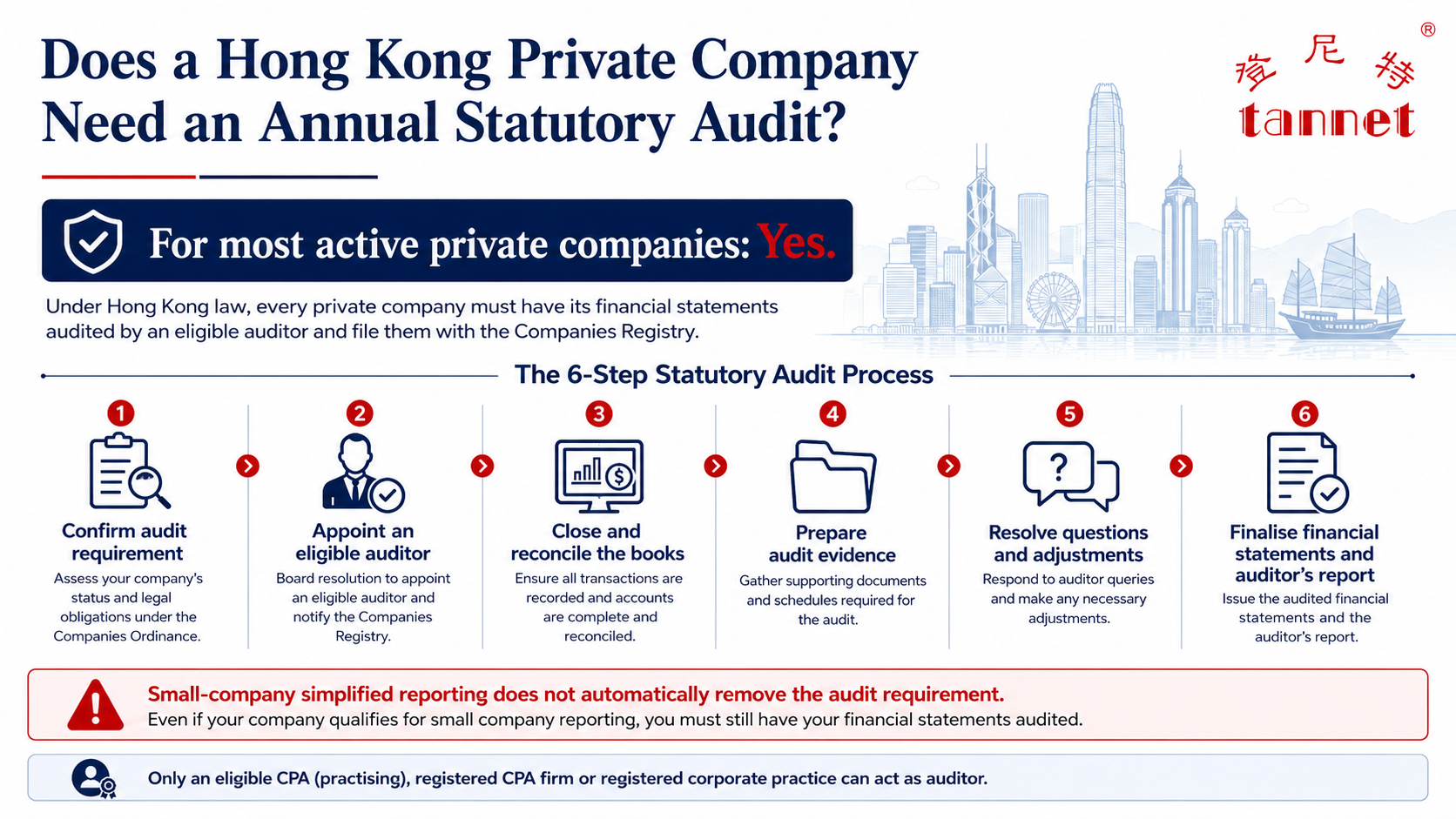
For most Hong Kong private companies, the financial statements must be audited even if the company is small; the Companies Registry states that the statutory audit requirement continues for companies using the reporting exemption, except dormant companies covered by the relevant exemption.
The audit should be performed by an eligible Hong Kong practice unit registered for statutory audit work.
The main practical issue is not the final audit report itself. It is whether the company has complete bookkeeping, consistent bank and tax records, and enough evidence for the auditor to test the financial statements efficiently.
1. First confirm whether the statutory audit requirement applies
Hong Kong’s Companies Ordinance requires companies to prepare financial statements for each financial year.
The Companies Registry explains that companies qualifying for the reporting exemption may prepare simplified financial reporting. However, the audit of financial statements is still required, except for dormant companies within the statutory dormant-company framework.
This distinction matters. “Small company,” “low revenue,” and “reporting exemption” do not automatically mean “no audit.”
2. Appoint an eligible auditor
A Hong Kong company auditor must be eligible to hold the appointment.
The Accounting and Financial Reporting Council states that only a CPA (practising), a registered CPA firm, or a registered corporate practice can act as auditor of a company under the Companies Ordinance.
Verify the auditor or practice unit in the AFRC public register and confirm who will sign the report.
The company should also distinguish bookkeeping from statutory audit. Management prepares the records and financial statements; the auditor independently examines them and forms an opinion.
3. Close the books before audit fieldwork
Audit should not begin with an unreconciled ledger.
Complete bookkeeping for the financial year. Reconcile bank accounts, payment platforms, customer balances, supplier balances, loans, director accounts, payroll, fixed assets, and major expense categories.
Prepare a trial balance and draft financial statements. Identify unresolved transactions before sending the file to the auditor.
4. Prepare an audit evidence pack
The auditor needs evidence to support balances and transactions.
A typical pack may include bank statements, bank confirmations, sales and purchase invoices, contracts, receipts, payroll records, loan agreements, fixed-asset schedules, inventory records, tax filings, company registers, board records, and related-party schedules.
The exact request depends on the business and audit risk.
Do not create documents after the fact to fill gaps. Explain genuine missing evidence and provide alternative support where available.
5. Audit planning and risk assessment
The auditor plans the engagement before testing everything in detail.
Hong Kong auditing standards require the auditor to assess risks of material misstatement and obtain sufficient appropriate audit evidence to reduce audit risk to an acceptably low level.
This means the auditor does not necessarily check every transaction. Testing focuses on material balances, higher-risk areas, controls, estimates, unusual transactions, and selected samples.
6. Fieldwork and testing
During fieldwork, the auditor tests evidence behind the financial statements.
Procedures may include inspecting documents, agreeing balances to bank or supplier records, testing transaction samples, reviewing subsequent receipts or payments, checking calculations, reviewing estimates, and obtaining external confirmations.
The auditor may also assess whether the financial statements follow the applicable financial reporting framework.
Respond to audit questions with facts and documents, not a preferred accounting or tax outcome.
7. Resolve audit queries and proposed adjustments
Audit queries are normal.
Some questions identify missing evidence. Others identify accounting errors, timing differences, classification issues, unsupported balances, or disclosures that need adjustment.
Management should review each proposed adjustment and understand its effect before approving it.
Keep a record of final adjustments so the closing and next year’s opening balances reconcile.
8. Finalise the financial statements and auditor’s report
After the auditor obtains sufficient appropriate evidence and unresolved issues are addressed, the auditor forms an opinion and issues the auditor’s report.
An audit is not a guarantee that the company has no error, no fraud, or no tax exposure. Audit standards are designed to provide reasonable assurance, not absolute assurance.
9. Use the audited accounts in the tax filing workflow
Audit and Profits Tax filing are connected but they are not the same process.
Current IRD guidance says corporations with gross income during the basis period should submit supporting documents with the Profits Tax Return, including financial statements and a tax computation. Where an auditor’s report is required by Hong Kong or foreign law, or has otherwise been prepared, it forms part of the specified supporting documentation.
A tax computation starts from accounting results and applies Hong Kong tax adjustments. The audit opinion does not itself determine assessable profits.
10. Start early to reduce audit cost and delay
Audit delays usually begin with bookkeeping gaps.
Monthly reconciliations, organised source documents, clear related-party records, and a clean year-end close can reduce repeated audit questions.
Do not wait until a tax filing deadline is close before locating bank statements or customer contracts.
Common mistakes
1. Assuming a small private company is automatically exempt from audit.
2. Confusing zero revenue with formal dormant-company status.
3. Hiring a provider without checking whether the auditor is an eligible registered practice unit.
4. Starting audit before the bank and ledger balances are reconciled.
5. Sending only spreadsheets without source documents.
6. Ignoring director, shareholder, and related-party balances.
7. Treating an audit opinion as a guarantee about tax or future compliance.
Frequently Asked Questions
Q1. Does every Hong Kong private company need an audit?
Most do. The Companies Registry states that audit remains required even for companies using the reporting exemption, except dormant companies covered by the statutory exemption.
Q2. Can my bookkeeper also sign the statutory audit report?
The statutory auditor must be an eligible practice unit. Audit independence and the actual engagement structure should be considered separately from bookkeeping support.
Q3. Who can act as auditor?
AFRC guidance states that only a CPA (practising), registered CPA firm, or registered corporate practice can hold the appointment or provide statutory audit service under the Companies Ordinance.
Q4. What documents does the auditor usually request?
Expect bank records, invoices, contracts, receipts, ledgers, payroll, asset schedules, tax records, corporate documents, and evidence supporting material balances. The exact list depends on the business.
Q5. Does an audit determine how much Profits Tax I pay?
No. The audit addresses the financial statements. A separate tax computation applies Hong Kong tax rules to determine assessable profits or adjusted losses.
Q6. When should a company begin audit preparation?
Preparation should begin throughout the financial year. A formal year-end close and audit pack should be ready well before the tax filing workflow reaches its deadline.
When Tannet May Be Suitable
Tannet may assist foreign-owned Hong Kong companies that need year-end bookkeeping cleanup, audit-readiness checks, financial statement preparation, document coordination, tax computation support, or liaison with an eligible audit practice.
This can be useful where records are spread across countries, payment platforms, banks, or related companies. The auditor remains responsible for the independent opinion, and IRD for tax assessment.
Reviewed by: Consultant Amy Huang
First published: 10 August 2026
Last reviewed: 10 August 2026
Jurisdiction: Hong Kong SAR
————————————————Simplifying Business, Empowering Entrepreneurs————————————————