Key Takeaway
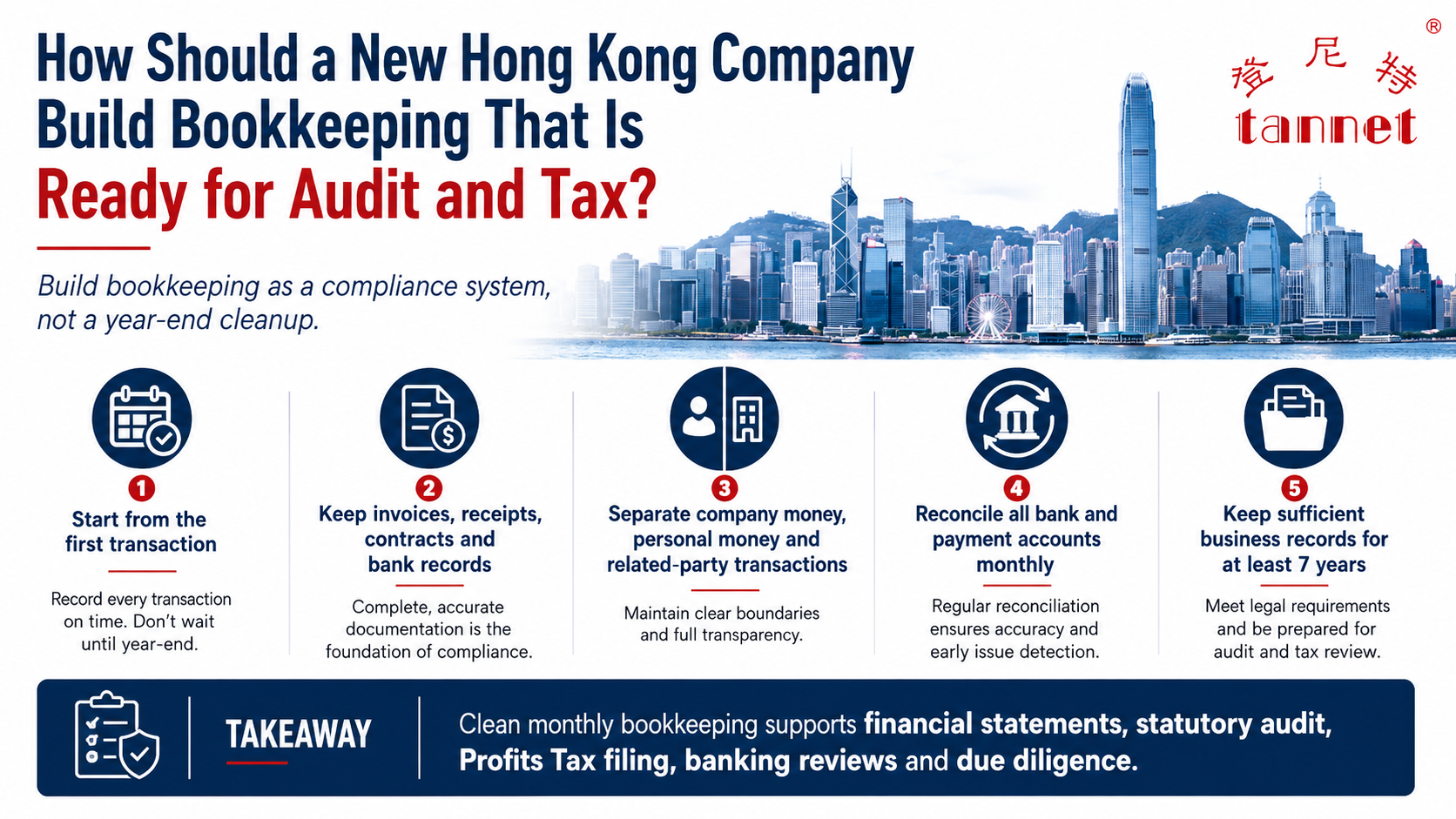
A new Hong Kong company should set up bookkeeping from the first transaction, not when the first tax return arrives.
The system should capture sales, purchases, expenses, bank movements, assets, liabilities, director or shareholder transactions, and supporting documents in a consistent way.
This is especially important for overseas founders who manage the company remotely or use several bank and payment accounts.
Hong Kong tax rules require sufficient business records to determine assessable profits, and records generally need to be retained for at least seven years.
The main practical risk is incomplete or inconsistent evidence that later delays financial statements, statutory audit, tax filing, banking reviews, or due diligence.
1. Start with the legal record-keeping baseline
Hong Kong bookkeeping is not only an internal management task. Section 51C of the Inland Revenue Ordinance requires a person carrying on a trade, profession, or business in Hong Kong to keep sufficient records in English or Chinese so assessable profits can be readily ascertained.
The Inland Revenue Department states that relevant business records should generally be retained for at least seven years. These records include books of receipts and payments, invoices, vouchers, bank statements, and records of assets and liabilities.
2. Create a chart of accounts before transaction volume grows
A chart of accounts is the structure used to classify transactions. It should reflect the company’s real business model.
Typical categories include revenue, cost of sales, professional fees, rent, marketing, travel, bank charges, payroll, fixed assets, receivables, payables, loans, director accounts, and shareholder balances.
The goal is consistency. The same type of expense should not be coded differently each month.
Foreign-owned companies should also identify related-party transactions clearly. Payments between the Hong Kong company, its parent, founders, subsidiaries, or connected companies should not be mixed with ordinary customer or supplier transactions.
3. Build a source-document rule for every transaction
A bookkeeping entry should have evidence behind it.
For sales, keep contracts, invoices, platform statements, and payment evidence. For purchases, retain supplier invoices, receipts, contracts, and proof of payment.
For bank transfers, record the commercial reason. A bank statement shows that money moved. It may not explain why it moved.
For expenses paid personally by a director or founder, keep the original receipt and record whether the amount is reimbursable, a director balance, or another properly classified transaction.
A practical rule is simple: every material transaction should be understandable by a person who did not originally process it.
4. Separate company and personal money
One of the most common problems in small foreign-owned companies is mixing business and personal payments.
Use company bank or payment accounts for company transactions where possible. If a founder pays a company expense personally, document it and post it consistently.
Do not classify personal withdrawals as business expenses. Do not treat a shareholder loan as revenue. Do not treat customer receipts as capital contributions simply because the description is unclear.
5. Reconcile every bank and payment account regularly
Bookkeeping is more reliable when reconciliation is done monthly.
Compare the accounting ledger with each bank statement and payment-platform statement. Investigate missing transactions, duplicate entries, unexplained transfers, outstanding receipts, and currency differences.
If the company uses multiple currencies, keep the original transaction currency and the accounting currency treatment clear. Avoid manually changing values without retaining the exchange-rate basis or source record.
6. Maintain a monthly document-close routine
A simple monthly close reduces year-end work.
Collect all bank statements, sales invoices, supplier bills, expense receipts, contracts, payroll information, and payment-platform reports. Check whether document numbers, counterparties, dates, and amounts agree with the ledger.
Review receivables and payables. Confirm whether old balances are still valid. Record new fixed assets and major prepayments. Review director and shareholder balances.
Mark each period as reviewed. If a late document arrives, post a controlled adjustment rather than silently changing history.
7. Design the system for audit and tax from day one
Bookkeeping should lead naturally into year-end financial reporting.
The Inland Revenue Department requires supporting documents with Profits Tax Returns in relevant cases. For corporations with gross income during the basis period, current IRD guidance says supporting documents include financial statements and tax computations.
From 1 April 2026, Hong Kong also began the first phase of mandatory electronic filing of Profits Tax Returns for specified persons. Not every company is automatically in that first-phase group, so the filing method should be checked against the current IRD rules.
8. Decide what to manage in-house and what to outsource
A founder can maintain source documents internally while outsourcing ledger preparation, reconciliations, financial statements, tax computation, and audit coordination.
The division of work should be written down. Define who collects documents, who posts entries, who approves adjustments, who reconciles accounts, and who follows up missing evidence.
If bookkeeping is outsourced, directors still need visibility. Request ledgers, trial balances, missing-document lists, and year-end schedules.
9. A practical seven-step setup
Step 1: Confirm the financial year-end and accounting currency.
Step 2: Create a chart of accounts that matches the business model.
Step 3: Establish folders for sales, purchases, expenses, banking, payroll, contracts, tax, and corporate records.
Step 4: Connect or import all company bank and payment accounts into the bookkeeping workflow.
Step 5: Record transactions consistently and attach source evidence.
Step 6: Reconcile accounts monthly and review director, shareholder, customer, and supplier balances.
Step 7: Perform a year-end readiness review before the audit and Profits Tax Return process begins.
Common mistakes
1. Waiting until the first tax return to start bookkeeping.
2. Keeping bank statements but not invoices, contracts, or receipts.
3. Mixing personal and company expenses without clear director-account treatment.
4. Failing to reconcile payment platforms with bank deposits.
5. Changing prior-period entries without an audit trail.
6. Treating transfers between related companies as ordinary revenue or expense.
7. Assuming zero profit means accounting records are unnecessary.
Frequently Asked Questions
Q1. Does a new Hong Kong company need bookkeeping before it has revenue?
Yes. The company may incur incorporation costs, subscriptions, deposits, professional fees, capital contributions, or director-funded expenses before revenue begins. Those transactions should still be recorded.
Q2. How long should business records be kept?
IRD guidance states that sufficient business records generally need to be retained for at least seven years.
Q3. Are bank statements enough for bookkeeping?
No. Bank statements show money movement but often do not establish the commercial nature of each transaction. Invoices, receipts, contracts, and other evidence may also be needed.
Q4. Can I keep records electronically?
Hong Kong permits electronic record keeping when the records remain sufficient, accessible, and capable of supporting the tax and accounting requirements. The company should maintain a controlled backup process.
Q5. How often should bookkeeping be updated?
Monthly is a practical baseline for most active small companies. Higher-volume businesses may need weekly or daily processing.
Q6. Do I need an accountant if I use bookkeeping software?
Software records transactions. It does not replace judgment about classification, year-end adjustments, accounting standards, tax treatment, or statutory audit requirements.
Q7. What should overseas founders pay particular attention to?
Keep related-party payments, foreign-currency transactions, remote expenses, payment-platform settlements, and director-funded costs clearly documented and consistently classified.
When Tannet May Be Suitable
Tannet may assist foreign-owned Hong Kong companies that need a bookkeeping setup, document checklist, monthly accounting workflow, bank reconciliation support, financial statement preparation, tax coordination, or audit preparation.
This can be relevant where records span multiple countries, payment channels, or related parties. Final accounting, tax, and audit treatment depends on the actual facts.
Written by: Tannet Hong Kong Business Services Team
Reviewed by: Consultant Amy Huang
First published: 10 August 2026
Last reviewed: 10 August 2026
Jurisdiction: Hong Kong SAR
————————————————Simplifying Business, Empowering Entrepreneurs————————————————