TL;DR: Hong Kong private companies generally need to maintain an accurate Significant Controllers Register that identifies individuals and legal entities with significant control. Compliance involves more than creating the register at incorporation. Companies must trace direct and indirect control, record the required particulars, maintain an eligible designated representative, and update the SCR when relevant ownership or control changes occur.
Key Takeaways
- A significant controller can qualify through share ownership, voting rights, board appointment powers, significant influence, or certain trust and firm arrangements.
- Foreign-owned companies may need to trace control through several overseas holding entities rather than stopping at the immediate shareholder.
- Changes in shareholders, voting arrangements, group structures, or control rights should trigger a review of the SCR.
- SCR failures can expose both the company and responsible persons to penalties, making regular record checks an important part of Hong Kong corporate compliance.
A Hong Kong private company may have all corporate filings in order yet still have compliance gaps hidden. One commonly overlooked requirement is the Hong Kong Significant Controllers Register (SCR), identifying ultimate company controllers beyond shareholders.
The issue is rarely lack of awareness, but rather that the register is prepared at incorporation and then left unchanged for years. This creates compliance risk as companies must update SCR, identify controllers, and appoint a designated representative properly accordingly.
The SCR Is Not Just a One-Time Setup
Significant Controllers Register applied since 1 March 2018 to improve ownership transparency in Hong Kong companies. It requires qualifying companies to identify individuals and legal entities that have significant control over the business.
Unlike an annual return, the SCR is not filed but kept at registered office or Hong Kong location. It must also be properly maintained and made available to law enforcement when required, and it should be updated whenever ownership or control changes.
Does Your Company Need an SCR?
For most Hong Kong private companies, SCR is required, broadly applying under Companies Ordinance, excluding listed and Part 16 companies. Small size, inactivity, or single shareholder status does not exempt companies from SCR obligations requirements to apply.
Even if a company concludes after proper checks that it has no significant controller, the register must still reflect that outcome rather than being left blank. The Companies Registry requires recording this outcome in the SCR for proper compliance with documentation purposes.
Who Really Controls the Company?
This is where SCR compliance becomes more than an administrative exercise, requiring analysis beyond simple share of ownership structures. Qualification applies when one or more statutory conditions are met, including 25% shares, voting rights, or board control.
Significant control may also arise from exercising influence over company or controlling trusts or firms that meet conditions. It is important to note that the threshold is strictly “more than 25%,” meaning an exact 25% holding does not satisfy the ownership test on its own.
Shares Are Not the Whole Story
A company with four shareholders does not necessarily have four equal controllers because voting rights, agreements, or indirect control differ. This is why checking the register of members alone is often not enough to determine true control.
Control Through Corporate Chains
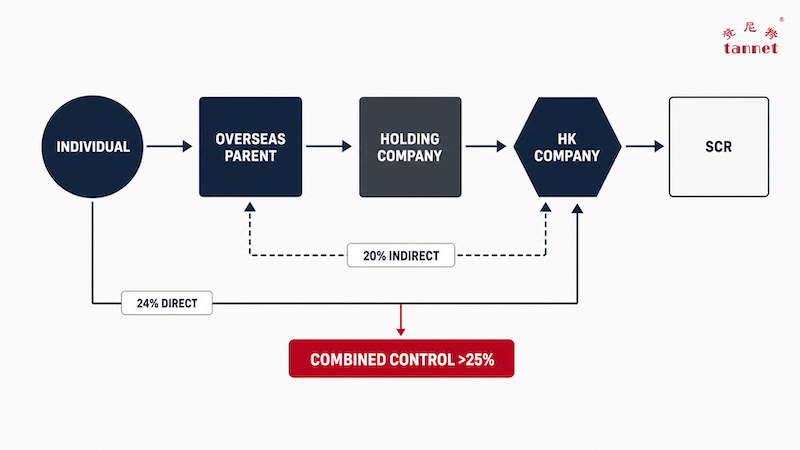
Foreign-owned Hong Kong companies with corporate shareholders require looking beyond overseas holding companies to identify ultimate significant controllers under SCR. In practice, it means:
- Indirect ownership must be traced through all holding layers
- Direct and indirect interests are combined (e.g., 24% direct + 20% indirect exceeds 25%)
- Individuals may qualify as significant controllers without majority shareholding, especially in complex international structures
Identifying Controllers Without Guesswork
The company has a duty to take reasonable steps to identify its significant controllers. That means the process should be based on evidence rather than assumptions about who appears to “own” the business.
Start With Company Records
Review the register of members, articles of association, statement of capital, shareholder agreements, and other relevant agreements. Companies should also consider interests held through legal entities, trusts, firms, and arrangements that may consolidate control rights.
For a straightforward owner-managed company, this exercise may be relatively simple. For a group involving several holding companies or overseas investors, tracing control can take more work.
Unclear Information? Send Notices
If a company reasonably believes someone is a significant controller, it must issue notice within seven days thereafter. Similar notice requirements also apply where the company believes another person may know the identity of a significant controller.
A notice is not always required if the controller has informed the company and provided required particulars properly. A person receiving an SCR notice generally has one month to comply with its requirements from service date.
Names Are Only Half the Job
After identifying controllers, the SCR must record required particulars for individuals and entities, including identity, address, registration, and control nature details. These details ensure the register clearly reflects who ultimately exercises significant control and how that control is held.
Timing is critical: once an individual controller’s required information is confirmed, enter into the SCR within seven days. For a registrable legal entity, each required detail must likewise be recorded within seven days after it comes to the company’s notice.
Don’t Miss the Designated Representative
Every company under the SCR regime must appoint at least one eligible person to assist law enforcement matters. This representative may be a Hong Kong resident director, member, or employee, or a qualified accountant, lawyer, or licensed trust or company service provider.
This important for overseas-owned companies with directors and shareholders outside Hong Kong because residence requirement applies unless professional. The designated representative’s name and contact details must be recorded in the SCR to ensure compliance.
Where the Register Is Kept Matters
The SCR must be kept at the company’s registered office or another approved location in Hong Kong. If stored elsewhere, the company must notify the Registrar using Form NR2 within 15 days of the change or initial placement at that location.
Certain transitional exceptions may apply to older companies keeping SCR with register of members at previously notified addresses. The register is not publicly accessible, but law enforcement officers have inspection rights; significant controllers have prescribed access.
One Change Can Break Your SCR
An SCR correct two years ago may now be outdated due to ownership, voting, or structural recent changes. Even changes higher up an overseas holding structure can also shift control and trigger a need to reassess the register.
Where a company knows or reasonably believes a registrable change occurred, it must update SCR within seven days. Records of former significant controllers cannot be deleted immediately must be retained for six years requiring ongoing compliance.
Key SCR Compliance Risks
Several problems appear simple but can produce an incomplete register:
- treating the shareholder register as the SCR
- stopping review at an overseas holding company
- using 25% instead of more than 25% threshold
- ignoring voting and board appointment rights
- missing indirect control
- not updating SCR after share transfers or restructuring
These are not just paperwork issues. Non-compliance with SCR obligations is a criminal offence, with companies and responsible persons liable to a Level 4 fine of HK$25,000 and a daily fine of HK$700 where applicable.
Give Your SCR a Practical Health Check
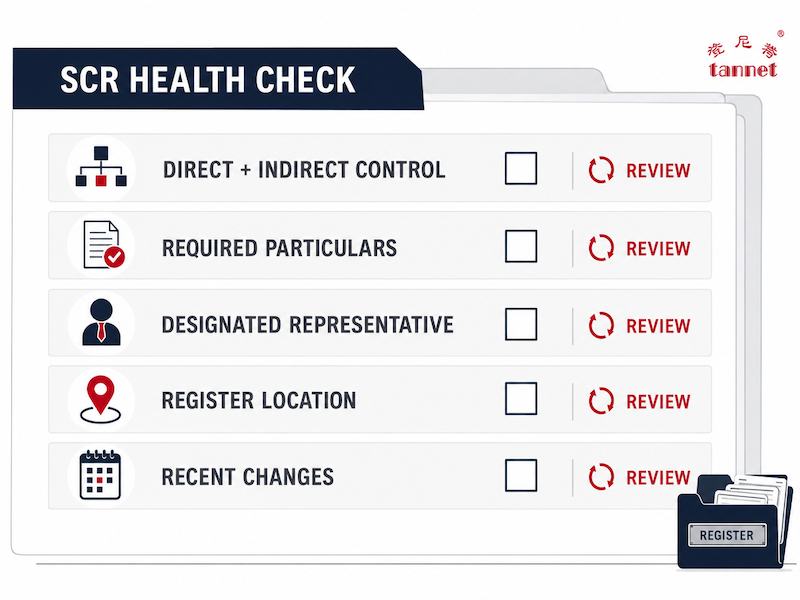
A useful review starts with a few direct questions. Do you know where your SCR is currently kept, and does it properly identify both direct and indirect controllers? Have all required particulars been recorded, and is the designated representative still eligible and reachable?
You should also consider what has changed since the register was last reviewed. A new investor, share transfer, restructuring, shareholder agreement, or change at an overseas parent company should prompt another review of the SCR.
How Tannet Supports Hong Kong Compliance
For overseas investors, the hardest part of corporate compliance is coordinating multiple obligations rather than understanding requirements exist. This becomes even more challenging as ownership, directors, business activities, and group structures continue to evolve.
Tannet provides Hong Kong company secretarial and corporate compliance support, including statutory registers, annual filings, and registered office services. Our Hong Kong company secretary services include SCR maintenance for foreign founders without in-house compliance teams.
Don’t Assume Your SCR Is Fine
An outdated SCR may remain unnoticed in company records until transactions, reviews, ownership changes, official requests reveal issues. If unsure whether your Hong Kong Significant Controllers Register reflects current ownership, contact Tannet for compliance review support.
Get a Quote now with Tannet!