Key Takeaway
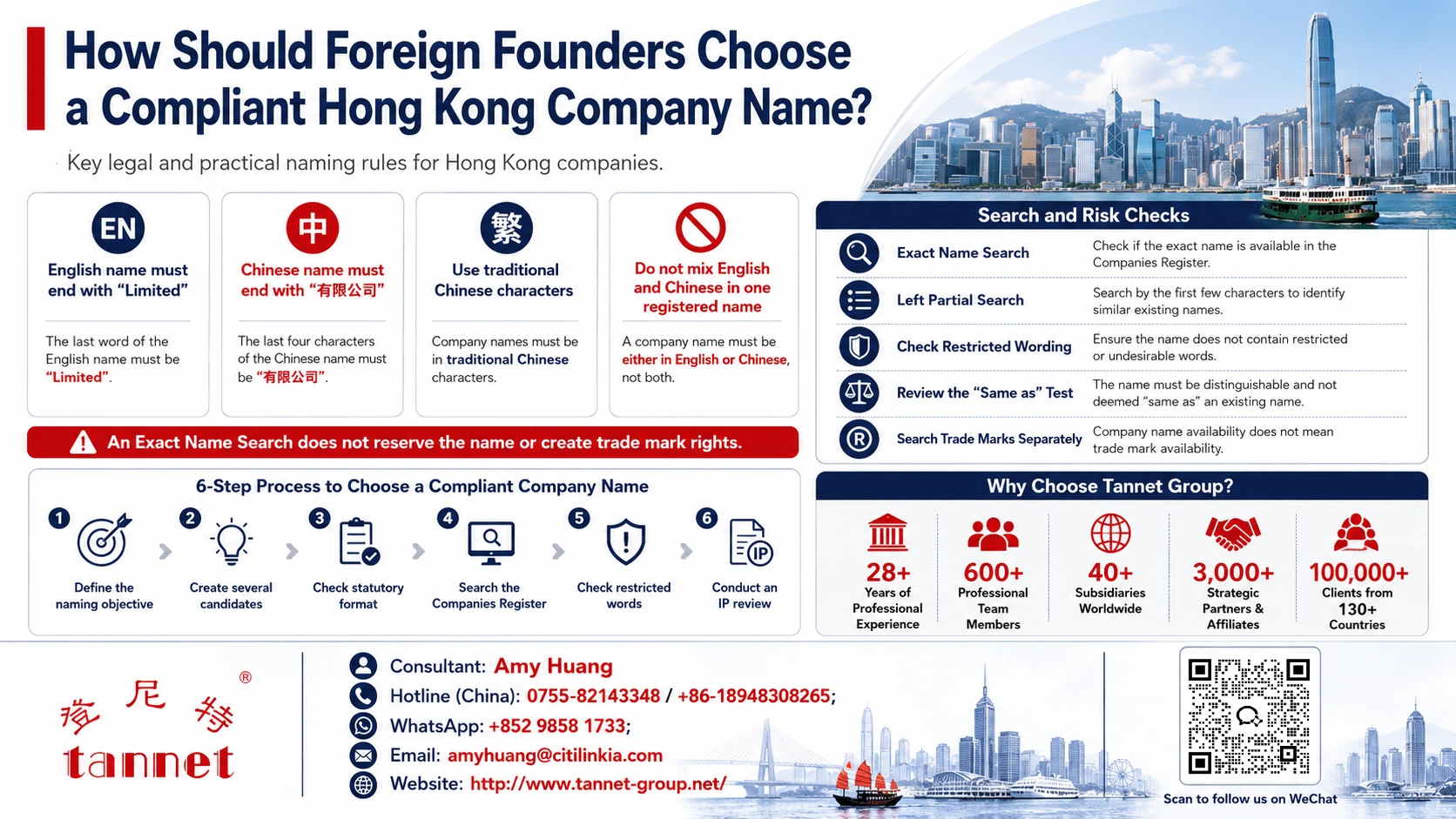
A compliant Hong Kong company name must satisfy the Companies Ordinance and the Companies Registry’s naming rules.
It may be registered in English, traditional Chinese, or both, but English letters and Chinese characters cannot be mixed within one name.
An English limited-company name must end with “Limited”, while a Chinese name must end with “有限公司”.
The most important caution is that an Exact Name Search does not guarantee registration and company-name registration does not create trade mark rights.
What name formats are permitted?
A local company may register:
- An English name only.
- A Chinese name only.
- One English name and one Chinese name.
A registered name cannot combine English letters and Chinese characters in a single name.
A Chinese company name must use traditional Chinese characters. Simplified Chinese characters are not accepted for the registered Chinese name.
What ending must a limited company use?
The last word of an English name for a limited company must be “Limited”.
The abbreviation “Ltd” is not accepted as the registered ending, even though it may be treated as equivalent in some name comparisons.
A Chinese name for a limited company must end with “有限公司”.
Practical point
Design the name exactly as it will appear in the incorporation form, articles, bank documents, contracts, website, and invoices.
Avoid creating a brand that depends on an unofficial abbreviation that may be confused with the registered name.
Why can an apparently available name still be rejected?
The Companies Registry will not register a name that is the same as a name in its Index of Company Names.
It may also reject a name that is the same as a statutory body, would constitute a criminal offence, is offensive, or is contrary to the public interest.
Some words and expressions require prior approval. A name may also require approval if it suggests a connection with the Central People’s Government, the Hong Kong SAR Government, or a government department or agency.
Practical point
Name availability is only one test.
The founder should also assess restricted wording, public-interest concerns, regulatory implications, and possible intellectual property conflicts.
How does the “same as” test work?
Founders often try to create uniqueness through punctuation, spaces, letter case, or common corporate endings.
Those differences may not be enough.
When comparing names, the Registrar may disregard letter case, spaces, accent marks, punctuation, and certain words or endings. Expressions such as “and” and “&”, “Hong Kong”, “Hongkong” and “HK”, and “Far East” and “FE” may be treated as the same.
Example
“North Harbour HK Limited” may not become distinct merely because another name uses “Hong Kong”, different punctuation, or different capitalization.
The legal comparison is not the same as a marketing comparison.
How should an Exact Name Search be conducted?
The Companies Registry provides free company name searches through its e-Search Services.
Use the Exact Name Search mode and enter the full proposed name. Include spaces, punctuation, and ending terms such as “Limited” or “有限公司”.
Search the English and Chinese names separately.
Only English or traditional Chinese characters should be used for the relevant search. A simplified Chinese search may incorrectly return no matching result.
A better search sequence
- Run an Exact Name Search for the full proposed name.
- Run a Left Partial Search using the distinctive opening words.
- Review current and old company names with similar initial wording.
- Prepare alternative names before submitting the incorporation application.
Why should founders check trade marks separately?
Company name registration, business registration, and trade mark registration are separate systems.
The Intellectual Property Department states that registering a company name does not give the company trade mark rights.
A company may obtain its name from the Companies Registry and still face a trade mark infringement or passing-off issue if the name conflicts with another party’s rights.
Practical point
Search the Hong Kong Trade Marks Register before building a website, packaging, advertising, or cross-border brand strategy around the name.
For a high-value brand, consider specialist intellectual property advice.
What makes a name commercially practical?
Legal registrability is the first test. Operational usability is the second.
A practical name should be easy to reproduce across bank, contract, tax, domain, and customer records.
It should not imply a regulated activity that the business is not licensed to conduct.
It should also leave room for the company to expand without making the registered name misleading or unnecessarily narrow.
Questions to ask
- Does the name describe the business too narrowly?
- Could it imply banking, insurance, trust, government, or another regulated status?
- Is the spelling easy for overseas customers and banks to verify?
- Are the matching domain and major social handles available?
- Does the Chinese version carry the intended meaning?
- Can the name be protected as a trade mark in the relevant markets?
A six-step name selection process
Step 1: Define the naming objective
Decide whether the name should identify a group, product, location, founder, or business activity.
Step 2: Create several candidates
Prepare at least three English options and, where relevant, corresponding traditional Chinese options.
Do not treat the Chinese name as an automatic translation. Confirm meaning, pronunciation, and commercial tone.
Step 3: Check statutory format
Confirm the required “Limited” or “有限公司” ending.
Remove any mixed English-Chinese wording within a single proposed name.
Step 4: Search the Companies Register
Use Exact Name Search and Left Partial Search. Review punctuation, spacing, abbreviations, and equivalent expressions.
Step 5: Check restricted and misleading words
Identify any wording that may require approval or imply a government or regulated connection.
Step 6: Conduct an intellectual property review
Search the Trade Marks Register and consider the markets where the brand will operate.
Common mistakes
- Using “Ltd” instead of “Limited” in the proposed English registered name.
- Using simplified Chinese characters.
- Combining English and Chinese in one name.
- Assuming punctuation or spaces create legal distinctiveness.
- Searching only the exact name and ignoring similar earlier names.
- Using restricted or regulated wording without checking approval requirements.
- Assuming Companies Registry acceptance creates trade mark protection.
- Printing marketing materials before the name is registered and checked for IP risk.
Frequently asked questions
Q1: Can a Hong Kong company have both English and Chinese names?
Yes. It may register one English name and one Chinese name.
Q2: Can one registered name mix English and Chinese characters?
No. A mixed English-Chinese company name will not be registered.
Q3: Can the English name end with “Ltd”?
No. The last word must be “Limited” for a limited company.
Q4: Can a Chinese company name use simplified Chinese?
No. The registered Chinese name must use traditional Chinese characters.
Q5: Does an Exact Name Search reserve the name?
No. It is a search tool and does not reserve or approve the proposed name.
Q6: Can I use “Hong Kong” or “HK” to make a name different?
Not necessarily. The Registrar may treat “Hong Kong”, “Hongkong”, and “HK” as the same when comparing names.
Q7: Does registering the company name protect the brand?
No. Trade mark protection is handled separately by the Intellectual Property Department.
Q8: What if the name is considered too like another company’s name after incorporation?
The Registrar may direct a company to change a name in circumstances provided by the Companies Ordinance. Founders should review similar names and intellectual property risks before filing.
When Tannet may be suitable
Tannet may assist foreign founders who need an English and Chinese company name review, Companies Registry name searches, incorporation document preparation, registered address and company secretary arrangements, or coordination with trade mark and branding work.
The final registrability of a proposed name is determined by the Companies Registry. Intellectual property protection requires a separate assessment.
Official sources
Written by: Tannet Hong Kong Business Services Team
Reviewed by: Consultant Amy Huang
First published: 6 August 2026
Last reviewed: 6 August 2026
Jurisdiction: Hong Kong SAR
————————————————Simplifying Business, Empowering Entrepreneurs————————————————