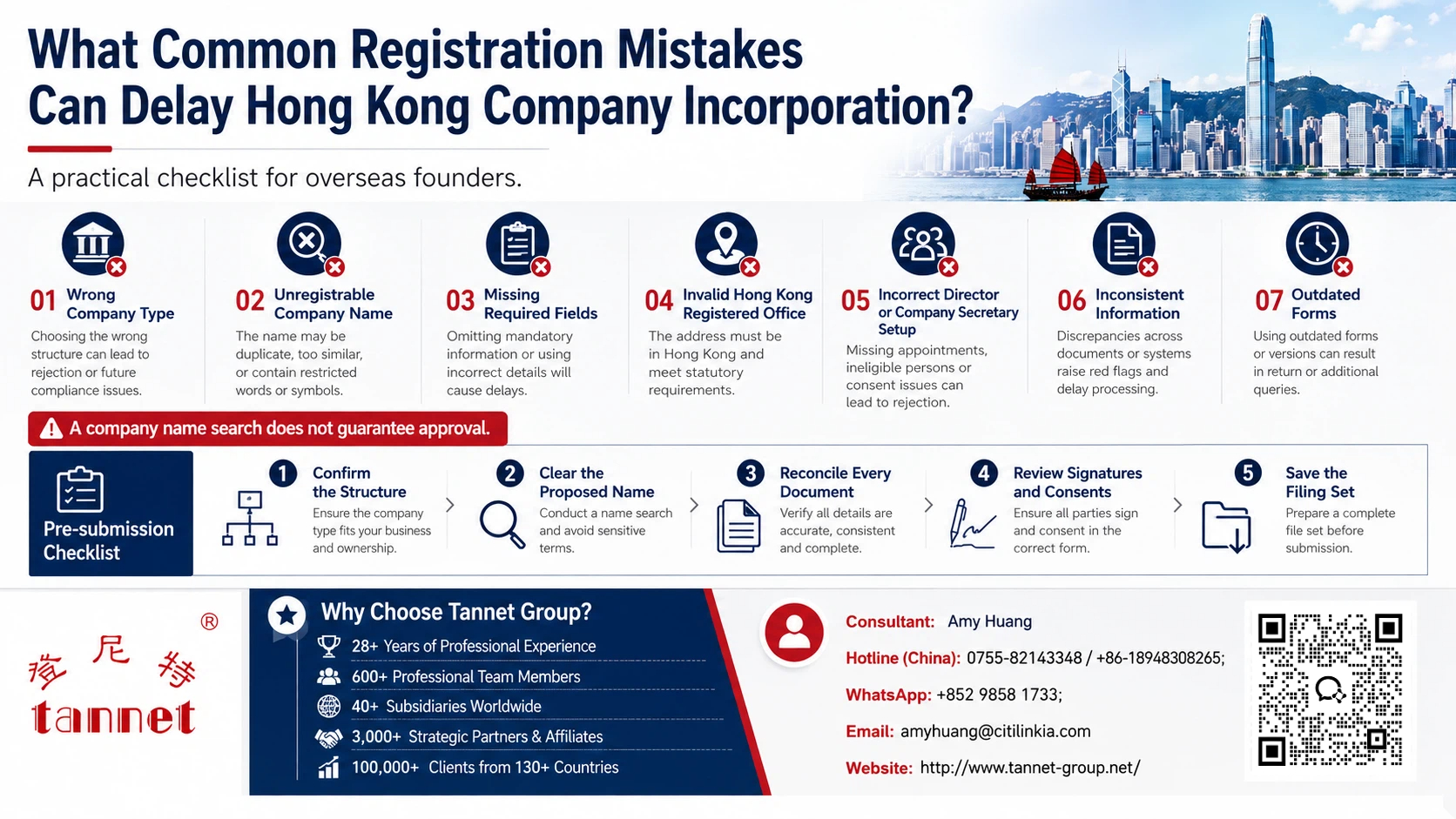
Key Takeaway
A Hong Kong company incorporation application can be delayed or rejected when the proposed name is not registrable, the wrong form is used, required documents are missing, or the details of directors, shareholders, the company secretary, and the registered office are incomplete or inconsistent.
The most important precaution is to review the complete filing package before submission.
A company name search is useful, but it does not guarantee acceptance.
The Companies Registry confirms registrability only after processing the application.
What must be submitted for incorporation?
For a local company limited by shares, the Companies Registry identifies three core documents:
- Form NNC1, the incorporation form.
- A copy of the articles of association.
- Form IRBR1, the notice to the Business Registration Office.
A company not limited by shares normally uses Form NNC1G. Under the one-stop service, the incorporation filing is also treated as a business registration application.
Mistake 1: Choosing the wrong company type
A private company limited by shares is common for commercial businesses. It is not the only company type.
A company limited by guarantee has no share capital and is often used by non-profit organisations.
How to avoid the mistake
Confirm the ownership, liability, and governance model before selecting NNC1 or NNC1G.
Mistake 2: Submitting a company name that cannot be registered
A name may be rejected if it duplicates an indexed name, uses restricted wording without approval, is offensive, or suggests an improper government connection.
An English limited-company name must end with “Limited”. A Chinese name must use traditional characters and end with “有限公司”. English and Chinese cannot be combined within one registered name.
How to avoid the mistake
Conduct an Exact Name Search through the Companies Registry’s e-Search Services.
Search the full proposed name, including spaces, punctuation, and the ending word. Prepare alternative names because a search result does not confirm final registrability.
Mistake 3: Leaving required fields blank
The incorporation form must state the particulars of the first director or directors, the company secretary, and the registered office.
The Companies Registry states that leaving these items blank makes the form unsatisfactory and the incorporation application will be rejected.
The proposed business nature code and description should also be completed using the current official list.
How to avoid the mistake
Use a completion checklist for every mandatory field.
Do not rely on an agent’s verbal confirmation. Review the final PDF or paper form before signing or submitting it.
Mistake 4: Using an invalid registered office arrangement
A local limited company’s registered office must be situated in Hong Kong.
An overseas founder may use a compliant address service, but the address should be available for official correspondence and accurately stated in the incorporation form.
An address outside Hong Kong cannot satisfy the registered office requirement.
How to avoid the mistake
Confirm the complete Hong Kong address before filing.
Use the structured address format recommended by the Companies Registry and check every address component for consistency.
Mistake 5: Appointing directors and the company secretary incorrectly
A private company needs at least one natural-person director and a company secretary.
An individual secretary must ordinarily reside in Hong Kong. A corporate secretary must have a registered or principal office in Hong Kong. The sole director cannot also be the secretary. A director does not generally need Hong Kong residency.
How to avoid the mistake
Map each proposed officer to the statutory role before submission.
Confirm whether the company secretary is acting as an individual or through a corporate service provider. Check that the same person is not entered in an incompatible combination of roles.
Mistake 6: Using inconsistent personal and corporate information
Differences in names, passport numbers, dates, addresses, shareholdings, or officer roles can trigger questions.
Examples include different passport-name formats, inconsistent addresses, or share figures that conflict with the articles.
How to avoid the mistake
Create one verified data sheet. Use consistent names, identification details, dates, addresses, and share figures across every document.
Mistake 7: Omitting or misaligning the articles of association
The articles form part of the incorporation package.
They govern shares, decision-making, and administration. Articles copied from another structure may conflict with Form NNC1.
How to avoid the mistake
Use articles matching the company type and share structure. Check the name, member provisions, share rights, and execution details.
Mistake 8: Missing director consent requirements
If a founder member signing the incorporation form is also a first director, the person should sign the consent to act in the form.
Other first directors may sign the consent in the incorporation form or deliver Form NNC3 within the prescribed period after incorporation.
How to avoid the mistake
Decide how each director will provide consent before filing.
Keep signed records and calendar any post-incorporation deadline that remains outstanding.
Mistake 9: Using outdated forms or an incomplete submission method
The Companies Registry publishes current specified forms. Outdated forms, altered QR codes, or inconsistent submission methods may cause problems.
The IRD states that the incorporation form and IRBR1 must use the same submission method.
How to avoid the mistake
Download forms directly from the Companies Registry shortly before filing.
Do not reuse old templates stored by a founder, agent, or previous company.
A practical pre-submission review
Step 1: Confirm the structure
Confirm the company type, shareholders, share capital, directors, secretary, and registered office.
Step 2: Clear the proposed name
Run an exact company name search and check restricted wording. Prepare at least two alternatives.
Step 3: Reconcile every document
Compare Form NNC1 or NNC1G, the articles, IRBR1, identity records, and address information.
Step 4: Review signatures and consents
Confirm who must sign and whether any director consent will be filed separately.
Step 5: Save the filing set
Keep the forms, articles, payment record, acknowledgement, and correspondence.
Common mistakes
- Selecting the company type after the documents have already been drafted.
- Assuming an available search result means the name is approved.
- Leaving officer, address, or business nature fields incomplete.
- Appointing the sole director as company secretary.
- Using an overseas address as the registered office.
- Submitting inconsistent names, dates, addresses, or share figures.
- Reusing old forms without checking the current version.
- Treating incorporation as separate from the simultaneous business registration filing.
Frequently asked questions
Q1: Can a foreigner be the sole shareholder and director?
A non-Hong Kong resident may form a local limited company. A private company must still have a Hong Kong-compliant company secretary and a registered office in Hong Kong.
Q2: Does Hong Kong require minimum paid-up capital?
The Companies Registry states that the Companies Ordinance does not prescribe a minimum amount of paid-up capital.
Q3: Does a successful company name search guarantee acceptance?
No. Registrability is confirmed only after the Companies Registry processes the incorporation application.
Q4: Can the registered office be outside Hong Kong?
No. A local limited company’s registered office must be in Hong Kong.
Q5: Can the sole director also be the company secretary?
No. The sole director of a private company must not also act as its company secretary.
Q6: What happens if required NNC1 fields are blank?
The Companies Registry may treat the form as unsatisfactory and reject the incorporation application.
Q7: Are company incorporation and business registration separate applications?
They are processed through a one-stop service. The incorporation filing includes a simultaneous business registration application.
When Tannet may be suitable
Tannet may assist overseas founders who need structure confirmation, company name checking, preparation of incorporation forms and articles, a Hong Kong registered address, company secretary support, document consistency review, or coordination of the one-stop incorporation and business registration filing.
Related support may include bank account preparation, accounting, tax compliance, intellectual property coordination, and ongoing corporate maintenance. Registration remains subject to the Companies Registry’s assessment.
Official sources
Written by: Tannet Hong Kong Business Services Team
Reviewed by: Consultant Amy Huang
First published: 6 August 2026
Last reviewed: 6 August 2026
Jurisdiction: Hong Kong SAR
————————————————Simplifying Business, Empowering Entrepreneurs————————————————