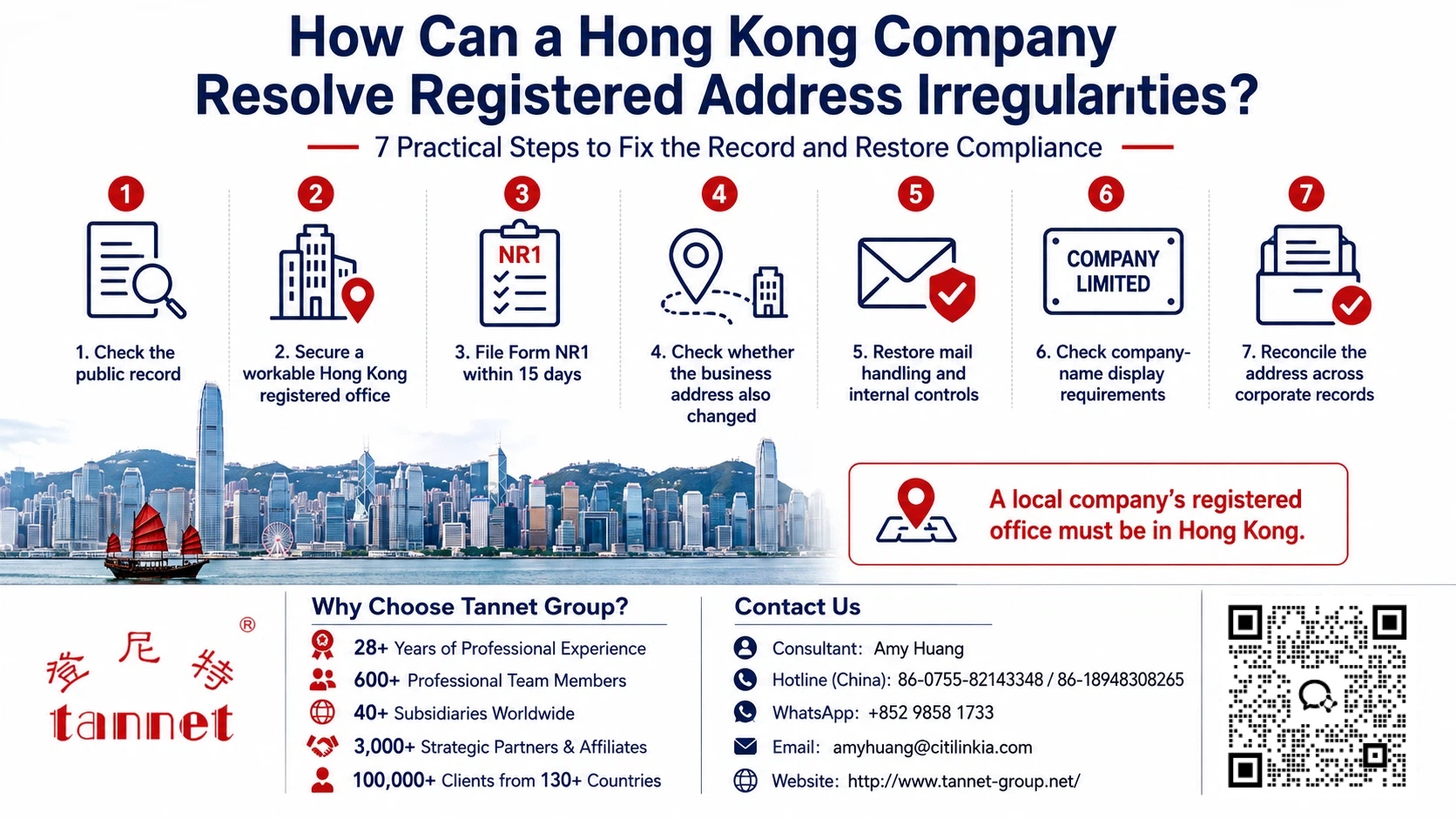
Key Takeaway
A Hong Kong company must keep a registered office in Hong Kong and ensure the public record reflects the correct address.
If an address becomes outdated, inaccessible, incorrectly filed, or unable to handle official correspondence, the company should first verify its Companies Registry record, secure a workable Hong Kong address, and file the correct notice without delay.
For a local company, a change of registered office is normally reported on Form NR1 within 15 days after the change.
The most important point is to fix both the legal record and the operational problem that caused the irregularity.
What Is a Registered Address Irregularity?
A registered address irregularity exists when the recorded address is inaccurate, outdated, incomplete, or no longer functioning as the company’s statutory contact point.
The company may have moved without updating the Companies Registry, or an address provider may have stopped handling mail.
The Companies Registry states that a local limited company’s registered office must be in Hong Kong. An irregularity can affect statutory filings, legal notices, public records, and tax correspondence.
Step 1 — Check the Public Record First
Before making any correction, confirm what the Companies Registry currently shows.
Use the Companies Registry’s e-Services Portal to compare the public record with the address actually used and check the effective date of any earlier change.
If the record appears wrong because of a mistake or unauthorised filing, investigate first. Registry guidance says companies should promptly report particulars that appear incorrect because of registered-document errors or unauthorised filings.
Questions to ask during the review
- Is the current registered office still available to the company?
- Is official mail being received and escalated promptly?
- Did the company physically move?
- Was Form NR1 previously filed?
- Does the effective date match the actual change?
- Is the business address also changing?
- Are directors, banks, accountants, and service providers using the same current details?
Step 2 — Secure a Workable Hong Kong Registered Office
If the existing address is no longer usable, arrange a replacement before leaving the company without a functioning registered office.
The Companies Registry confirms that the registered office of a local limited company cannot be outside Hong Kong.
The registered office does not have to be the day-to-day operating location. Overseas founders may use a professional address service.
The arrangement should still work in practice. Official correspondence must be received and escalated reliably.
Step 3 — File Form NR1 Within the Required Time
When a local company changes its registered office address, Form NR1 is the specified notice used under section 658(3) of the Companies Ordinance.
The Companies Registry’s current FAQ states that Form NR1 must be delivered within 15 days after the change.
Do not leave the effective date blank. The Registry’s filing tips identify two common errors: reporting the new address without the effective date, or reporting the effective date without the new address.
The form should reflect the real change and effective date.
Step 4 — Check Whether the Business Address Also Changed
A registered office address and a business address are not necessarily the same thing.
If only the registered office changes, the Companies Registry transmits the new registered-office information to the Business Registration Office after NR1 is registered.
If the business address also changes, current guidance states that the business-address change should be reported within one month. An optional electronic one-stop service is available in certain local-company cases.
Do not assume one filing updates every address used by the company.
Step 5 — Restore Mail Handling and Internal Controls
Filing the correct address is only one part of the remedy.
The company should document who receives mail, how often it is checked, how urgent letters are escalated, and who confirms that a deadline has been completed.
Use a shared mail log rather than informal envelope photos. Record the sender, receipt date, deadline, responsible person, and completion status, especially for government, court, tax, and bank correspondence.
Step 6 — Check Company Name Display Requirements
Registered address compliance is also connected with company-name disclosure.
The Companies Registry explains that a company should generally display its registered name in legible characters at the registered office and business venues.
For locations serving more than six companies, specified electronic display can satisfy the rule. A 2024 Companies Registry prosecution included convictions for failure to report a registered-office change and failure to display the company name.
Step 7 — Reconcile the Address Across Corporate Records
After correcting the Companies Registry record, review business registration, bank records, invoices, contracts, licences, websites, and internal templates.
Not every system must use the registered office. The goal is to label each address correctly and update third parties through their own procedures.
Common Mistakes
- Updating the business address but forgetting the registered office record.
- Filing NR1 without the correct effective date.
- Assuming a virtual or shared address is compliant merely because a provider sells it as a “registered address.”
- Keeping an address after the provider has stopped receiving or forwarding mail.
- Waiting for the annual return to correct an address that already changed.
- Assuming the Companies Registry update automatically changes every bank, licence, contract, and vendor record.
- Ignoring company-name display requirements at a shared registered office.
Frequently Asked Questions
Q1. Can a Hong Kong company keep its registered office outside Hong Kong?
No. The Companies Registry states that the registered office of a local limited company must be situated in Hong Kong.
Q2. Which form is used to change a local company’s registered office?
Form NR1, Notice of Change of Address of Registered Office, is the specified form under section 658(3).
Q3. How quickly must Form NR1 be filed?
The Companies Registry states that it should be delivered within 15 days after the change.
Q4. Does changing the registered office automatically change the business address?
Not necessarily. The registered office and business address are different concepts. If the business address also changes, review the Business Registration Office requirements or use the optional electronic one-stop service where applicable.
Q5. What if the previous provider suddenly stops handling mail?
Arrange a functioning replacement address, update the statutory record when the registered office changes, and review whether any official correspondence was missed during the disruption.
Q6. Can the company wait until its next annual return?
That is not the normal approach for a registered office change. The Companies Registry requires the change to be reported on Form NR1 within the statutory filing period.
Q7. How can directors check whether the public address is correct?
Use the Companies Registry’s e-Services search functions and review the company’s registered documents and current particulars.
When Tannet May Be Suitable
Tannet may assist when a Hong Kong company needs to replace an unusable registered address, review whether the Companies Registry record is current, coordinate Form NR1 filing, organise mail-handling procedures, or reconcile registered-office and business-address information.
For overseas founders, Tannet can also coordinate company secretary, registered address, accounting, tax, banking preparation, and ongoing corporate maintenance. The company and its officers remain responsible for statutory compliance, and government registration decisions remain with the relevant authority.
Official Sources
Hong Kong Companies Registry — Local Limited Companies: Incorporation FAQ
https://www.cr.gov.hk/en/faq/local-company/incorporation.htm
Hong Kong Companies Registry — One-stop Notification of Change of Company Particulars
https://www.cr.gov.hk/en/faq/local-company/change-of-particulars.htm
Hong Kong Companies Registry — Filing Tips: Documents Relating to Address of Registered Office
https://www.cr.gov.hk/en/forms/filing/reasons-address.htm
Hong Kong Companies Registry — Disclosure of Company Name and Liability Status
https://www.cr.gov.hk/en/legislation/companies-ordinance/cap622/keychanges/disclose-comp-name-liab.htm
Hong Kong Companies Registry — Filing Tips / e-Services Search
https://www.cr.gov.hk/en/forms/filing.htm
Written by: Tannet Hong Kong Business Services Team
Reviewed by: Consultant Amy Huang
First published: 11 August 2026
Last reviewed: 11 August 2026
Jurisdiction: Hong Kong SAR
————————————————Simplifying Business, Empowering Entrepreneurs————————————————