Key Takeaway
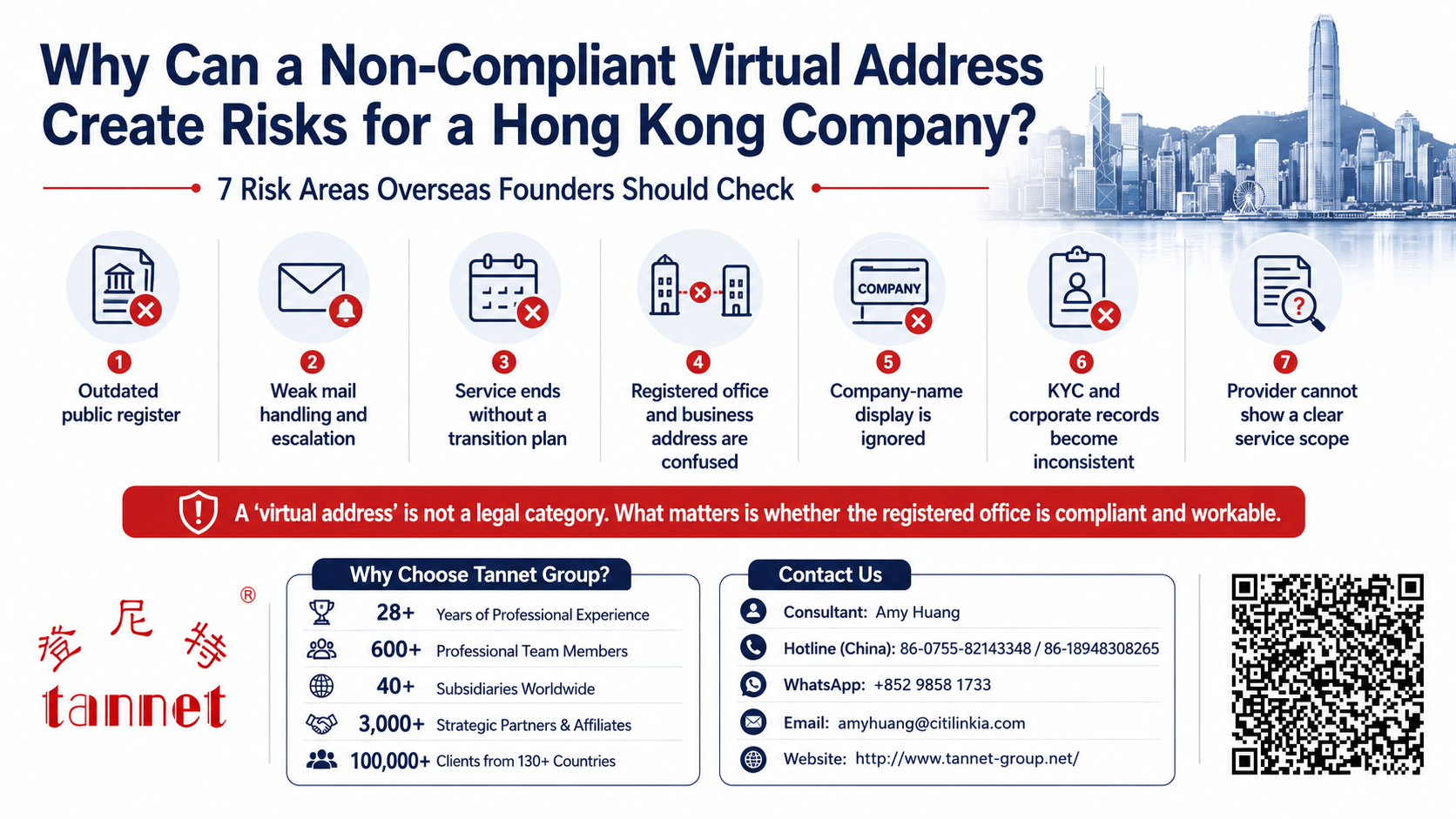
A “virtual address” is a commercial service label, not a separate legal category under Hong Kong company law. The real question is whether the address used as the company’s registered office satisfies statutory and practical requirements.
A Hong Kong company needs a registered office in Hong Kong, an accurate public filing, reliable receipt of official correspondence, and compliance with company-name display rules. A low-cost shared address can work if those functions are properly handled.
The main risks arise when the address is outdated, inaccessible, poorly managed, falsely presented, or disconnected from the company’s actual compliance process.
The Risk Is Not the Word “Virtual”
Many overseas founders use professional address services instead of leasing a full office. That arrangement is not automatically a problem.
The Companies Registry requires a local limited company to have a registered office in Hong Kong. The practical test is whether official correspondence can reach the company and whether the public record is accurate.
Marketing labels such as “virtual office” or “business centre” do not answer those questions.
Risk 1 — The Address on the Public Register Is Outdated
The most basic failure occurs when a company leaves an address but does not update the Companies Registry.
For local companies, the current Companies Registry FAQ states that Form NR1 should be delivered within 15 days after a registered office change.
An outdated record can send government or legal correspondence to the wrong place and create inconsistencies for banks or counterparties checking the public record.
Risk 2 — Official Mail Is Received but Not Escalated
A service may receive mail but still have weak operating procedures. Slow scanning, inactive notification emails, or no deadline escalation can cause missed notices.
Ask how mail is logged, how quickly it is scanned or forwarded, how urgent documents are handled, and what happens when the main contact cannot be reached.
Risk 3 — The Service Ends Without a Transition Plan
Address irregularities often occur when a service contract expires.
If the service ends, arrange a replacement and update the statutory record when the registered office changes.
The contract should cover termination, post-termination mail, forwarding, original-document collection, and the timing for removing the address from company records.
Risk 4 — The Registered Office and Business Address Are Confused
A company’s registered office and business address do not always serve the same purpose.
If only the registered office changes, the Companies Registry transmits the new registered-office information to the Business Registration Office after NR1 is registered.
If the business address also changes, current guidance states that it should be reported within one month. An optional electronic one-stop service is available in certain local-company cases.
Treating all addresses as interchangeable is a common mistake.
Risk 5 — Company Name Display Is Ignored
The Companies (Disclosure of Company Name and Liability Status) Regulation contains requirements for displaying a company’s registered name.
The Companies Registry explains that the registered name should generally be displayed in legible characters at the registered office and business venues.
For locations serving more than six companies, specified electronic display can meet the rule. A 2024 Companies Registry prosecution included convictions for failure to report a registered-office change and failure to display the company name.
Risk 6 — The Address Creates Inconsistency in KYC and Corporate Records
Banks and regulated institutions conduct their own due diligence. A registered office does not automatically prove where the business operates or where a director lives.
Label registered, operating, business, and residential addresses accurately and keep supporting evidence for each where required.
Risk 7 — The Provider Cannot Show a Clear Service Scope
A compliant-looking address is not enough if the service agreement is vague.
Check whether the package covers registered-office use, mail receipt, scanning, forwarding, company-name display, original documents, and address-change support.
Confirm who handles statutory filings. An address provider may receive mail without acting as company secretary.
A Seven-Point Due-Diligence Checklist
1. Verify the actual Hong Kong location
Confirm the full address that will appear on the Companies Register.
2. Confirm registered-office use is included
Do not rely on a generic “mailbox” package if it does not permit statutory registered-office use.
3. Test the mail process
Ask about scanning speed, original document retention, forwarding, urgent notices, and escalation.
4. Ask how company-name display is handled
This is particularly important at addresses shared by many companies.
5. Review termination procedures
Know when the address stops being available and how a change will be coordinated.
6. Separate registered office from business and operating addresses
Use the correct address for each form, bank request, invoice, contract, and licence.
7. Review the public record periodically
The Companies Registry recommends monitoring company records and checking that registered particulars remain current and accurate.
A practical control is to schedule a quarterly public-record check. Compare the registered office, directors, company secretary, and recent filings against the company’s internal records. If the address provider changes its trading name, premises, service terms, or contact process, confirm that the statutory address itself remains unchanged and usable. This simple review can detect a service failure before a government letter or legal notice is missed.
Common Mistakes
- Assuming every “virtual office” automatically qualifies as a registered office.
- Choosing only by price and ignoring mail handling.
- Letting the address contract expire before arranging a replacement.
- Missing the 15-day NR1 filing period after an address change.
- Treating the registered office as proof of physical operations.
- Forgetting company-name display requirements.
- Assuming the provider will update banks and commercial counterparties automatically.
Frequently Asked Questions
Q1. Is a virtual office automatically illegal for a Hong Kong company?
No. The label itself does not determine compliance. The underlying registered office arrangement must satisfy the applicable requirements and work as a real statutory contact point.
Q2. Can the registered office be outside Hong Kong?
No. The Companies Registry states that a local limited company’s registered office must be in Hong Kong.
Q3. How quickly must a registered office change be reported?
The Companies Registry states that Form NR1 must be delivered within 15 days after the change.
Q4. Does a registered office prove where the company actually trades?
No. A registered office and an operating or business address can be different.
Q5. What mail-handling features should an overseas founder check?
Check receipt, logging, scanning speed, forwarding, original retention, urgent-document escalation, and contact backup procedures.
Q6. What happens if a shared-address provider closes?
The company should arrange a replacement, determine the actual date of change, file the required notice, and review missed correspondence and other address records.
Q7. Can many companies share the same location?
Shared locations exist in practice. Company-name display rules include specific electronic-display provisions for locations serving more than six companies.
When Tannet May Be Suitable
Tannet may assist overseas founders who need a Hong Kong registered address service with company secretary coordination, mail handling, address-change filings, corporate record updates, and a clearer separation between registered, business, and operating addresses.
Where a company also needs accounting, tax, banking preparation, or wider corporate maintenance, these services can be coordinated as part of the same compliance workflow. Tannet does not control regulatory or bank decisions, and each company remains responsible for accurate information and timely compliance.
Official Sources
Hong Kong Companies Registry — Local Limited Companies: Incorporation FAQ
https://www.cr.gov.hk/en/faq/local-company/incorporation.htm
Hong Kong Companies Registry — One-stop Notification of Change of Company Particulars
https://www.cr.gov.hk/en/faq/local-company/change-of-particulars.htm
Hong Kong Companies Registry — Disclosure of Company Name and Liability Status
https://www.cr.gov.hk/en/legislation/companies-ordinance/cap622/keychanges/disclose-comp-name-liab.htm
Hong Kong Companies Registry — Filing Tips
https://www.cr.gov.hk/en/forms/filing.htm
Hong Kong Companies Registry — Prosecution Case, 14 August 2024
https://www.cr.gov.hk/en/compliance/prosecution/case-20240814.htm
Written by: Tannet Hong Kong Business Services Team
Reviewed by: Consultant Amy Huang
First published: 11 August 2026
Last reviewed: 11 August 2026
Jurisdiction: Hong Kong SAR
————————————————Simplifying Business, Empowering Entrepreneurs————————————————