Key Takeaway
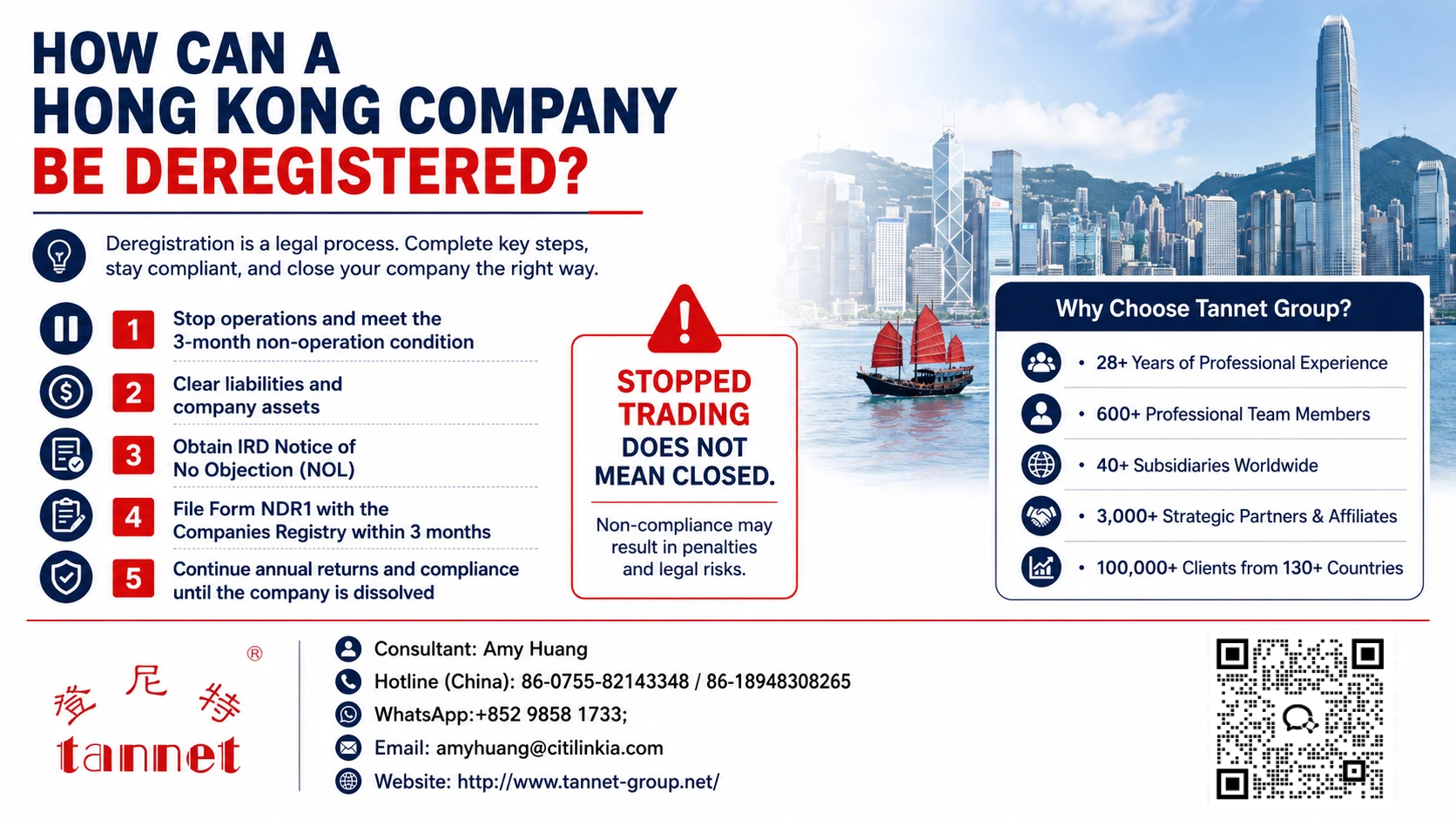
Hong Kong company deregistration is a voluntary route for closing a defunct, solvent local private company or a local company limited by guarantee that meets the statutory conditions.
It is most suitable when the company has stopped trading, has no outstanding liabilities, is not involved in legal proceedings, and has properly cleared its assets and tax matters.
The critical point is that deregistration is not the same as simply abandoning a company.
The company must first obtain a Notice of No Objection from the Inland Revenue Department, then file Form NDR1 with the Companies Registry, and continue meeting statutory obligations until it is formally dissolved.
Who Can Use Hong Kong Company Deregistration?
Deregistration is designed for a defunct solvent company. It is not a substitute for winding up an insolvent company.
The Companies Registry states that only an eligible local private company or local company limited by guarantee may apply. A company with outstanding creditors should not assume deregistration is available.
The Seven Core Eligibility Conditions
Before filing, the company should be able to satisfy all of the following conditions:
- All members agree to the deregistration.
- The company has never commenced business, or has not operated during the three months immediately before the application.
- The company has no outstanding liabilities.
- The company is not a party to legal proceedings.
- The company has no immovable property in Hong Kong.
- If it is a holding company, none of its subsidiaries holds immovable property in Hong Kong.
- The company has obtained a Notice of No Objection from the Commissioner of Inland Revenue.
These conditions should be checked before documents are submitted, not after a problem is raised.
Step 1 – Stop Operations and Clear the Company Position
A company should first confirm that business activity has stopped and that the three-month non-operation condition can be met.
Stopping sales is not enough if the company is still issuing invoices, receiving trading income, entering contracts, or employing staff.
The company should identify every liability, including tax, trade creditors, payroll, loans, director balances, and contractual obligations.
Deal With Company Assets Before Deregistration
The Companies Registry specifically warns companies to dispose of property before applying. This includes credit balances in company bank accounts, vehicles, and landed property.
A common mistake is to leave cash in a corporate bank account. Once a company is dissolved, unresolved property may create recovery problems.
Directors should review bank balances, receivables, deposits, intellectual property, equipment, and other assets before applying.
Step 2 – Clear Tax Matters and Apply for the Notice of No Objection
The next stage is the Inland Revenue Department.
The applicant must request a Notice of No Objection to a Company Being Deregistered using Form IR1263. The current IRD application fee is HK$270 and is non-refundable.
According to the IRD, the normal processing time for a valid request is within 21 working days after lodgement and payment.
The IRD will not issue the notice if tax matters remain outstanding.
What Tax Issues Can Block the Notice?
The IRD states that a company should have no outstanding tax liabilities or obligations. This can include Profits Tax, Property Tax, Stamp Duty, Business Registration fees, penalties, court fees, outstanding returns, unanswered enquiries, or unsettled objections and appeals.
A company that stopped trading years ago may still have unfiled returns or unresolved tax correspondence.
Step 3 – File Form NDR1 With the Companies Registry
After receiving the Notice of No Objection, the company must act within the required period.
The Companies Registry requires Form NDR1 to be delivered within three months from the date of the Notice of No Objection.
The current filing fee for Form NDR1 is HK$420 and is non-refundable.
The application may be filed electronically or in hard copy. Check the Companies Registry instructions for the required form of the Notice of No Objection.
Step 4 – Continue Compliance Until Formal Dissolution
Submitting Form NDR1 does not immediately dissolve the company.
The Companies Registry states that the company must continue filing outstanding annual returns and comply with Companies Ordinance obligations until dissolution.
The Registry normally issues an acknowledgement of a deregistration application in about four working days. It also states that the first Gazette notice is usually published about three weeks after the acknowledgement.
The company should keep its registered office, records, contacts, and compliance arrangements in order while the process remains open.
Deregistration, Striking Off and Winding Up Are Different
Deregistration is an application made by an eligible defunct solvent company.
Striking off is a statutory power exercised by the Registrar when there is reason to believe a company is not operating. A company does not apply for striking off as a shortcut.
Winding up is a different process used to settle accounts, realise assets, distribute remaining property, and dissolve a company. It may be relevant where deregistration conditions cannot be met.
Choosing the wrong route can delay the exit.
Common Mistakes
Mistake 1 – Stopping Business but Ignoring Annual Returns
A company remains subject to filing obligations until it is dissolved. An application for deregistration does not erase earlier compliance failures.
Mistake 2 – Leaving Money in the Bank Account
Company property should be properly dealt with before deregistration. Closing the company while assets remain can create recovery and ownership problems.
Mistake 3 – Applying While Liabilities Still Exist
Even a small unpaid invoice or unresolved director balance may conflict with the no-liability condition.
Mistake 4 – Assuming the IRD Notice Means the Company Is Closed
The Notice of No Objection is only a prerequisite for the Companies Registry application. It is not the final dissolution.
Mistake 5 – Missing the Three-Month Filing Window
Form NDR1 must be delivered within three months from the date of the Notice of No Objection.
Mistake 6 – Providing Inaccurate Information
The Companies Registry warns that knowingly or recklessly providing materially false or misleading information in connection with deregistration is an offence.
Frequently Asked Questions
Q1. Can I deregister a Hong Kong company that still has debts?
No. The company must have no outstanding liabilities. If liabilities remain, another closure route may need to be considered.
Q2. Does the company need to stop trading for three months?
Yes. The company must either never have commenced business or have stopped operating for the three months immediately before the deregistration application.
Q3. Do I need to clear tax before filing Form NDR1?
Yes. A Notice of No Objection from the IRD is required before the Companies Registry application.
Q4. Can I leave a small bank balance in the company account?
That is not a good approach. The Companies Registry advises that company property, including bank balances, should be properly disposed of before the application.
Q5. Do annual return obligations stop once NDR1 is filed?
No. The Companies Registry states that annual returns and other statutory obligations continue until the company is dissolved.
Q6. Can a deregistered company be restored later?
A company dissolved by deregistration may be restored by an application to the Court of First Instance under the Companies Ordinance. Administrative restoration does not apply to a company dissolved by deregistration.
When Tannet May Be Suitable
Tannet may assist where a Hong Kong company needs a pre-deregistration compliance review, tax and accounting record coordination, annual return catch-up, asset and liability checklist, IRD Notice of No Objection preparation, Form NDR1 support, or communication across company secretary and accounting functions.
This can be particularly relevant for overseas shareholders who need one team to coordinate corporate records, tax clearance steps, and the closure timeline. The final tax and deregistration decisions remain with the Inland Revenue Department and Companies Registry.
Official Sources
Hong Kong Companies Registry – How to deregister a defunct solvent company:
https://www.cr.gov.hk/en/services/deregister-company.htm
Hong Kong Companies Registry – FAQ on deregistration, striking off and winding up:
https://www.cr.gov.hk/en/faq/local-company/dereg-striking-off-winding-up.htm
Hong Kong Inland Revenue Department – How to apply for a Notice of No Objection:
https://www.ird.gov.hk/eng/tax/bus_han.htm
Written by: Tannet Hong Kong Business Services Team
Reviewed by: Consultant Amy Huang
First published: 13 August 2026
Last reviewed: 13 August 2026
Jurisdiction: Hong Kong SAR
————————————————Simplifying Business, Empowering Entrepreneurs————————————————