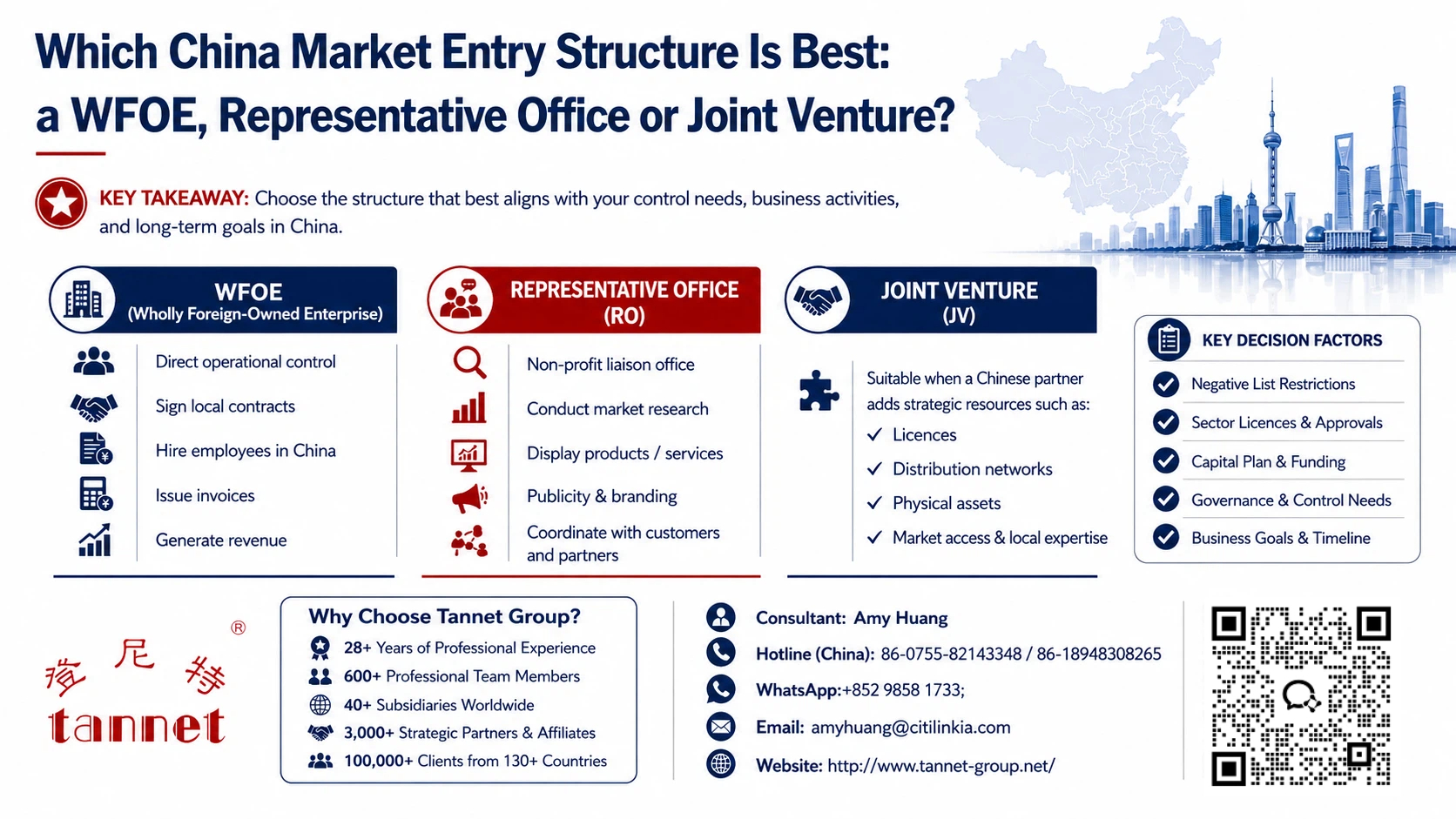
Key Takeaway
There is no single best China market entry structure for every foreign investor.
A wholly foreign-owned enterprise, commonly called a WFOE, is usually the most practical option when the foreign investor wants direct operational control, local contracts, employees, invoicing, and revenue in Mainland China.
A representative office is narrower and is mainly suitable for non-profit liaison, market research, display, publicity, and coordination.
A joint venture can be appropriate when a Chinese partner contributes market access, licences, assets, distribution, technology, or other strategic resources.
The most important step is to check the current foreign investment negative list, sector licensing rules, governance needs, and capital plan before choosing a structure.
First, Understand the Current Legal Framework
China’s Foreign Investment Law took effect on 1 January 2020 and replaced the former separate laws on wholly foreign-owned enterprises and joint ventures.
“WFOE” and “joint venture” remain useful commercial terms, but current enterprises are organised under the Foreign Investment Law, Company Law, and other applicable rules.
Foreign investment is subject to a pre-establishment national treatment plus negative-list system, as well as sector-specific licensing rules.
Option 1 – WFOE: Best for Direct Operating Control
A WFOE is commonly understood as a Mainland China company wholly owned by one or more foreign investors.
For many operating businesses, the practical form is a foreign-invested limited liability company.
A WFOE may suit an investor that needs staff, local contracts, invoicing, revenue, premises, assets, and direct operating control without a Chinese equity partner.
Main Advantages of a WFOE
The investor retains equity control and can build its own employees, suppliers, customers, accounting, tax, banking, and intellectual property processes.
This structure is often appropriate where foreign ownership is permitted and full local operations are required.
Main WFOE Cautions
Foreign ownership does not remove sector restrictions.
The 2024 national Foreign Investment Negative List, effective from 1 November 2024, sets out prohibited and restricted sectors. Activities outside the list can still require industry licences or approvals.
Capital planning also matters. Under the current Company Law, shareholders of a limited liability company generally must pay subscribed capital within five years from establishment, unless other rules apply. The amount should reflect the operating plan.
Option 2 – Representative Office: Best for Limited Non-Profit Presence
A representative office is not a separate legal person.
Under the current regulations administered by the State Administration for Market Regulation, a foreign enterprise representative office is an office engaged in non-profit activities related to the foreign enterprise’s business.
It cannot generally conduct profit-making activities.
What a Representative Office Can Do
Permitted activities can include market research, display, and publicity relating to the foreign enterprise’s products or services.
It can also conduct liaison activities relating to product sales, service delivery, domestic sourcing, and domestic investment.
This makes an RO useful for market testing, communication, partner liaison, and coordination without a full operating company.
What a Representative Office Cannot Replace
An RO is not a suitable substitute for a revenue-generating subsidiary.
If the business needs to sign commercial contracts in the RO’s own name, invoice customers, receive operating revenue, or run a full local business, a foreign-invested company may be more appropriate.
Registration, annual reporting, accounting, tax, employment, and office requirements still apply.
Option 3 – Joint Venture: Best When a Local Partner Adds Real Value
A joint venture may be useful when a Chinese partner contributes distribution, licences, facilities, supply-chain resources, technology, brand access, or sector knowledge.
A JV should not be chosen only because a local partner says it is easier.
Governance Is the Core JV Issue
The main risk is not incorporation. It is the relationship between shareholders after incorporation.
The parties should define board composition, voting rights, reserved matters, capital, management appointments, profit distribution, intellectual property, related-party transactions, transfer restrictions, deadlock procedures, and exit rights.
These points should be consistent across the constitutional documents and actual governance process.
How to Choose Between WFOE, RO and JV
Choose a WFOE When
You need a full operating company.
You want direct control over employees, contracts, revenue, suppliers, and business processes, and your sector permits the intended foreign ownership.
Choose a Representative Office When
You mainly need market research, liaison, display, publicity, sourcing, or investment coordination, and do not need the office itself to conduct profit-making activities.
Choose a Joint Venture When
A local shareholder contributes resources that are difficult to replace through normal contracts.
The commercial model makes shared ownership useful, and both sides are prepared to negotiate governance and exit rules before investment is committed.
Common Mistakes
Mistake 1 – Treating WFOE as a Separate Old Legal Regime
The old Wholly Foreign-owned Enterprise Law was repealed when the Foreign Investment Law took effect. Current company structure should be reviewed under the Foreign Investment Law, Company Law, and sector rules.
Mistake 2 – Assuming an RO Can Invoice Customers
A representative office is designed for non-profit activities and cannot generally conduct profit-making business.
Mistake 3 – Choosing a JV Without a Governance Plan
A strong local partner does not remove shareholder conflict risk. Control, capital, IP, management, and exit terms should be defined early.
Mistake 4 – Ignoring the Negative List
Foreign ownership rules vary by sector. Check the current national negative list before committing to a structure.
Mistake 5 – Setting Unrealistic Registered Capital
Capital should support the business plan and comply with current contribution rules. An arbitrary figure may create future funding or compliance pressure.
Mistake 6 – Using a Hong Kong Company as a Substitute for Mainland Registration
A Hong Kong company can be a regional or holding platform, but it does not replace a Mainland entity or licence where one is required.
Frequently Asked Questions
Q1. Is a WFOE still a valid term in 2026?
Yes as a business shorthand. Legally, foreign-invested enterprises now operate under the unified Foreign Investment Law and applicable Company Law framework rather than the former WFOE law.
Q2. Can a representative office receive sales revenue?
Generally no. A representative office is intended for non-profit activities such as market research, publicity, and liaison.
Q3. Do I need a Chinese shareholder for a WFOE?
No. The concept is a company wholly owned by foreign investors, subject to the negative list and sector-specific restrictions.
Q4. Is a joint venture required in restricted industries?
It depends on the specific sector and the current negative list or other special rules. Some restricted sectors may impose equity or management conditions.
Q5. Can a Hong Kong company own a Mainland WFOE?
A Hong Kong company can potentially invest in a Mainland foreign-invested enterprise, subject to the applicable investment, registration, beneficial ownership, sector, tax, and licensing rules.
Q6. Which structure is usually fastest to set up?
Speed should not be the main criterion. Sector, licensing, capital, ownership, tax, and governance matter more.
When Tannet May Be Suitable
Tannet may assist businesses that need to compare Hong Kong and Mainland China structures, coordinate a Hong Kong holding or operating company with a Mainland market-entry plan, organise incorporation and corporate documents, or connect company setup with banking, accounting, tax, intellectual property, and ongoing compliance.
For a WFOE, RO, or JV project, the final structure should be checked against the current Mainland foreign investment rules, industry licences, local registration requirements, and the investor’s commercial objectives. Registration and licensing outcomes remain subject to the relevant authorities.
Official Sources
Foreign Investment Law of the People’s Republic of China:
https://english.www.gov.cn/services/investment/202102/24/content_WS6035aa38c6d0719374af9609.html
State Administration for Market Regulation – Regulations on Resident Representative Offices of Foreign Enterprises:
https://www.samr.gov.cn/zw/zfxxgk/fdzdgknr/fgs/art/2023/art_9114ca69b3c24a08a850e59ea41838c3.html
National Development and Reform Commission – 2024 Foreign Investment Negative List:
https://www.ndrc.gov.cn/xxgk/zcfb/fzggwl/202409/t20240907_1392875_ext.html
State Administration for Market Regulation – Company Law of the People’s Republic of China:
https://www.samr.gov.cn/zw/zfxxgk/fdzdgknr/fgs/art/2023/art_067c072db6ef4679a2e0180996be4cf8.html
InvestHK – Setting Up in Hong Kong:
https://www.investhk.gov.hk/en/setting-up-in-hong-kong/
Written by: Tannet Hong Kong Business Services Team
Reviewed by: Consultant Amy Huang
First published: 13 August 2026
Last reviewed: 13 August 2026
Jurisdiction: Hong Kong SAR / Mainland China market-entry context
————————————————Simplifying Business, Empowering Entrepreneurs————————————————