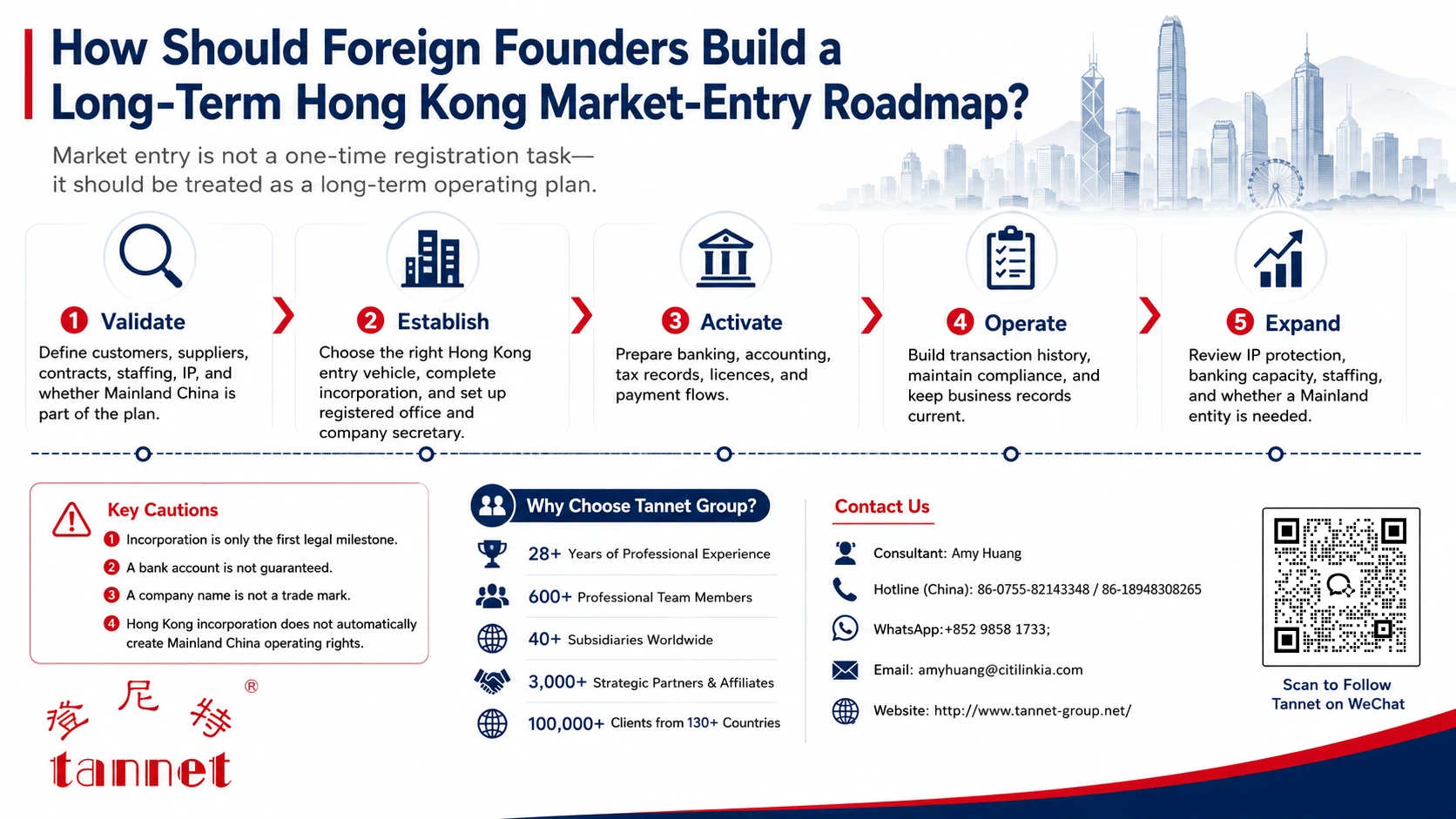
Key Takeaway
A long-term Hong Kong market-entry roadmap should be built as a sequence, not as a one-time company-registration task.
It is most suitable for foreign founders who want Hong Kong to function as an operating company, regional hub, contracting entity, investment vehicle, or bridge to wider Asian markets.
The main caution is to align the legal entity, banking, tax, licensing, intellectual property, staffing, and future Mainland China plan with the real business model from the beginning.
Incorporation is only the first legal milestone.
Operational readiness and ongoing compliance determine whether the structure remains useful over time.
Start with the business model, not the company form
Before forming a Hong Kong company, define what the entity will actually do.
Identify target customers, sales channels, payment flows, suppliers, currencies, staffing, intellectual property, and where contracts will be performed.
A Hong Kong company does not solve every cross-border requirement. Licensing, tax, banking, employment, customs, and Mainland market-access rules depend on actual activity.
Questions to answer before incorporation
Clarify the following points in writing:
- Who will buy the product or service?
- Where will the work be performed?
- Where will customers and suppliers be located?
- Which currencies will be received and paid?
- Will staff be hired in Hong Kong?
- Will the company need regulated licences?
- Will the business later enter Mainland China?
Choose the right Hong Kong entry vehicle
Many overseas founders use a local private company limited by shares.
The Companies Registry requires at least one natural-person director and a company secretary. Directors need not be Hong Kong residents. The registered office must be in Hong Kong.
An overseas company establishing a Hong Kong place of business may instead need registration as a non-Hong Kong company, generally within one month.
The choice should reflect liability, group structure, contracts, tax, and operations.
Complete incorporation and business registration correctly
Hong Kong company incorporation and business registration are closely connected.
InvestHK explains that an application to incorporate a local company includes a simultaneous application for business registration. Core incorporation documents include the relevant incorporation form, Articles of Association, and business-registration notice.
The Companies Registry states that straightforward electronic incorporation of a private company limited by shares can normally be processed within about one hour when the name and information pass system checks.
Build operational readiness immediately after incorporation
A newly incorporated company still needs systems to trade, receive money, keep records, and meet regulatory obligations.
Banking and payment preparation
Banks apply customer due diligence and may request information on ownership, business activity, expected transactions, source of funds, customers, suppliers, and jurisdictions.
The Hong Kong Monetary Authority notes that account-opening requirements vary by bank risk assessment and customer circumstances.
Prepare a consistent ownership chart, business explanation, contracts, source-of-funds evidence, and transaction forecast.
Accounting and tax records
The Inland Revenue Department applies profits tax to profits arising in or derived from Hong Kong from a trade, profession, or business carried on in Hong Kong.
Tax outcomes are fact-specific. Incorporation location alone does not determine the final tax position.
IRD guidance also requires sufficient business records, generally retained for at least seven years.
Licences and sector approvals
A Certificate of Incorporation does not replace sector-specific licences.
GovHK provides a Business Licence Information Service to identify licences and permits. Check regulated sectors before committing to contracts, leases, staffing, or capital expenditure.
Protect the brand separately from the company name
A registered company name is not the same as a registered trade mark.
Hong Kong’s Intellectual Property Department states that registering a company or business name does not itself create registered trade mark rights.
Founders should search relevant marks early and consider registration before major spending on packaging, websites, advertising, or expansion.
Design the Mainland China plan as a separate workstream
A Hong Kong company can be useful for regional ownership, international contracts, financing, procurement, and cross-border coordination.
However, a Hong Kong company does not automatically give the right to conduct every type of domestic business in Mainland China.
If the founder plans to hire Mainland staff, issue local invoices, operate premises, or obtain local licences, a Mainland structure may be required, such as a foreign-invested enterprise.
For some service sectors, CEPA may offer preferential access. The Trade and Industry Department states that a Hong Kong juridical person generally needs substantive Hong Kong business operations to qualify as a Hong Kong Service Supplier.
A paper company is not automatic CEPA qualification.
Build ongoing compliance into the roadmap
Long-term market entry requires a compliance calendar.
A Hong Kong private company generally files its annual return within 42 days after each incorporation anniversary. Local unlisted companies generally maintain a Significant Controllers Register.
Keep company records, accounting evidence, tax correspondence, ownership information, contracts, and key resolutions current.
A practical 12-to-24-month market-entry sequence
Phase 1 – Validate
Confirm customers, pricing, business activity, expected transactions, licensing issues, and the role Hong Kong will play.
Phase 2 – Establish
Choose the entity, complete incorporation, arrange a compliant registered office and company secretary, and establish record-keeping procedures.
Phase 3 – Activate
Prepare banking, accounting, contracts, tax processes, licences, insurance, and intellectual property.
Phase 4 – Operate
Build real transaction history, maintain customer and supplier records, monitor cash flow, and keep filings current.
Phase 5 – Expand
Review whether the business needs staff, licences, Mainland operations, a subsidiary, more IP protection, or additional banking.
Common Mistakes
- Incorporating before defining the actual business model.
- Treating a bank account as guaranteed after company registration.
- Using a registered address without understanding compliance responsibilities.
- Ignoring licences until after contracts or leases are signed.
- Assuming a company name automatically protects the brand.
- Treating Hong Kong incorporation as automatic permission to operate in Mainland China.
- Delaying accounting, tax, and annual-return planning until deadlines are close.
Frequently Asked Questions
Q1. Can a foreigner own 100% of a Hong Kong private company?
Yes. A Hong Kong private company can generally be foreign-owned. Directors need not be Hong Kong residents, but the company secretary and registered office must meet local requirements.
Q2. Do I need a Hong Kong bank account before I start trading?
Not always, but payment arrangements should be planned early. Banks and payment providers conduct independent due diligence.
Q3. Can I use my Hong Kong company to sell directly in Mainland China?
It depends on the activity. Domestic operations, hiring, licences, invoicing, or premises may require a Mainland entity or approvals.
Q4. Is business registration the same as company incorporation?
No. They are different legal concepts, although Hong Kong provides a one-stop process for local company incorporation and business registration.
Q5. When should I register a trade mark?
Ideally before major brand investment or expansion. A company name registration does not provide the same rights as a registered trade mark.
Q6. What should be reviewed after the first year?
Review annual returns, accounting, tax, licences, banking, ownership, contracts, IP, and whether the structure still matches operations.
Q7. When should a founder consider a Mainland China entity?
Consider it when the business needs sustained domestic operations, local employees, local invoicing, local licences, or a physical presence in Mainland China.
When Tannet May Be Suitable
Tannet may assist foreign founders coordinating Hong Kong incorporation with registered office and company secretary support, banking preparation, accounting and tax compliance, intellectual property, licences, or a wider China and Asia plan.
This can be relevant where several providers or jurisdictions must be coordinated. The appropriate structure depends on the actual business model and regulatory requirements.
Sources
Written by: Tannet Hong Kong Business Services Team
Reviewed by: Consultant Amy Huang
First published: 14 August 2026
Last reviewed: 14 August 2026
Jurisdiction: Hong Kong SAR
————————————————Simplifying Business, Empowering Entrepreneurs————————————————