Key Takeaway
A Hong Kong company and a Mainland China WFOE are not interchangeable.
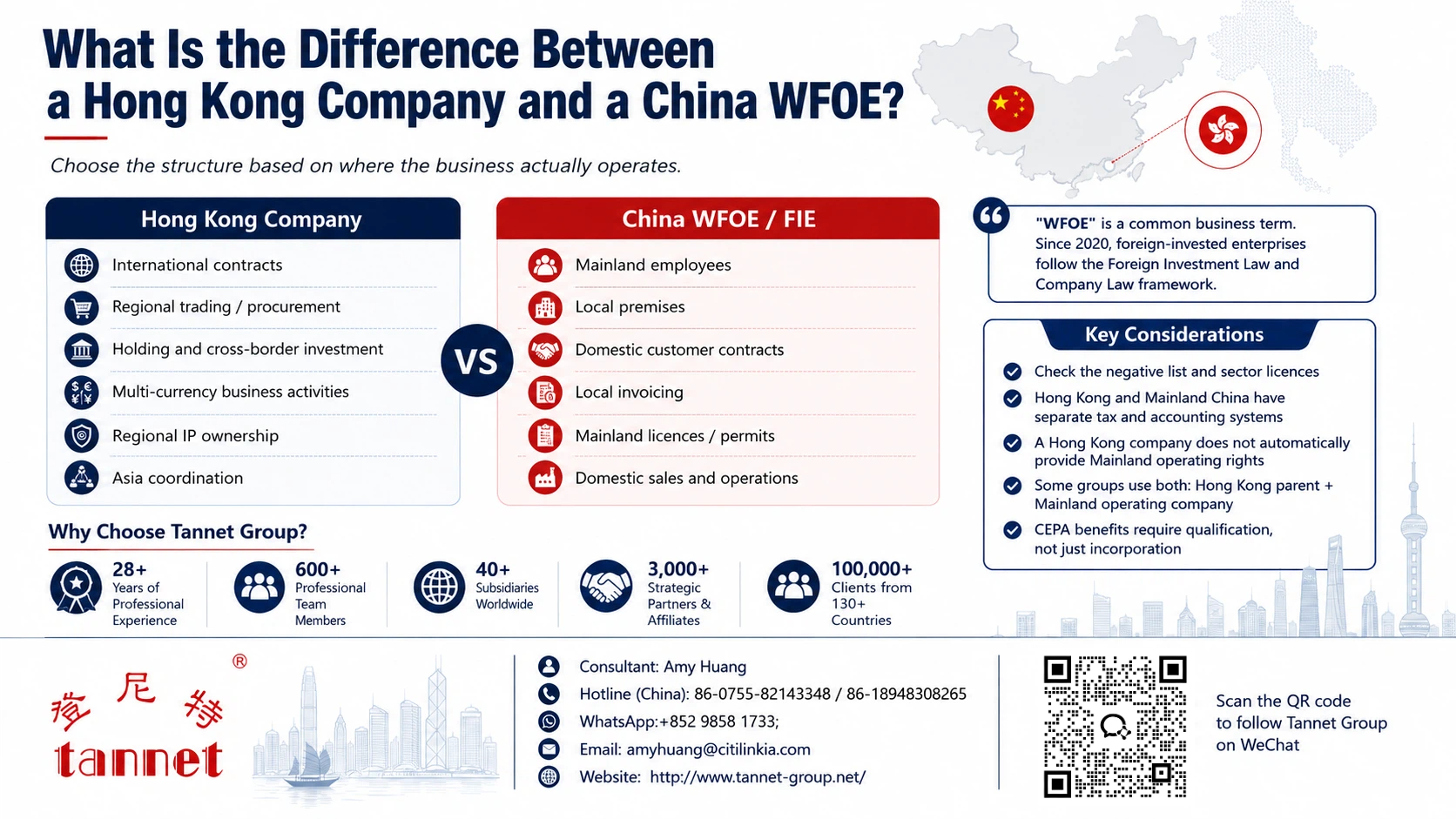
A Hong Kong company is incorporated under Hong Kong law and is commonly used for Hong Kong operations, international contracting, regional holding, trade, financing, and cross-border coordination.
A “WFOE” is the common business term for a wholly foreign-owned foreign-invested enterprise established in Mainland China under the current Foreign Investment Law and Company Law framework.
It is more suitable when the business needs sustained Mainland operations, local staff, domestic contracts, local invoicing, or sector licences.
The main caution is to choose the entity based on where the business actually operates.
First, understand what “WFOE” means today
The term WFOE, or Wholly Foreign-Owned Enterprise, remains widely used in business discussions.
China’s Foreign Investment Law changed the framework from 1 January 2020.
Article 42 repealed the former Law on Wholly Foreign-Owned Enterprises. Article 31 places foreign-invested enterprise organisation and governance under the Company Law, Partnership Enterprise Law, and other applicable laws.
“WFOE” still describes a Mainland company wholly owned by foreign investor(s), but it is commercial shorthand rather than a separate legacy regime.
The two entities belong to different legal jurisdictions
A Hong Kong company is incorporated in the Hong Kong SAR under the Companies Ordinance.
A Mainland foreign-invested enterprise is established in Mainland China and is subject to Mainland company, foreign-investment, tax, labour, foreign-exchange, licensing, and other applicable rules.
This affects contracts, employees, invoicing, banking, tax, licences, and regulatory supervision. A Hong Kong company is not a Mainland domestic operating company.
Ownership is often simple in both structures, but market access differs
A Hong Kong private company can generally be wholly foreign-owned. Directors need not be Hong Kong residents, but the company needs a Hong Kong registered office and compliant company secretary.
Mainland China permits wholly foreign-owned foreign-invested enterprises in many sectors, subject to the Foreign Investment Law and national negative list.
The 2024 national Negative List, effective from 1 November 2024, contains 29 restrictive measures and removed the remaining foreign-investment restrictions in manufacturing. Restrictions still apply in some other sectors.
Check the actual industry, licences, equity limits, and local requirements.
A Hong Kong company is often designed for cross-border flexibility
A Hong Kong company may be suitable when the main objective is:
- International sales and service contracts
- Regional procurement or trading
- Holding shares in other companies
- Cross-border investment
- Multi-currency commercial activity
- Regional intellectual-property ownership
- Coordinating Asian operations
- Establishing a future Mainland investment platform
Hong Kong incorporation by itself does not create a right to perform regulated activities or conduct domestic Mainland operations.
A WFOE is usually closer to the Mainland operating business
A wholly foreign-owned foreign-invested enterprise may suit businesses needing a Mainland operating presence, including:
- Hiring employees under Mainland employment arrangements
- Renting and operating a Mainland office
- Entering domestic customer contracts
- Issuing local invoices where required
- Applying for Mainland licences or permits
- Maintaining local accounting and tax systems
- Receiving domestic business revenue
- Building local sales, service, or operational teams
Tax and accounting systems should not be mixed together
Hong Kong and Mainland China have separate tax and accounting systems.
Hong Kong applies a territorial profits-tax framework, with chargeability depending on source and facts.
A Mainland foreign-invested enterprise handles Mainland tax, accounting, labour, social insurance, foreign exchange, and reporting under Mainland rules.
Do not choose between the entities using a single headline tax rate. Consider where contracts are negotiated, services performed, people work, customers pay, IP is used, and management decisions occur.
Banking and payment flows are also different
A Hong Kong company uses Hong Kong corporate documents for banking or payment due diligence.
A Mainland foreign-invested enterprise uses Mainland banking arrangements and follows Mainland rules for domestic payments, foreign exchange, capital, and cross-border transfers.
Intercompany payments need a genuine commercial basis and documentation.
Hong Kong can be the parent of a Mainland operating company
A common cross-border structure is a Hong Kong holding or regional company that owns a Mainland foreign-invested subsidiary.
This can centralise regional ownership and international contracting while the Mainland entity handles domestic operations.
The structure should reflect commercial substance, funding, tax, transfer pricing, licensing, and foreign-exchange requirements.
CEPA can matter, but a Hong Kong company alone is not enough
CEPA can provide preferential treatment in certain service sectors. The Trade and Industry Department says a juridical person seeking Hong Kong Service Supplier status generally needs substantive business operations in Hong Kong.
The 2024 CEPA amendment removed the previous three-year operating-period requirement for many service sectors, but newly incorporated Hong Kong companies do not automatically qualify for preferential Mainland access.
How to choose between the two
Choose a Hong Kong company first when
The business is initially international or Hong Kong-focused, customers are outside Mainland China, the founder wants a regional holding or contracting entity, or Mainland entry is a later phase.
Choose a Mainland WFOE or other FIE when
The business needs sustained domestic Mainland operations, local employees, domestic customers, local invoices, premises, or licences.
Consider both when
Hong Kong will serve as the regional parent or international commercial platform while the Mainland company performs local operations.
Review the final structure for tax, transfer pricing, ownership, regulation, and commercial substance.
Common Mistakes
- Assuming a Hong Kong company can operate in Mainland China without additional registrations.
- Treating “WFOE” as a separate legal regime that still operates under the old WFOE law.
- Ignoring the foreign-investment negative list and sector licences.
- Choosing a structure based only on tax rates.
- Using a Hong Kong company with no commercial substance solely to claim Mainland advantages.
- Failing to document intercompany payments between Hong Kong and Mainland entities.
- Assuming CEPA benefits apply automatically after Hong Kong incorporation.
Frequently Asked Questions
Q1. Can a Hong Kong company hire employees in Mainland China directly?
Not always. Long-term local employment normally requires a compliant Mainland employment and operating arrangement.
Q2. Can a Hong Kong company issue Mainland China invoices?
No. A Hong Kong company does not automatically have the same domestic invoicing position as a Mainland enterprise. The structure depends on the transaction and local rules.
Q3. Is a WFOE still a legal term?
It is widely used commercially, but the former WFOE law was repealed in 2020. Wholly foreign-owned companies now operate under the Foreign Investment Law and Company Law framework.
Q4. Can a Hong Kong company own 100% of a Mainland company?
In many permitted sectors, yes. Sector restrictions, licensing, and the negative list must still be checked.
Q5. Does CEPA make Mainland entry automatic for a Hong Kong company?
No. Preferential treatment depends on the relevant sector and qualification requirements, including Hong Kong Service Supplier requirements where applicable.
Q6. Which structure is better for an e-commerce business?
It depends on customers, platform rules, inventory location, payment flows, fulfilment, employees, tax, and whether sales are domestic Mainland sales or cross-border sales.
Q7. Can I start with Hong Kong and add a Mainland company later?
Yes. This is a common staged approach when Mainland operations are not required on day one.
When Tannet May Be Suitable
Tannet may assist foreign founders comparing Hong Kong incorporation with a Mainland foreign-invested structure, coordinating a Hong Kong parent and Mainland operating company, or aligning formation with banking, accounting, tax, IP, and cross-border investment.
For Mainland projects, confirm registration and licensing for the intended city and activity. Required authority approvals cannot be replaced by a service provider.
Sources
Written by: Tannet Hong Kong Business Services Team
Reviewed by: Consultant Amy Huang
First published: 14 August 2026
Last reviewed: 14 August 2026
Jurisdiction: Hong Kong SAR
————————————————Simplifying Business, Empowering Entrepreneurs————————————————