Key Takeaway
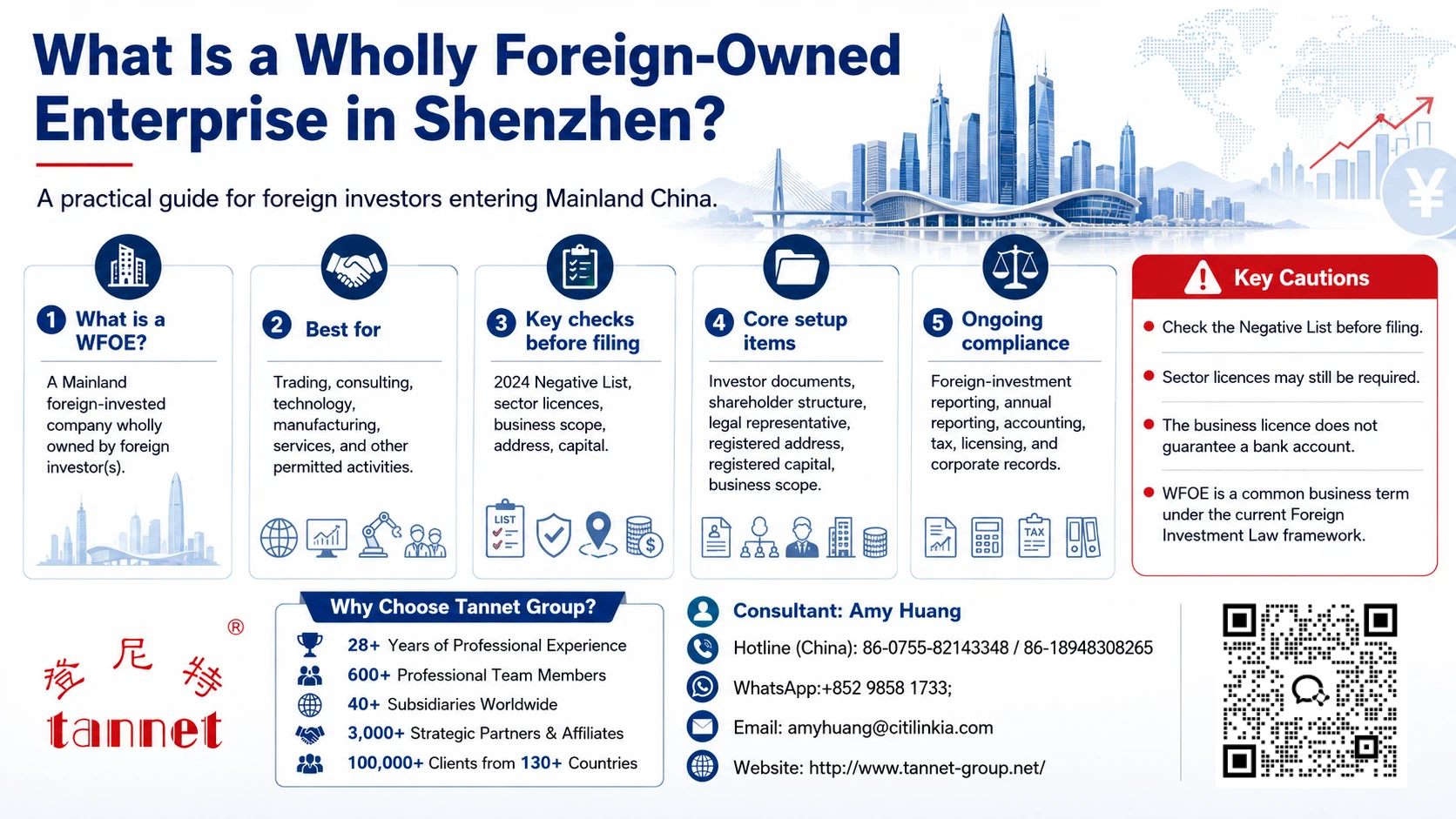
A Wholly Foreign-Owned Enterprise, or WFOE, is the common business term for a Mainland China foreign-invested enterprise wholly owned by one or more foreign investors.
In Shenzhen, it can be used for eligible trading, consulting, technology, manufacturing, services, and other permitted activities.
It is most suitable when the foreign investor wants a separate Mainland operating company rather than only a representative presence.
The most important point is to check the current foreign-investment Negative List and sector licences before filing. Outside restricted sectors, foreign investment is generally managed under national-treatment principles. Registration, foreign-investment information reporting, tax, banking, and ongoing compliance remain separate obligations.
What Is a China WFOE?
“WFOE” means Wholly Foreign-Owned Enterprise. The term remains widely used by investors, banks, and professional advisers.
The legal framework has changed. The former Law on Wholly Foreign-Owned Enterprises was repealed when the Foreign Investment Law took effect in 2020. Today, a wholly foreign-owned company operates under the Foreign Investment Law, Company Law, and other applicable regulations.
In practical terms, a China WFOE is a Mainland company whose equity is held entirely by foreign investor(s), where the sector permits that ownership structure.
Who Can Set Up a WFOE in Shenzhen?
Foreign individuals, overseas companies, and other eligible foreign investors can invest in Mainland China through permitted forms of foreign-invested enterprise.
The first question is not “Can a foreigner register a company?” It is “Is the proposed business open to foreign investment in the proposed form?”
China applies a pre-establishment national treatment plus Negative List system. The 2024 national Negative List contains 29 restrictive measures. Outside the Negative List, foreign investment is generally treated under the same market-access principles as domestic investment, subject to other market-entry requirements.
Sectors that need extra checking
Some sectors remain subject to ownership limits, management requirements, or prohibitions.
Even outside the Negative List, a business may need industry licences, qualifications, permits, or approvals.
Therefore, the business scope should be checked before choosing the company structure.
What Can a Shenzhen WFOE Do?
A WFOE can conduct activities permitted by its registered business scope, such as consulting, technology services, trading, manufacturing, R&D, and procurement.
The scope should match actual operations. Regulated activities may require separate licences.
What Should Foreign Investors Prepare?
1. Investor information
The registration authority needs information about the foreign investor and, where applicable, the actual controlling person.
For an overseas corporate investor, the required qualification documents must follow the applicable authentication and document rules.
Shenzhen’s current guidance states that foreign investor qualification or identity documents may need notarisation and consular legalisation, subject to applicable treaties and exceptions.
2. Company structure
Decide the shareholder structure, legal representative, and governance arrangements required by the applicable company form.
3. Registered address
A Shenzhen company needs a compliant registered address.
The address is not just a mailing point. It is part of the company’s registration and compliance record.
4. Registered capital
Under the current Company Law, a limited liability company’s subscribed capital is generally to be paid according to the Articles of Association within five years from company establishment, unless another rule applies.
The capital amount should therefore be commercially reasonable.
Avoid choosing an inflated figure simply to make the company look larger.
5. Business scope
The business scope should match the actual plan.
If the activity is regulated, check the licence or approval requirements before filing.
How to Register a WFOE in Shenzhen
Step 1: Check foreign-investment access
Review the national Negative List and any sector-specific market-entry rules.
If the activity is prohibited, the proposed WFOE cannot be registered for that activity.
If the activity is restricted, confirm the ownership and other conditions before proceeding.
Step 2: Choose the company structure
For many ordinary operating businesses, a foreign-invested limited liability company is practical. The form should match the business model and regulatory requirements.
Step 3: Prepare the investor documents
Prepare passports or corporate qualification documents, proof of authority, translated documents where required, and other application materials.
Shenzhen guidance notes that foreign-language materials may require Chinese translations.
Step 4: Choose the company name and business scope
Prepare a compliant Chinese company name and define the business scope.
The scope should be specific enough to describe the business without creating unnecessary licensing issues.
Step 5: Submit the application
Shenzhen uses the “Enterprise Start-up One-Stop” platform for company establishment services.
Current Shenzhen guidance describes a process that includes user registration, application information, identity verification or electronic signatures where applicable, submission, and online result checking.
Some foreign-invested applications may require a non-full-process route and an in-person document submission depending on the applicant and circumstances.
Step 6: Submit the foreign-investment initial report
Foreign investors must submit the initial foreign-investment information report when handling the establishment registration.
The report includes company, investor, actual-controller, and investment information.
Step 7: Obtain the business licence
The Shenzhen Municipal Administration for Market Regulation issues the business licence when the application is approved. It confirms registration but does not replace sector licences.
Step 8: Complete post-registration setup
After registration, the company may need to arrange company seals, tax-related procedures, corporate banking, social insurance, housing provident fund registration where applicable, and sector-specific permits.
Foreign employees may also require separate work-permit and visa procedures.
What Is the Ongoing Compliance Position?
A WFOE is not a “register once and forget” structure.
Foreign-invested enterprises must continue to report relevant investment information.
Under the Foreign Investment Information Reporting Measures, an enterprise may have initial, change, cancellation, and annual reporting obligations.
The annual report is generally submitted through the National Enterprise Credit Information Publicity System from 1 January to 30 June for the previous year. Newly established enterprises report from the following year.
Accounting, tax, employment, licensing, and corporate records should also be maintained.
Common Mistakes
- Registering before checking the Negative List.
- Assuming every foreign-owned business can operate without a sector licence.
- Treating WFOE as a separate legal regime instead of a current commercial term.
- Choosing an unrealistic registered capital amount.
- Using a business scope that does not match actual operations.
- Preparing foreign investor documents without checking authentication and translation requirements.
- Assuming the business licence provides banking or industry approval.
- Forgetting annual foreign-investment reporting and other compliance duties.
Frequently Asked Questions
Q1. Can one foreign individual own 100% of a Shenzhen WFOE?
Generally yes, where the proposed sector permits wholly foreign ownership and all registration requirements are met.
Q2. Is a WFOE still a separate legal category under Chinese law?
“WFOE” remains a common commercial term. The former WFOE law was repealed in 2020. Current companies operate under the Foreign Investment Law, Company Law, and applicable sector rules.
Q3. Does every WFOE need a Chinese partner?
No. In sectors open to wholly foreign ownership, a Chinese shareholder is not required.
Q4. How much registered capital does a Shenzhen WFOE need?
There is no single universal amount for every WFOE. The capital should match the business plan and applicable rules. For a limited liability company, subscribed capital is generally subject to the five-year payment rule under the current Company Law.
Q5. Can a WFOE hire foreign employees?
Yes, but employment, work-permit, visa, and residence procedures are separate.
Q6. Can a WFOE conduct any business listed in its business scope?
Not necessarily. Regulated activities may require separate licences or approvals.
Q7. Does registration guarantee a corporate bank account?
No. Banks conduct independent due diligence and make their own account decision.
When Tannet May Be Suitable
Tannet may assist foreign investors who need to coordinate Shenzhen company formation with registered address support, investor-document preparation, banking preparation, accounting and tax compliance, work-permit coordination, intellectual property, or wider China business setup.
The appropriate structure depends on the proposed activity, investor profile, location, and applicable regulatory requirements.
Sources
- Shenzhen Municipal Bureau of Commerce, Enterprise Registration Process
- Shenzhen Qianhai Authority, Foreign-Invested Enterprise Establishment Process
- Shenzhen Municipal Administration for Market Regulation, Enterprise Start-up One-Stop
- Ministry of Commerce / State Administration for Market Regulation, Foreign Investment Information Reporting Measures
- NDRC / Ministry of Commerce, 2024 Foreign Investment Negative List
- State Administration for Market Regulation, Company Law
Written by: Tannet China Business Services Team
Reviewed by: Consultant Amy Huang
First published: 17 August 2026
Last reviewed: 17 August 2026
Jurisdiction: Mainland China
————————————————Simplifying Business, Empowering Entrepreneurs————————————————