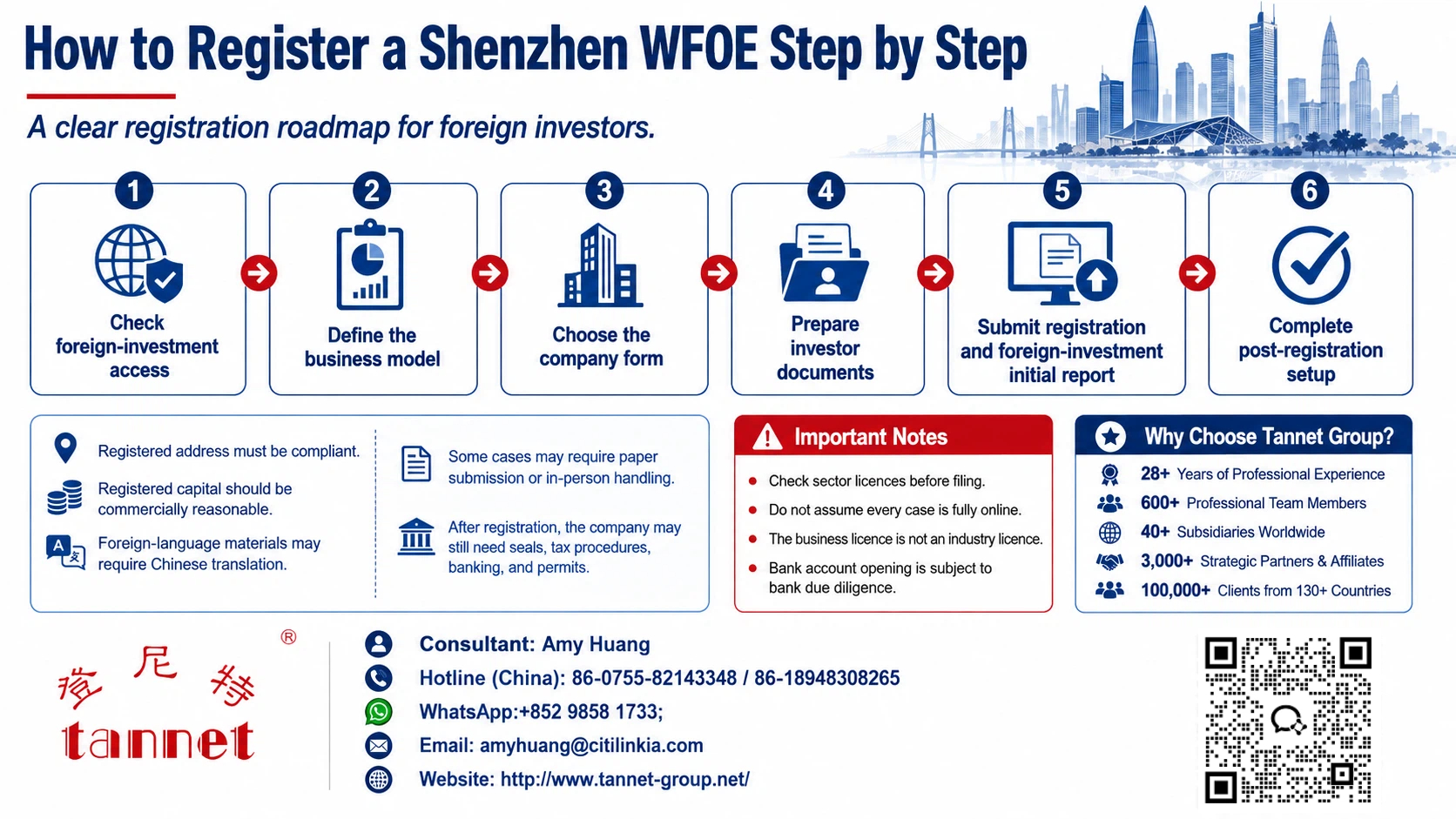
Key Takeaway
Foreign investors can establish a wholly foreign-owned company in Shenzhen when the proposed business is open to foreign investment and the registration conditions are satisfied.
The process is more than filing a company name.
It normally involves checking foreign-investment access, defining the business scope, preparing investor documents, arranging a compliant Shenzhen address, setting registered capital, submitting the company registration application, filing the foreign-investment initial report, and completing post-registration procedures. The most important caution is to check the current Negative List and sector licences before submitting documents. A business licence creates the company as a registered legal entity. It does not automatically create permission for regulated activities or guarantee a corporate bank account.
Step 1: Confirm That the Business Can Be Wholly Foreign-Owned
Start with market access.
China uses a pre-establishment national treatment plus Negative List system for foreign investment.
The 2024 national Negative List has 29 restrictive measures. If an activity is outside the Negative List, it is generally subject to the same market-access principles as domestic investment, while other laws and licences still apply.
If the activity is restricted, confirm the required ownership ratio, management requirements, and other conditions.
If it is prohibited, do not build the registration plan around a WFOE.
Step 2: Define the Actual Business Model
Before registration, write down what the company will actually do.
Clarify:
- Products or services
- Target customers
- Main suppliers
- Sales channels
- Expected payment flows
- Employees and work locations
- Planned office or facility
- Import or export needs
- Sector licences
- Whether the company will later expand elsewhere in China
This information should drive the business scope and capital plan.
Step 3: Choose the Company Form
For many foreign investors operating a normal commercial business, a foreign-invested limited liability company may be suitable.
The shareholder can be one or more foreign investors where the sector permits wholly foreign ownership.
The Articles of Association should match the actual ownership and governance structure.
Do not copy a generic template without checking whether it fits the company’s activities.
Step 4: Select a Shenzhen Registered Address
A registered address is required for the company registration.
The address should be suitable for the intended business and accepted under local registration rules.
If the business needs a physical office, warehouse, laboratory, factory, or other premises, check whether the proposed location can support the intended activity before signing a long lease.
Step 5: Decide the Registered Capital
The registered capital should reflect expected operating needs.
Under the current Company Law, shareholders of a limited liability company generally pay subscribed capital according to the Articles of Association within five years after establishment, unless a different rule applies.
The registered capital should therefore reflect genuine operating needs, including working capital and expected investment timing.
Step 6: Prepare Foreign Investor Documents
Typical preparation includes:
- Passport or corporate qualification documents
- Investor information
- Actual-controller information where required
- Company name information
- Articles of Association
- Registered address information
- Legal representative and governance information
- Business scope
- Registered capital and contribution schedule
Foreign corporate documents may need notarisation, legalisation, or another recognised authentication route.
Shenzhen’s current Qianhai guidance also notes that foreign-language materials may require Chinese translation.
The exact document list depends on the investor type and application route.
Step 7: Submit the Foreign-Investment Initial Report
The initial foreign-investment report is part of the establishment process.
The Ministry of Commerce states that a foreign investor establishing an enterprise in China should submit the initial report through the enterprise registration system when completing establishment registration.
The report covers company information, investor and actual-controller information, and investment transaction information.
The information must be true, accurate, and complete.
Step 8: Obtain the Business Licence
After the registration authority approves the application, the company receives its business licence.
This establishes the registered business entity.
It does not automatically grant every industry licence, import/export qualification, or other approval that the business may need.
Step 9: Complete Post-Registration Procedures
After receiving the licence, the company may need to arrange:
- Company seals
- Tax-related procedures
- Corporate bank account
- Accounting system
- Social insurance
- Housing provident fund registration where applicable
- Customs or import/export procedures where relevant
- Sector-specific licences
If the company will employ foreign staff, work permits, Z visas, and residence procedures are handled separately under the relevant rules.
Step 10: Maintain the Company
Registration is not the end of the process.
Foreign-invested enterprises have ongoing investment-information reporting duties.
The Foreign Investment Information Reporting Measures provide for initial, change, cancellation, and annual reports. Annual reports are generally submitted from 1 January to 30 June for the previous year.
The company must also maintain tax, accounting, employment, licence, and corporate records.
How Long Does Registration Take?
There is no single official processing time that applies to every Shenzhen WFOE.
The actual timeline depends on the investor’s documents, authentication, business scope, address, application route, whether sector approval is required, and whether the registration authority requests corrections.
A straightforward application with complete documents can move faster than a regulated or document-heavy case.
Do not promise a fixed completion date before reviewing the case.
Common Mistakes
- Starting registration without checking foreign-investment access.
- Using a generic business scope that does not reflect the actual activity.
- Preparing foreign corporate documents without checking authentication requirements.
- Choosing an address before confirming its suitability for the business.
- Setting registered capital without a realistic funding plan.
- Assuming all foreign-invested applications can be completed fully online.
- Treating the business licence as an industry licence.
- Forgetting the foreign-investment annual report and other compliance duties.
Frequently Asked Questions
Q1. Can a foreigner register a WFOE in Shenzhen without a Chinese partner?
Yes, if the proposed sector permits wholly foreign ownership and the investor satisfies the relevant requirements.
Q2. Can a foreign company be the shareholder of a Shenzhen WFOE?
Yes. An overseas company can generally invest in an eligible foreign-invested enterprise, subject to the required investor qualification documents and market-access rules.
Q3. Do foreign documents need to be notarised and legalised?
They may. The route depends on the investor’s jurisdiction and the documents involved.
Q4. Can I use a virtual address?
Do not assume that every virtual-address product is suitable. The address must satisfy Shenzhen registration and any business-specific requirements.
Q5. How much capital should I register?
There is no single amount suitable for every business. Plan it around genuine operating needs and the current five-year capital-contribution framework for limited liability companies.
Q6. Can I open a bank account immediately after receiving the licence?
You can begin the bank-account process, but the bank makes its own KYC and risk decision. Account opening is not automatic.
Q7. Can the WFOE sponsor a foreign employee for a work visa?
A properly operating employer may handle the relevant employment and work-permit process for eligible foreign employees. The work permit, Z visa, and residence procedures are separate from company registration.
When Tannet May Be Suitable
Tannet may assist foreign investors with Shenzhen WFOE planning, investor-document preparation, registered address coordination, registration support, bank-account preparation, accounting and tax compliance, and foreign employee work-permit coordination.
For regulated sectors or special approvals, the relevant government authority remains responsible for the approval decision.
Sources
- Shenzhen Municipal Bureau of Commerce, Enterprise Registration Process
- Shenzhen Qianhai Authority, Foreign-Invested Enterprise Establishment Process
- Shenzhen Municipal Administration for Market Regulation, Enterprise Start-up One-Stop
- Ministry of Commerce / State Administration for Market Regulation, Foreign Investment Information Reporting Measures
- NDRC / Ministry of Commerce, 2024 Foreign Investment Negative List
- State Administration for Market Regulation, Company Law
Written by: Tannet Hong Kong Business Services Team
Reviewed by: Consultant Amy Huang
First published: 17 August 2026
Last reviewed: 17 August 2026
Jurisdiction: Mainland China
————————————————Simplifying Business, Empowering Entrepreneurs————————————————