Key Takeaway
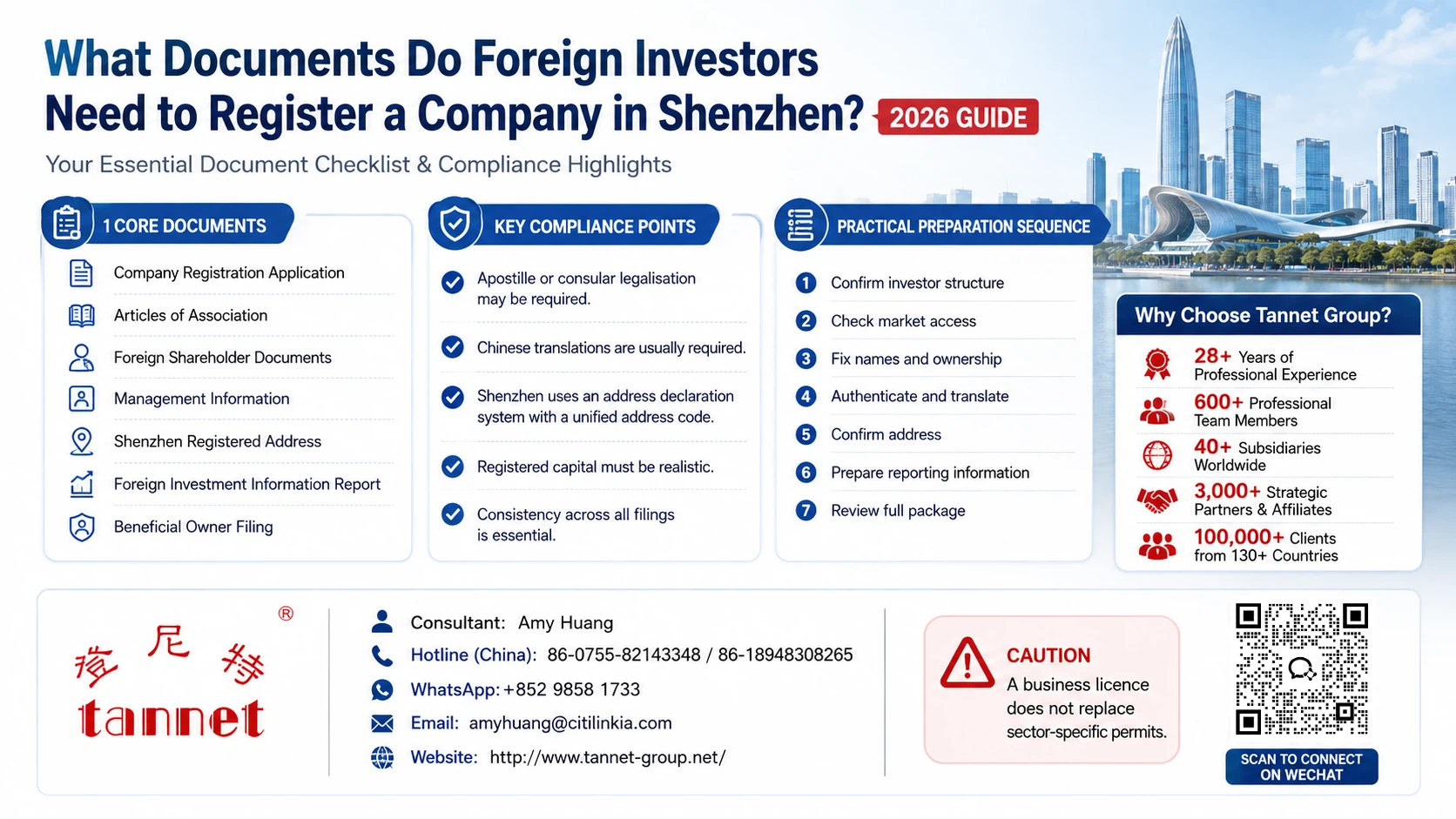
Foreign investors registering a company in Shenzhen normally need a company registration application, Articles of Association, investor identity or qualification documents, management information, a lawful Shenzhen address, and any prior licences required for the business scope.
Foreign-source documents may also need notarisation plus an Apostille, or consular legalisation, depending on the investor’s jurisdiction.
For a wholly foreign owned enterprise, the most important point is consistency: investor names, passport or registration numbers, ownership, registered capital, business scope, address, and beneficial-owner information should match across every filing.
What does “China WFOE” mean in 2026?
“Wholly foreign owned enterprise” and “China WFOE” remain common business terms.
New foreign-invested companies now operate under China’s Foreign Investment Law, Company Law, and market-entity registration rules. The former Foreign-Capital Enterprise Law was repealed in 2020.
For most foreign founders, the practical vehicle is a foreign-invested limited liability company wholly owned by one or more foreign investors.
Before preparing documents, check the proposed activity against the current Foreign Investment Negative List. The 2024 national list has 29 restrictive measures and applies from 1 November 2024.
Core documents for Shenzhen company registration
1. Company Registration (Filing) Application
The 2026 SAMR standards require a Company Registration (Filing) Application.
It records the company name, type, registered capital, business scope, address, legal representative, shareholders, and other filing information.
The details must match the Articles and investor documents.
2. Articles of Association
A limited liability company submits Articles of Association signed by all shareholders.
The Articles normally cover the company name, address, business scope, registered capital, shareholder contributions, governance, and legal representative.
For a newly established limited liability company, subscribed capital generally must be paid within five years from establishment, unless special rules apply.
3. Foreign shareholder documents
If the shareholder is a foreign company, prepare a current corporate qualification document proving legal existence.
If the shareholder is an individual, prepare a valid passport or other accepted identity document.
The authentication route depends on the country and document type.
Apostille or consular legalisation
China has applied the Apostille Convention since 7 November 2023.
For documents from a Convention member country where the Convention applies with China, an Apostille generally replaces Chinese consular legalisation.
For non-member jurisdictions, notarisation followed by Chinese consular legalisation generally continues to apply.
There are exceptions. For example, a foreign individual using a passport confirmed through Chinese immigration entry procedures may, after the original is checked, avoid separate notarisation, legalisation, or Apostille requirements for that identity document.
Confirm the exact route before ordering authentication.
Chinese translations
Foreign-language registration materials normally need Chinese translations.
The 2026 SAMR standard requires the foreign-language document and Chinese translation to be submitted together.
Where a translation company prepares the translation, the filing standard also requires appropriate company identification, seal, accuracy statement, translator details, and contact information.
Use the same translation for investor names and addresses throughout the filing.
Legal representative and management documents
The filing normally needs identity information for the legal representative, directors, supervisors, senior management, registration liaison, and relevant filing contacts.
Appointment documents may also be required.
The 2026 standard allows some appointment documents to be waived where the appointment is confirmed through the real-name registration process.
Decide the governance structure before submission.
Shenzhen registered-address information
Shenzhen uses an address declaration system based on a unified address code.
Official Shenzhen guidance states that additional address proof is generally not required at the initial filing stage if the applicant declares lawful use of the address.
However, the company remains responsible for the truth and legality of the address.
If the address is verified, the authority may request a lease, property document, premises-use certificate, or other evidence.
Business scope and prior approvals
The business scope must comply with market-access rules and the Foreign Investment Negative List.
If an activity requires approval before registration, submit the relevant approval or licence.
A business licence does not automatically authorise every regulated activity.
Foreign investment information report
A foreign investor establishing a foreign-invested enterprise must submit an initial foreign investment information report through the enterprise registration system.
The report includes company, investor, actual-controller, and investment information.
It is an information-reporting obligation, not a separate approval.
Beneficial-owner information
Companies are generally subject to China’s beneficial-owner filing rules.
A new company should normally file beneficial-owner information through the registration system at establishment. If that cannot be done through the system, the filing should generally be completed within 30 days after registration.
A narrow exemption exists for certain entities with registered capital of no more than RMB 10 million where all shareholders are natural persons and no other person controls or benefits from the entity outside the stated ownership structure.
Many WFOEs with corporate shareholders will not qualify for that exemption.
Registered-capital information
The application must state subscribed registered capital and the contribution arrangements.
For a standard limited liability company, a capital-verification report is generally not required at establishment.
That does not make the capital optional. Shareholders generally must complete subscribed contributions within five years, subject to special industry rules.
Choose an amount the business can realistically fund.
A practical preparation sequence
Step 1: Confirm the investor structure
Decide whether the shareholder is an individual, an overseas company, or multiple foreign investors.
Step 2: Check market access
Review the Foreign Investment Negative List and sector licensing rules.
Step 3: Fix names and ownership
Use consistent legal names, translations, ownership percentages, and capital information.
Step 4: Authenticate and translate
Arrange notarisation, Apostille or legalisation, and Chinese translation only after confirming the correct route.
Step 5: Confirm the address
Use a lawful Shenzhen address with a valid unified address code.
Step 6: Prepare reporting information
Complete the company filing, foreign investment information report, and beneficial-owner information.
Step 7: Review the full package
Check names, document numbers, dates, addresses, shareholding, capital, and business scope before submission.
Common Mistakes
- Using an old WFOE checklist based on repealed foreign-enterprise laws.
- Starting an Apostille or legalisation process before confirming the correct document.
- Using inconsistent translations of the same investor name.
- Choosing an address that cannot withstand verification.
- Setting registered capital without considering the five-year funding obligation.
- Ignoring beneficial-owner or foreign investment information reporting.
- Assuming a business licence replaces sector-specific permits.
Frequently Asked Questions
Q1. Does a foreign individual always need an Apostille for a passport?
No. The 2026 SAMR standard provides exceptions in certain cases. Confirm the exact identity document and filing route.
Q2. What does a foreign corporate shareholder usually need?
A current corporate qualification document, the required authentication, and a Chinese translation.
Q3. Do I need a lease to register in Shenzhen?
Not always at initial filing because Shenzhen uses address declaration. The company must still have lawful use of the address and may need evidence if verified.
Q4. Is a capital-verification report required?
Generally not for a standard limited liability company at establishment. Special industries may differ.
Q5. Can I choose any business scope?
No. It must comply with market-access rules, the Foreign Investment Negative List, and licensing requirements.
Q6. Is beneficial-owner filing required for a WFOE?
Usually yes. The exemption is narrow and many foreign-invested structures do not qualify.
Q7. Is foreign investment information reporting a separate approval?
No. The initial report is submitted through the registration system as an information-reporting obligation.
When Tannet May Be Suitable
Tannet may assist foreign investors coordinating investor-document authentication, Chinese translation, Shenzhen company registration, registered-address arrangements, Articles of Association, foreign investment reporting, beneficial-owner filing, bank-account preparation, accounting, tax, or later work-permit support.
The exact document list depends on investor type, country of origin, business activity, address, and ownership structure.
Sources
- State Administration for Market Regulation, Standardised Materials for Business Entity Registration (2026 Edition).
- Shenzhen Administration for Market Regulation, company-establishment and address-declaration guidance.
- Ministry of Foreign Affairs of the PRC, Apostille and consular legalisation guidance.
- NDRC and Ministry of Commerce, Foreign Investment Negative List (2024 Edition).
- Ministry of Commerce and SAMR, Measures for Foreign Investment Information Reporting.
- People’s Bank of China and SAMR, Measures for the Administration of Beneficial Owner Information.
- SAMR, Measures for the Implementation of Company Registration Administration.
Written by: Tannet Business Services Team
Reviewed by: Consultant Amy Huang
First published: 18 August 2026
Last reviewed: 18 August 2026
Jurisdiction: Mainland China
————————————————Simplifying Business, Empowering Entrepreneurs————————————————